1
/
of
1
NorrChemica™
VI706 | Diazaborine 62 | Sodium Salt Lead | ≥95%
VI706 | Diazaborine 62 | Sodium Salt Lead | ≥95%
Regular price
€427,00 EUR (incl. VAT)
Regular price
Sale price
€427,00 EUR
Taxes included.
Shipping calculated at checkout.
Quantity
Couldn't load pickup availability
Technical Specifications
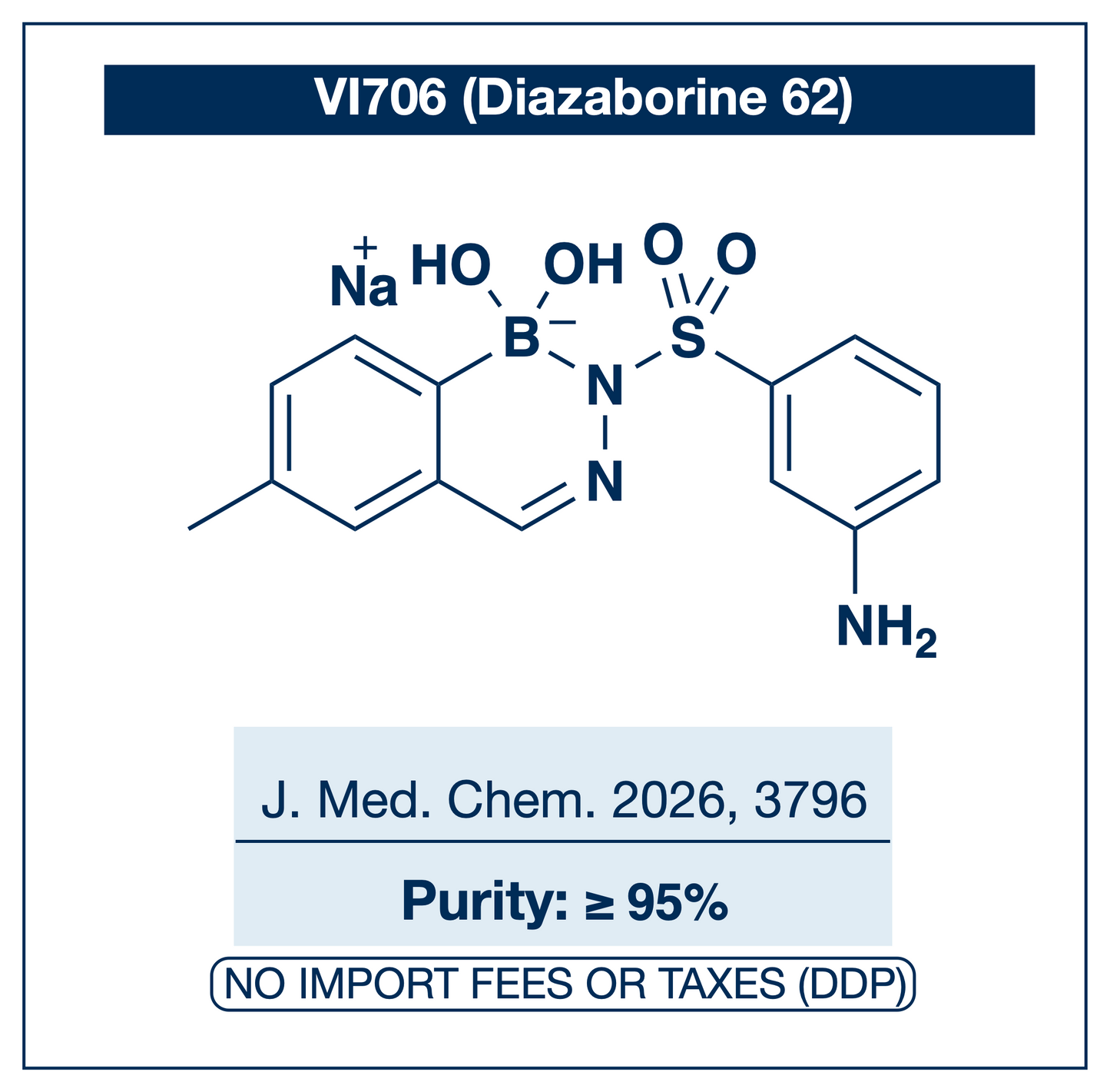
| SMILES | [B-]1(C2=C(C=C(C=C2)C)C=NN1S(=O)(=O)C3=CC=CC(=C3)N)(O)O.[Na+] |
| InChI | InChI=1S/C14H15BN3O4S.Na/c1-10-5-6-14-11(7-10)9-17-18(15(14,19)20)23(21,22)13-4-2-3-12(16)8-13;/h2-9,19-20H,16H2,1H3;/q-1;+1 |
| InChIKey | BDGMYXSFYAQUEL-UHFFFAOYSA-N |
| PubChem CID | 178269837 |
| Molecular Formula | C14H15BN3NaO4S |
| Molecular Weight | 355.2 g/mol |
| Solubility | Soluble in water, DMSO |
| Purity | ≥95% |
| Physical Form | White to yellow solid |
| HS Code | 2934.99 |
| Shelf Life | Retest period: 36 months from date of manufacture |
| Storage Conditions | Store in a cool, dry place in a tightly sealed container |
Product Description & Scientific Applications
- Identity: Sodium 1,1-dihydroxy-6-methyl-2-((3-aminophenyl)sulfonyl)-1,2-dihydrobenzo[d][1,2,3]diazaborin-1-uide. The water-soluble sodium salt of the lead diazaborine (paper compound 11) from Ilina et al., J. Med. Chem. 2026, 69, 3796–3810, designated Diazaborine 62 in the publication. The benzodiazaborine ring system carries a 6-methyl substituent on the benzo ring and a 3-aminobenzenesulfonyl group on N2; the boron centre is anionic with sodium counterion.
- Position in the SAR series: VI706 carries the two optimised substituents identified in the paper's SAR work — R¹ = 3-methyl on the benzodiazaborine ring and R² = 3-aminophenyl on the sulfonyl side chain. The paper reports the 3-aminophenyl at R² and 3-methyl at R¹ combination as yielding the most favourable results both in E. coli MIC and in the isolated FabI inhibition assay.
- Antibacterial spectrum: The parent compound 11 shows MIC 6.25 μM against E. coli ATCC 25922, Acinetobacter baumannii 19606, and Salmonella enterica serovar Typhimurium 19585; 6.25–12.5 μM across three pathogenic E. coli strains including the uropathogenic UMN026 strain characterised by multiple antibiotic resistances; and 12.5 μM against Klebsiella aerogenes 13048. Activity against K. pneumoniae 700603 was substantially lower (75 μM).
- FabI inhibition data: Compound 11 was reported with a preliminary Kᵢ of 0.32 μM against isolated E. coli FabI in the paper's enzymatic assay — among the most potent compounds tested in that subset. Mechanism: covalent adduct formation between the boron atom and the 2′-hydroxyl of the ribose in the enzyme-bound NAD⁺ cofactor (PDB 5CG1, 5CG2; resolution 2.07–2.2 Å). A disordered loop (Leu195–Met206 in E. coli) folds to cover the inhibitor site.
- Cytotoxicity and selectivity: HepG2 IC₅₀ = 106 ± 13 μM; Hs27 (noncancerous fibroblast) IC₅₀ = 240 ± 9 μM, corresponding to an approximate HepG2/MIC selectivity index of 17×. LDH membrane-integrity assay showed only minor leakage at 250 μM (40× MIC), increasing to ~20% at 750 μM. Among the phenyl-series, compound 11 had the lowest cytotoxicity profile.
- Colistin synergy (FICI 0.25): Checkerboard assay against E. coli ATCC 25922 demonstrates strong synergy with colistin — FICI 0.25 (the threshold for synergy is ≤0.5). Compound 11 at 1.25 μM reduces colistin MIC from 1 to 0.25 μg/mL. The paper screened compound 11 against eight other partners (metronidazole, sulfadiazine, meropenem, amoxicillin, ciprofloxacin, metformin, citric acid, choline chloride) and identified synergy only with colistin among the tested partners — a selectivity profile positioning VI706 specifically for polymyxin-adjuvant research.
- Aqueous handling and Na-salt equivalence: Free-acid parent diazaborines are barely water-soluble; sodium salts were used in the paper's plasma-stability work to avoid DMSO interference. The paper explicitly reports that the biological performance of the salts was identical with the original compounds, with the Na, K, and Cl salts of compound 11 showing the same MIC as the parent free acid. VI706 provides the water-soluble sodium-salt form for aqueous research workflows without DMSO.
- Plasma stability (¹¹B NMR): The Na salt of compound 11 retained its characteristic ¹¹B NMR single peak at ca. +6.5 ppm after 72 h in human plasma at 37 °C, supporting structural integrity of the diazaborine ring under reported plasma-stability conditions. In the parallel water-stability experiment (37 °C, semiquantitative), the salt series showed an approximate 20% concentration decrease over the period.
- Time-kill kinetics and resistance profile: Compound 11 shows slow bactericidal kinetics typical of intracellular-target antibiotics: ~2 log reduction in viable bacteria at 8 h, complete clearance at 24 h with no regrowth (in contrast, triclosan-treated wells showed resistance development over the same period). MPC/MIC = 32 (similar to fabimycin, approximately 2× ciprofloxacin under the same protocol). Spontaneous mutation frequency 2×10⁻⁸ to 9×10⁻⁹, comparable to ciprofloxacin (1×10⁻⁹).
- In vivo efficacy (Galleria mellonella infection model): Compound 11 rescued G. mellonella larvae from lethal E. coli ATCC 25922 infection at therapeutic dose 1.13 mg/kg (2× MIC) with 75% survival, significantly different from the non-treated infected group (p<0.05). At 2.81 mg/kg, compound 11 was not significantly different from ciprofloxacin at 20 mg/kg under the study conditions (p>0.05). No significant toxic effect was observed up to 5.63 mg/kg (10× MIC) compared to PBS controls.
- Research applications: Polymyxin-adjuvant combination studies (the colistin-synergy profile is the primary commercial driver); checkerboard assays against outer-membrane permeabilisers, efflux-pump inhibitors, and LPS-pathway modulators; FabI target-engagement and ortholog-profiling studies in Gram-negative antibacterial discovery; structure-guided optimisation using PDB 5CG1, 5CG2; in vivo efficacy and PK studies in invertebrate and mammalian infection models; plasma-stability and protein-binding studies under physiological conditions.
- Class context: Mechanistically distinct from cyclic boronate β-lactamase inhibitors approved or in clinical development (vaborbactam, FDA-approved 2017; taniborbactam and xeruborbactam in clinical development). Different target (FabI vs β-lactamases), different binding partner (NAD⁺ ribose vs active-site serine), different ring geometry. The original Sandoz diazaborine programme (Grassberger 1984, J. Med. Chem. 27, 947) was halted on intrinsic-toxicity concerns about boron, a position the modern boron-drug regulatory record reopens.
- Documentation: ≥95% purity by ¹H NMR. CoA and SDS provided with each shipment. DDP shipping to EU, UK, EFTA, and worldwide locations.
- Further reading: Scientific background on diazaborine FabI inhibitors and water-soluble sodium-salt derivatives in NorrChemica's Lab Journal: Water-Soluble Diazaborines: Selective Gram-Negative Antibiotic Candidates for Synergy Studies and R&D.
Shipping Destinations
- EU & UK: Priority delivery, 2–5 business days.
- United States (DDP): 3–7 business days, duties and taxes prepaid.
- EFTA Countries (DDP): 3–7 business days, duties and taxes prepaid.
- Worldwide: 7–14 business days, selected locations.
The NorrChemica™ Standard
Identity Verified — Batch-verified via analytical QC; documentation available on request.
Direct EU Distribution — Dispatched from Finland for fast delivery to EU-based laboratories.
Professional Logistics — Tracked courier shipping via UPS / Matkahuolto / Posti.
Packaging & Storage
- Supplied in tightly sealed containers suitable for laboratory handling.
- Store under recommended conditions as specified on the product label and SDS.
- Retest period per lot-specific CoA / label under recommended conditions.
Technical Documentation
- Batch-specific Certificate of Analysis (CoA) included with every order.
- GHS-compliant Safety Data Sheet (SDS) provided with every shipment.
- Batch documentation available for institutional procurement.
| Payment: Wise (Bank Transfer) or Manual Invoice. |
| Disclaimer: Research Use Only (RUO) — not for human or veterinary use. Sold strictly for laboratory research and technical applications. By purchasing this item, the buyer confirms professional intent and compliance with applicable regulations. |
Safety Information
| Hazard Class | None — not subject to transport regulations |
| Transport Category | Not classified as dangerous goods for transport (ADR/IATA/IMDG) |
NorrChemica™ is a Finnish supplier of niche research reagents — focused on reliable EU distribution, transparent analytical documentation, and specialist technical support.
Share