NorrChemica™
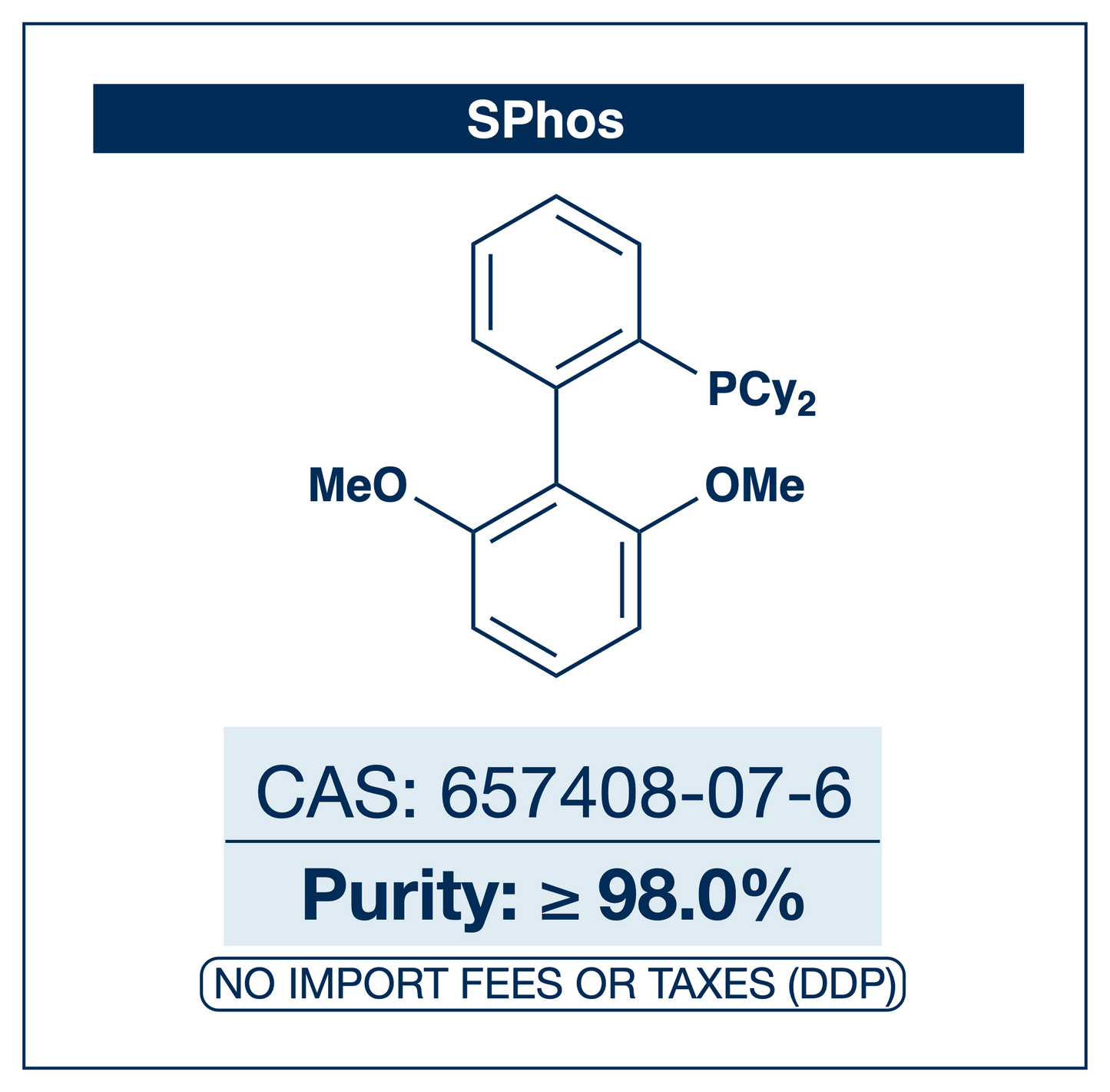
SPhos | CAS 657408-07-6 | ≥98%
SPhos | CAS 657408-07-6 | ≥98%
Couldn't load pickup availability
Technical Specifications
| CAS Number | 657408-07-6 |
| EC / EINECS Number | 613-838-2 |
| MDL Number | MFCD05861611 |
| SMILES | COC1=C(C(=CC=C1)OC)C2=CC=CC=C2P(C3CCCCC3)C4CCCCC4 |
| InChI | InChI=1S/C26H35O2P/c1-27-23-17-11-18-24(28-2)26(23)22-16-9-10-19-25(22)29(20-12-5-3-6-13-20)21-14-7-4-8-15-21/h9-11,16-21H,3-8,12-15H2,1-2H3 |
| InChIKey | VNFWTIYUKDMAOP-UHFFFAOYSA-N |
| PubChem CID | 11269872 |
| Molecular Formula | C₂₆H₃₅O₂P |
| Molecular Weight | 410.53 g/mol |
| Melting Point | 164 - 166 °C |
| Solubility | Insoluble in water; soluble in common organic solvents (e.g. dichloromethane, toluene, THF). |
| Purity | ≥98% |
| Physical Form | Solid |
| HS Code | 2931.49 |
| Shelf Life | Retest period: 36 months from date of manufacture |
| Storage Conditions | Store tightly sealed under inert gas (N2 or Ar) at 2-8 °C, protected from light, air and moisture. |
Product Description & Scientific Applications
SPhos (2-dicyclohexylphosphino-2′,6′-dimethoxybiphenyl) is an air-stable, electron-rich biaryl monophosphine of the Buchwald class, built on a biphenyl backbone bearing a dicyclohexylphosphino group and two ortho-methoxy substituents. Its palladium chemistry runs through a monoligated species: the bulky, strongly σ-donating phosphine supports a coordinatively unsaturated L·Pd(0) centre, and oxidative addition of the aryl halide proceeds through this single-ligand complex rather than a bis-phosphine one. Electron-rich palladium accelerates oxidative addition of sluggish substrates, while the ligand’s steric demand favours reductive elimination, giving SPhos broad reach in difficult Suzuki–Miyaura coupling.
Suzuki–Miyaura coupling
Introduced by the Buchwald group as a rationally designed broad-scope ligand, SPhos has Suzuki–Miyaura coupling as its defining application. With a palladium source it couples aryl- and heteroaryl halides with aryl-, heteroaryl- and vinylboronic acids, and its reach extends to substrates that defeat classical triarylphosphine catalysts. Its activity brings unactivated aryl chlorides — unreactive toward classical Pd(0)/PPh₃ systems — into routine, often room-temperature, use, while its steric profile enables highly hindered biaryl formation at low palladium loadings.
The role of the dimethoxy backbone
What distinguishes SPhos from a simple bulky trialkylphosphine is its lower, methoxy-bearing ring. Structural and computational studies of its palladium complexes show that this ring folds over the metal, establishing a stabilising π-interaction between the palladium centre and the ipso-carbon of the arene, supported by the proximity of the two ortho-methoxy groups. This interaction supports the reactive monoligated centre and helps maintain the single-ligand geometry through which oxidative addition proceeds. Comparative studies that vary ligand bulk and phosphorus substituents independently show that both the electron-donating dicyclohexylphosphino group and the stabilising backbone interaction contribute to catalyst activity.
Scope and precatalyst deployment
SPhos can be used as the free ligand with a palladium source, but generic precursors such as palladium(II) acetate can give off-cycle, less-reactive cyclometalated palladium species. To avoid this and ensure controlled catalyst generation, SPhos is frequently deployed as a preformed aminobiphenyl palladacycle precatalyst (G2–G4 series), fixing a 1:1 ligand-to-palladium ratio and releasing the active palladium(0) species cleanly on treatment with base. Beyond Suzuki–Miyaura coupling, SPhos has secondary use in palladium-catalysed C–N coupling. Its substrate breadth, tolerance of hindered and heteroaromatic partners, low catalyst loadings and bench stability establish it as a widely used reference ligand for biaryl bond construction.
Further applications
- Synthesis of hindered biaryls: Enables extremely hindered biaryl construction, including tetra-ortho-substituted products, where steric congestion makes reductive elimination demanding.
- Coupling of heteroaryl boron partners: Couples heteroaryl boronic acids and esters, including heterocyclic motifs prone to protodeboronation under basic coupling conditions, to give heterobiaryls in good to excellent yields.
- Boron partner scope: Operates with aryl-, heteroaryl- and vinylboronic acids, potassium aryl trifluoroborates, and alkylboron derivatives, extending the usable boron-partner range beyond simple arylboronic acids.
- Miyaura borylation: Acts as a supporting ligand in palladium-catalysed borylation of aryl chlorides and bromides with bis(pinacolato)diboron, converting aryl halides into pinacol boronates for subsequent Suzuki–Miyaura reactions.
Shipping Destinations
- EU & UK: Priority delivery, 2–5 business days.
- United States (DDP): 3–7 business days, duties and taxes prepaid.
- EFTA Countries (DDP): 3–7 business days, duties and taxes prepaid.
- Worldwide: 7–14 business days, selected locations.
The NorrChemica™ Standard
Identity Verified — Batch-verified via analytical QC; documentation available on request.
Direct EU Distribution — Dispatched from Finland for fast delivery to EU-based laboratories.
Professional Logistics — Tracked courier shipping via UPS / Matkahuolto / Posti.
Packaging & Storage
- Supplied in tightly sealed containers suitable for laboratory handling.
- Store under recommended conditions as specified on the product label and SDS.
- Retest period per lot-specific CoA / label under recommended conditions.
Technical Documentation
- Batch-specific Certificate of Analysis (CoA) included with every order.
- GHS-compliant Safety Data Sheet (SDS) provided with every shipment.
- Batch documentation available for institutional procurement.
| Payment: Wise (Bank Transfer) or Manual Invoice. |
| Disclaimer: Research Use Only (RUO) — not for human or veterinary use. Sold strictly for laboratory research and technical applications. By purchasing this item, the buyer confirms professional intent and compliance with applicable regulations. |
Safety Information
| Hazard Class | Not regulated for transport |
| Transport Category | Not classified as dangerous goods for transport (ADR/IATA/IMDG) |
NorrChemica™ is a Finnish supplier of niche research reagents — focused on reliable EU distribution, transparent analytical documentation, and specialist technical support.
Share