Skip to product information
1 of 3

NorrChemica™

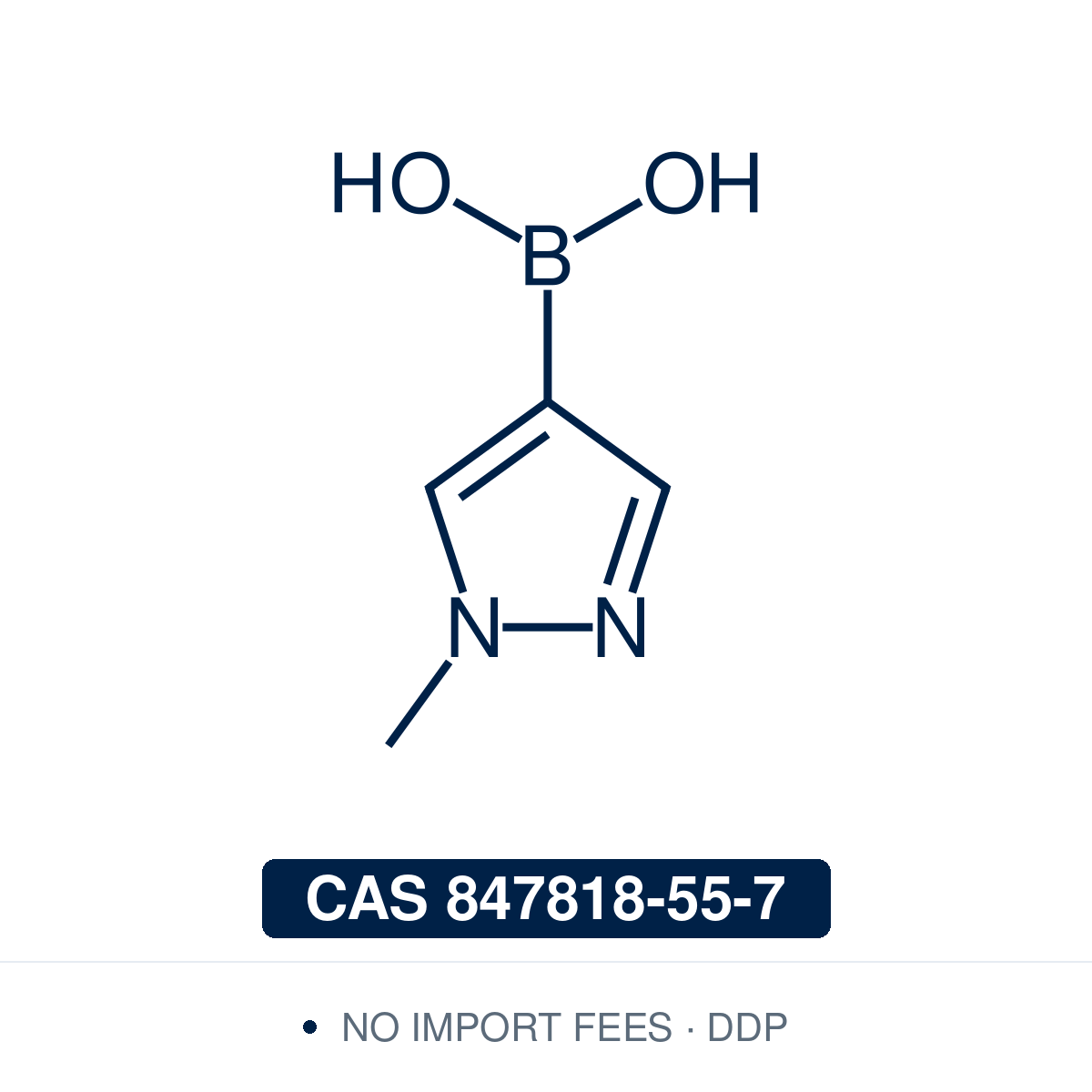
1-Methyl-1H-pyrazole-4-boronic Acid | CAS 847818-55-7 | ≥95%

1-Methyl-1H-pyrazole-4-boronic Acid | CAS 847818-55-7 | ≥95%

Regular price €29,90 EUR
Regular price Sale price €29,90 EUR
Sale Sold out
Taxes included. Shipping calculated at checkout.
Weight
Quantity

Technical Specifications

CAS Number 847818-55-7
EC / EINECS Number 690-821-6
MDL Number MFCD09414709
SMILES B(C1=CN(N=C1)C)(O)O
InChI InChI=1S/C4H7BN2O2/c1-7-3-4(2-6-7)5(8)9/h2-3,8-9H,1H3
InChIKey RYGOBSYXIIUFOR-UHFFFAOYSA-N
PubChem CID 11263501
Molecular Formula C₄H₇BN₂O₂
Molecular Weight 125.92 g/mol
Solubility Soluble in alcoholic solvents, acetonitrile, DMF, DMSO
Purity ≥95%
Physical Form White to off-white powder
HS Code 2931.90
Shelf Life Retest period: 36 months from date of manufacture.
Storage Conditions Store refrigerated (2–8 °C) in a tightly sealed container.​​​​​​​​​​​​​​​​

1-Methyl-1H-pyrazole-4-boronic acid ((1-methylpyrazol-4-yl)boronic acid, 1-methylpyrazole-4-boronic acid) is a heteroaromatic boronic acid bearing the boronic acid group at the 4-position of an N-methylated pyrazole ring. The N-methyl group eliminates the acidic NH proton that inhibits palladium catalysis in unprotected pyrazole boronic acids, enabling efficient Suzuki–Miyaura cross-coupling under standard conditions without requiring specialised bulky phosphine ligands or elevated temperatures. The 1-methylpyrazol-4-yl motif is present in multiple FDA-approved kinase inhibitors across oncology and haematology therapeutic areas, and this compound provides direct Suzuki-mediated access to this pharmacophore. Additional applications include agrochemical scaffold construction, Chan–Lam coupling for C–N and C–O bond formation, and incorporation into fluorescent and luminescent materials. This product contains varying amounts of the corresponding boronic acid anhydride.

Common Scientific Applications

Suzuki–Miyaura cross-coupling: 1-Methyl-1H-pyrazole-4-boronic acid is a widely used heteroaryl boronic acid for palladium-catalysed Suzuki–Miyaura cross-coupling reactions, enabling the formation of carbon–carbon bonds between the 1-methylpyrazol-4-yl group and a broad range of aryl, heteroaryl, and vinyl halides or pseudohalides. The reaction proceeds under standard Suzuki conditions with palladium catalysts such as Pd(dppf)Cl₂ or Pd(PPh₃)₄ in the presence of an aqueous base. A key synthetic advantage of this compound over unprotected pyrazole boronic acids is that the N-methyl group eliminates the acidic NH proton. In unprotected azole boronic acids, the free NH can coordinate to the palladium centre, suppressing catalytic turnover and promoting protodeboronation. With the nitrogen capped as N-methyl, standard catalyst loadings and mild conditions are sufficient, without requiring the specialised bulky phosphine ligands and elevated temperatures that unprotected pyrazole boronic acids demand. The compound is also compatible with microwave-assisted Suzuki protocols, which significantly reduce reaction times while maintaining high yields across electron-rich, electron-poor, and sterically demanding coupling partners.

Kinase inhibitor synthesis and medicinal chemistry: The pyrazole ring is one of the most pharmacologically important five-membered heterocycles in modern drug discovery, present in multiple FDA-approved protein kinase inhibitors across oncology, haematology, and inflammatory disease therapeutic areas targeting kinases including ALK, c-Met, JAK1/2, FGFR, B-Raf, and BTK. 1-Methyl-1H-pyrazole-4-boronic acid provides direct Suzuki-mediated access to the 1-methylpyrazol-4-yl pharmacophore present in many of these structural classes. The 1-methylpyrazol-4-yl motif has been specifically highlighted in c-Met kinase inhibitor programmes, where it provides favourable coplanarity with the drug's core scaffold and makes productive hydrogen-bond contacts with the hinge region of the kinase active site. This boronic acid has also been employed in the synthesis of Aurora-A kinase inhibitors, where a pyrazol-4-yl group is introduced at the C-7 position of an imidazo[4,5-b]pyridine scaffold via Suzuki coupling with chloronitropyridine intermediates.

Agrochemical synthesis: The pyrazole ring is a recurring structural motif in commercial fungicides and herbicides. 1-Methyl-1H-pyrazole-4-boronic acid serves as a building block for introducing the 1-methylpyrazol-4-yl group into agrochemical scaffolds via cross-coupling, providing access to analogues with modified biological activity, improved environmental profiles, or enhanced metabolic stability in plant systems. The ability to rapidly generate libraries of 4-substituted 1-methylpyrazole derivatives from this single boronic acid building block makes it particularly valuable in agrochemical lead optimisation campaigns.

Heterocyclic building block chemistry: Beyond Suzuki coupling, 1-methyl-1H-pyrazole-4-boronic acid can be converted to the corresponding pinacol ester (CAS 761446-44-0) or to the bench-stable lithium hydroxy ate complex — both of which offer improved handling stability and extended shelf life for long-term storage. The lithium ate complex can be employed directly in Suzuki couplings without the need for added base, simplifying reaction setup. The boronic acid itself also participates in Chan–Lam coupling reactions — copper-mediated C–N and C–O bond-forming reactions that allow the attachment of amines, amides, or phenols to the pyrazole ring under mild, base-free conditions.

Materials science and fluorescent frameworks: N-Methylpyrazole-containing building blocks are used in the construction of fluorescent and luminescent materials, where the nitrogen-rich heterocycle contributes to the electronic structure of the emissive framework. 1-Methyl-1H-pyrazole-4-boronic acid enables Suzuki-mediated incorporation of the pyrazole unit into extended conjugated architectures designed for optical applications, including fluorescent sensors, organic light-emitting materials, and coordination polymers. In coordination chemistry, 4-aryl-1-methylpyrazole derivatives prepared from this boronic acid serve as ligands for transition-metal and lanthanide complexes, where the pyrazole nitrogen atoms provide directional coordination sites.

Shipping Destinations

  • EU & UK: Priority delivery, 2–5 business days.
  • United States (DDP): 3–7 business days, duties and taxes prepaid.
  • EFTA Countries (DDP): 3–7 business days, duties and taxes prepaid.
  • Worldwide: 7–14 business days, selected locations.

The NorrChemica™ Standard

Identity Verified — Batch-verified via analytical QC; documentation available on request.

Direct EU Distribution — Dispatched from Finland for fast delivery to EU-based laboratories.

Professional Logistics — Tracked courier shipping via UPS / Matkahuolto / Posti.

Packaging & Storage

  • Supplied in tightly sealed containers suitable for laboratory handling.
  • Store under recommended conditions as specified on the product label and SDS.
  • Retest period per lot-specific CoA / label under recommended conditions.

Technical Documentation

  • Batch-specific Certificate of Analysis (CoA) included with every order.
  • GHS-compliant Safety Data Sheet (SDS) provided with every shipment.
  • Batch documentation available for institutional procurement.
Payment: Wise (Bank Transfer) or Manual Invoice.
Disclaimer: Research Use Only (RUO) — not for human or veterinary use. Sold strictly for laboratory research and technical applications. By purchasing this item, the buyer confirms professional intent and compliance with applicable regulations.

Safety Information

GHS Pictograms
GHS07 Harmful/Irritant
Signal Word Warning
Hazard Class None — not subject to transport regulations
Transport Category Not classified as dangerous goods for transport (ADR/IATA/IMDG)
H-Statements H315 — Causes skin irritation
H319 — Causes serious eye irritation
H335 — May cause respiratory irritation
P-Statements P261 — Avoid breathing dust/fume/gas/mist/vapours/spray
P264 — Wash thoroughly after handling
P271 — Use only outdoors or in a well-ventilated area
P280 — Wear protective gloves/eye protection/face protection
P302 + P352 — IF ON SKIN: Wash with plenty of water
P304 + P340 — IF INHALED: Remove person to fresh air and keep comfortable for breathing
P305 + P351 + P338 — IF IN EYES: Rinse cautiously with water for several minutes. Remove contact lenses, if present and easy to do. Continue rinsing
P312 — Call a POISON CENTER/doctor if you feel unwell
P332 + P313 — If skin irritation occurs: Get medical advice/attention
P337 + P313 — If eye irritation persists: Get medical advice/attention
P362 + P364 — Take off contaminated clothing and wash it before reuse
P403 + P233 — Store in a well-ventilated place. Keep container tightly closed
P405 — Store locked up
P501 — Dispose of contents/container in accordance with local regulations

NorrChemica™ is a Finnish supplier of niche research reagents — focused on reliable EU distribution, transparent analytical documentation, and specialist technical support.

View full details