NorrChemica™
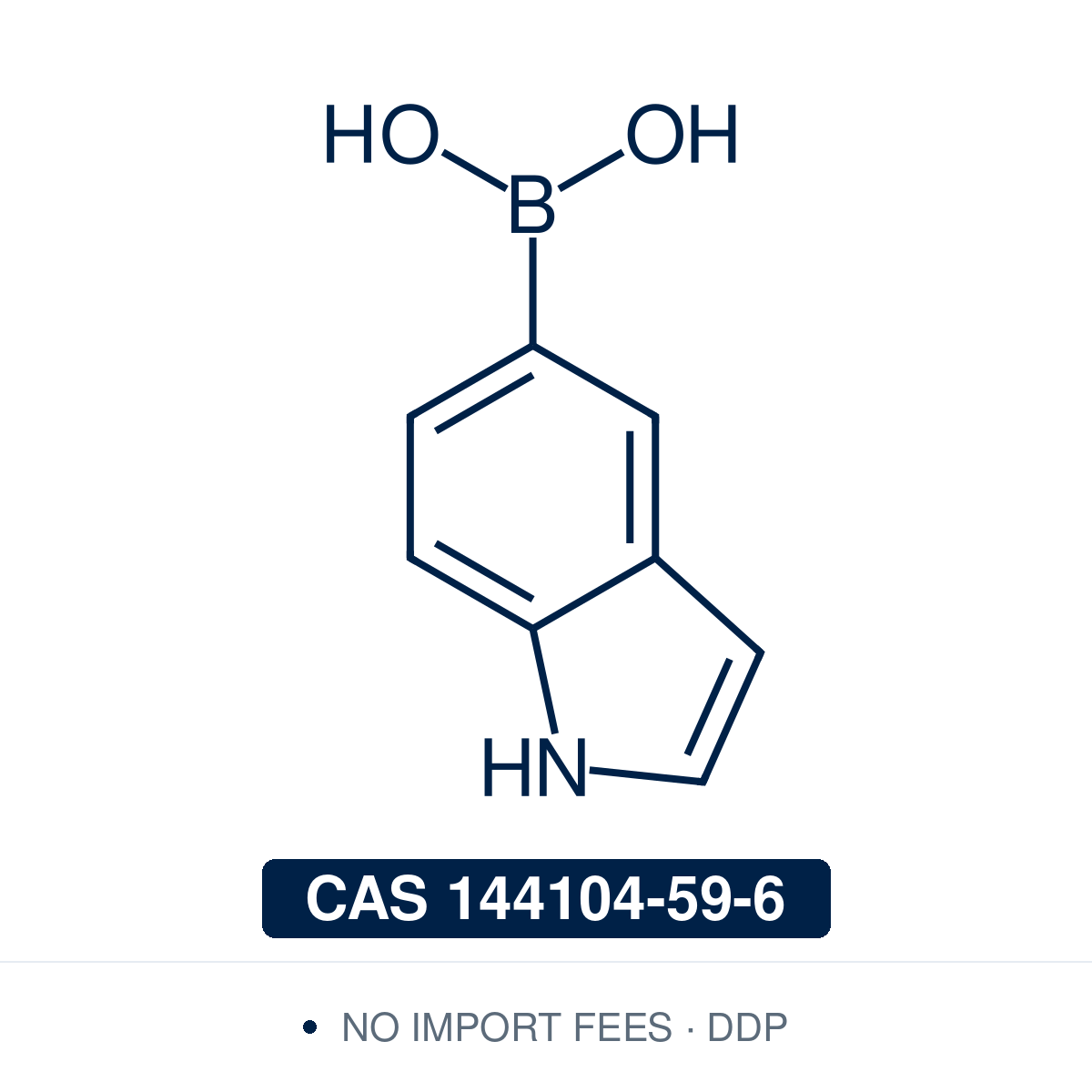
(1H-Indol-5-yl)boronic Acid (Powder) | CAS 144104-59-6 | ≥98%
Couldn't load pickup availability
Technical Specifications
| CAS Number | 144104-59-6 |
| EC / EINECS Number | 627-180-9 |
| MDL Number | MFCD01319013 |
| SMILES | B(C1=CC2=C(C=C1)NC=C2)(O)O |
| InChI | InChI=1S/C8H8BNO2/c11-9(12)7-1-2-8-6(5-7)3-4-10-8/h1-5,10-12H |
| InChIKey | VHADYSUJZAPXOW-UHFFFAOYSA-N |
| PubChem CID | 2734361 |
| Molecular Formula | C₈H₈BNO₂ |
| Molecular Weight | 160.97 g/mol |
| Melting Point | 170–175 °C |
| Solubility | Soluble in alcoholic solvents, acetonitrile, DMF, DMSO |
| Purity | ≥98%. May contain varying amounts of the corresponding boronic acid anhydrides. |
| Physical Form | White to light brown powder |
| HS Code | 2931.90 |
| Shelf Life | Retest period: 36 months from date of manufacture. |
| Storage Conditions | Store refrigerated (2–8 °C) in a tightly sealed container, protected from light. |
(1H-Indol-5-yl)boronic acid (indole-5-boronic acid, 5-indolylboronic acid) is a heteroaromatic boronic acid bearing the boronic acid group at the 5-position of the indole ring — the same substitution point present in serotonin (5-hydroxytryptamine) and numerous approved pharmaceuticals. This compound is widely used as a Suzuki–Miyaura coupling partner for the construction of 5-substituted indole derivatives, with documented applications in MMP-13 inhibitor synthesis for osteoarthritis research, substituted pyrimidine tubulin polymerisation inhibitors for anticancer programmes, and aryl-hetarylfurocoumarin synthesis. It also serves as an aryl donor in rhodium-catalysed 1,4-conjugate additions to maleimides and as a substrate for copper-catalysed trifluoromethylation and oxidative cross-coupling with mercaptoacetylenes. The indole unit is additionally applied in organic electronics as a building block for OLED emissive layers and conjugated copolymers. This product contains varying amounts of the corresponding boronic acid anhydride.
Common Scientific Applications
Suzuki–Miyaura cross-coupling: (1H-Indol-5-yl)boronic acid is widely used as a nucleophilic coupling partner in palladium-catalysed Suzuki–Miyaura reactions to form carbon–carbon bonds between two aromatic or heteroaromatic rings. The boronic acid reacts with aryl or heteroaryl halides (bromides, chlorides, iodides) in the presence of a palladium catalyst and a base, producing biaryl or heteroaryl–indole products under mild conditions with broad functional group tolerance. The reaction is compatible with unprotected NH indole substrates, making it especially practical for late-stage diversification of complex molecules. This reagent has been employed in Suzuki–Miyaura couplings to construct aryl-hetarylfurocoumarins, aryl-substituted oxabenzindoles, and methanobenzindoles — polycyclic frameworks of interest in medicinal chemistry and natural product synthesis. Beyond traditional coupling with aryl halides, (1H-indol-5-yl)boronic acid is also compatible with aryl triflates, tosylates, and mesylates as electrophilic partners, expanding the range of accessible 5-substituted indole derivatives.
Medicinal chemistry and drug discovery: The indole scaffold is one of the most frequently encountered motifs in approved drugs and clinical candidates. (1H-Indol-5-yl)boronic acid provides direct access to 5-substituted indole derivatives, a substitution pattern found in compounds with diverse pharmacological profiles. It has been specifically used in the synthesis of indole-based inhibitors of MMP-13 (matrix metalloproteinase-13), a zinc-dependent enzyme involved in cartilage degradation that is actively investigated as a therapeutic target for osteoarthritis and degenerative joint diseases. This compound has also been utilised as a building block in the preparation of substituted pyrimidines that act as tubulin polymerisation inhibitors — compounds that disrupt microtubule assembly during cell division and are of significant interest in anticancer drug development programmes. The 5-position of the indole ring is the same substitution point present in serotonin (5-hydroxytryptamine), making 5-substituted indole derivatives particularly relevant to the development of serotonin receptor ligands for neurological and psychiatric research.
Rhodium-catalysed conjugate addition: (1H-Indol-5-yl)boronic acid serves as an aryl donor in rhodium-catalysed 1,4-conjugate addition reactions to unprotected maleimides, a class of cyclic electrophiles relevant to bioconjugation and the synthesis of succinimide-containing bioactive molecules. This reaction introduces the indole ring at the β-position of the maleimide carbonyl under mild transition-metal-catalysed conditions, providing 3-arylsuccinimide products in good yields (Tetrahedron Lett. 2007, 48, 4413). Rhodium-catalysed conjugate additions using heteroaryl boronic acids are valued for their high functional group tolerance, stereoselectivity, and compatibility with aqueous or protic solvent systems.
Oxidative cross-coupling and trifluoromethylation: This boronic acid participates in palladium- and copper-catalysed oxidative cross-coupling reactions with mercaptoacetylenes — terminal alkynes bearing a thiol group — to form carbon–carbon bonds between the indole ring and sulfur-containing alkyne fragments without requiring a pre-installed halide leaving group. (1H-Indol-5-yl)boronic acid and its pinacol ester derivatives are also documented substrates for copper-catalysed trifluoromethylation, a reaction that replaces the boronic acid group with a –CF₃ group. Trifluoromethylated indoles are of high interest in medicinal chemistry because the CF₃ group increases metabolic stability and lipophilicity of drug candidates, and in materials science for tuning the electronic properties of organic semiconductors. Kotovshchikov et al. (Molecules 2019, 24, 3523) provide a comprehensive review of indolylboronic acid preparation and applications including trifluoromethylation.
Materials science and organic electronics: Indole-containing building blocks are used in the construction of organic electronic materials, including hole-transport layers and emissive layers in organic light-emitting diodes (OLEDs). The electron-rich character of the indole nitrogen and the extended conjugation of the bicyclic system contribute to favourable charge-transport and light-emission properties. (1H-Indol-5-yl)boronic acid enables Suzuki–Miyaura coupling reactions that incorporate the indole unit into larger conjugated architectures designed for these applications. In polymer chemistry, 5-functionalised indole monomers derived from this boronic acid can be incorporated into conjugated copolymers through step-growth polycondensation, enabling systematic tuning of bandgap, HOMO/LUMO levels, and photophysical properties relevant to organic photovoltaics and fluorescence-based sensors.
Shipping Destinations
- EU & UK: Priority delivery, 2–5 business days.
- United States (DDP): 3–7 business days, duties and taxes prepaid.
- EFTA Countries (DDP): 3–7 business days, duties and taxes prepaid.
- Worldwide: 7–14 business days, selected locations.
The NorrChemica™ Standard
Identity Verified — Batch-verified via analytical QC; documentation available on request.
Direct EU Distribution — Dispatched from Finland for fast delivery to EU-based laboratories.
Professional Logistics — Tracked courier shipping via UPS / Matkahuolto / Posti.
Packaging & Storage
- Supplied in tightly sealed containers suitable for laboratory handling.
- Store under recommended conditions as specified on the product label and SDS.
- Retest period per lot-specific CoA / label under recommended conditions.
Technical Documentation
- Batch-specific Certificate of Analysis (CoA) included with every order.
- GHS-compliant Safety Data Sheet (SDS) provided with every shipment.
- Batch documentation available for institutional procurement.
| Payment: Wise (Bank Transfer) or Manual Invoice. |
| Disclaimer: Research Use Only (RUO) — not for human or veterinary use. Sold strictly for laboratory research and technical applications. By purchasing this item, the buyer confirms professional intent and compliance with applicable regulations. |
Safety Information
| GHS Pictograms |
|
| Signal Word | Warning |
| Hazard Class | None — not subject to transport regulations |
| Transport Category | Not classified as dangerous goods for transport (ADR/IATA/IMDG) |
| H-Statements | H315 — Causes skin irritation H319 — Causes serious eye irritation H335 — May cause respiratory irritation |
| P-Statements | P261 — Avoid breathing dust/fume/gas/mist/vapours/spray P264 — Wash thoroughly after handling P271 — Use only outdoors or in a well-ventilated area P280 — Wear protective gloves/eye protection/face protection P302 + P352 — IF ON SKIN: Wash with plenty of water P304 + P340 + P312 — IF INHALED: Remove person to fresh air and keep comfortable for breathing. Call a POISON CENTER/doctor if you feel unwell P305 + P351 + P338 — IF IN EYES: Rinse cautiously with water for several minutes. Remove contact lenses, if present and easy to do. Continue rinsing P332 + P313 — If skin irritation occurs: Get medical advice/attention P337 + P313 — If eye irritation persists: Get medical advice/attention P362 — Take off contaminated clothing and wash before reuse P403 + P233 — Store in a well-ventilated place. Keep container tightly closed P405 — Store locked up P501 — Dispose of contents/container to an approved waste disposal plant |
NorrChemica™ is a Finnish supplier of niche research reagents — focused on reliable EU distribution, transparent analytical documentation, and specialist technical support.
Share