NorrChemica™
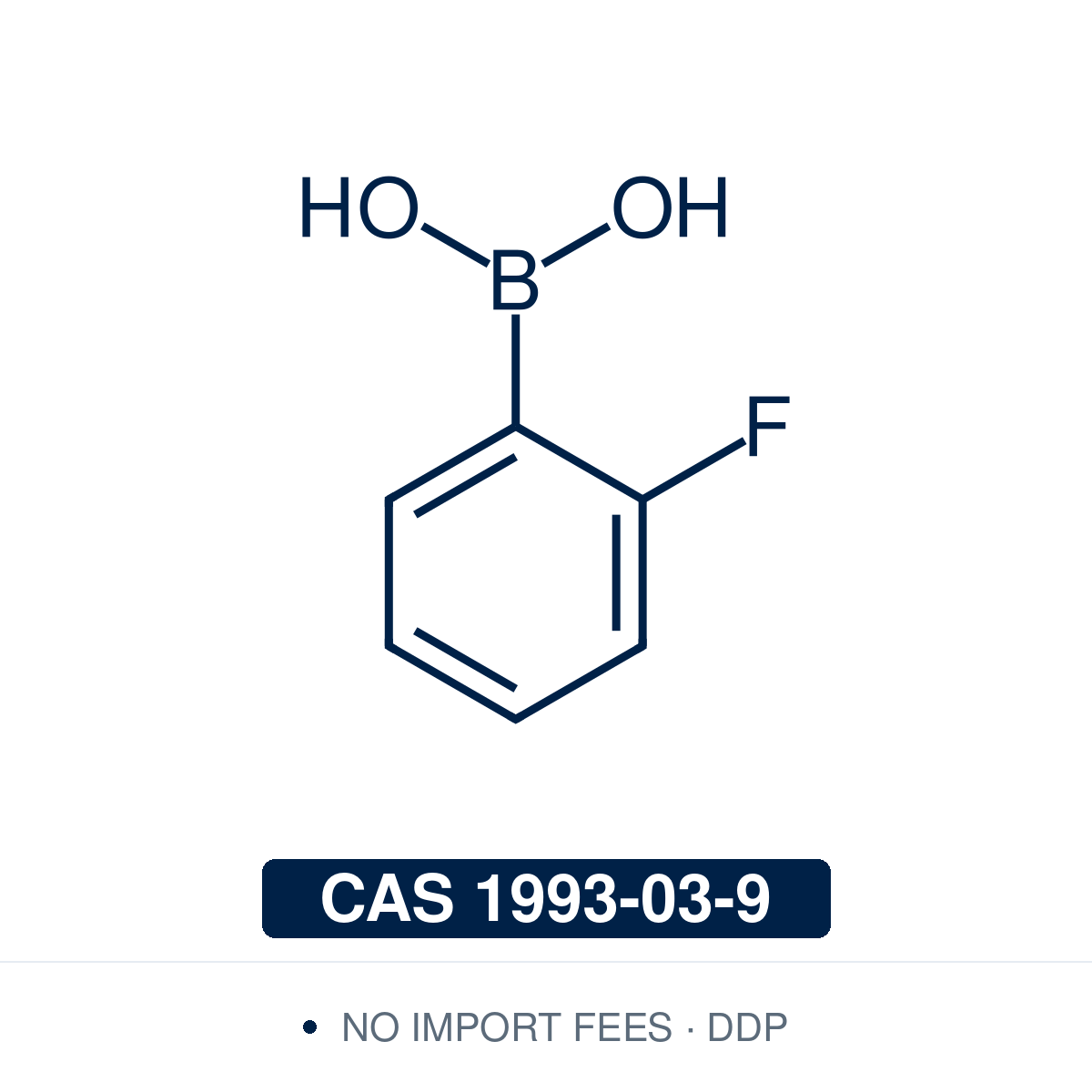
2-Fluorophenylboronic Acid
2-Fluorophenylboronic Acid | CAS 1993-03-9 | ≥98%
Couldn't load pickup availability
Technical Specifications
| CAS Number | 1993-03-9 |
| EC / EINECS Number | 671-858-7 |
| MDL Number | MFCD00674013 |
| SMILES | B(C1=CC=CC=C1F)(O)O |
| InChI | InChI=1S/C6H6BFO2/c8-6-4-2-1-3-5(6)7(9)10/h1-4,9-10H |
| InChIKey | QCSLIRFWJPOENV-UHFFFAOYSA-N |
| PubChem CID | 2734354 |
| Molecular Formula | C₆H₆BFO₂ |
| Molecular Weight | 139.92 g/mol |
| Melting Point | 101–110 °C (lit.) |
| Solubility | Soluble in alcoholic solvents, acetonitrile, DMF, DMSO |
| Purity | ≥98%. May contain varying amounts of the corresponding boronic acid anhydrides. |
| Physical Form | White to off-white crystalline powder |
| HS Code | 2931.90 |
| Shelf Life | Retest period: 36 months from date of manufacture |
| Storage Conditions | Store in a cool, dry place in a tightly sealed container |
Product Description & Scientific Applications
2-Fluorophenylboronic acid (2-fluorobenzeneboronic acid; o-fluorophenylboronic acid) is an ortho-substituted arylboronic acid with the fluorine adjacent to the boronic acid group.
May contain small amounts of the cyclic anhydride 2-fluorophenylboroxine. Under aqueous or basic coupling conditions the two forms re-equilibrate and the impact on yield is minor.
Stability and protodeboronation: the ortho-fluorine accelerates base-mediated protodeboronation. Phenyl, 3-fluoro-, and 4-fluorophenylboronic acid protodeboronate slowly and at near-identical rates, whereas the ortho-fluorinated isomers, including this one, are markedly faster. As the pathway is base- and pH-dependent, milder bases, active catalyst systems that complete coupling quickly, and the more robust surrogate formats (pinacol ester, MIDA boronate, potassium trifluoroborate) are the usual ways to suppress it. Separately, the ortho-fluorine lowers the boronic acid pKa relative to the parent.
Applications and Reactions
Suzuki–Miyaura cross-coupling: installs the 2-fluorophenyl group into biaryls and heterobiaryls — scaffolds for pharmaceutical, agrochemical, and materials synthesis — with aryl, heteroaryl, and alkenyl halides and triflates. The small ortho-fluorine adds little steric demand; condition choice follows the stability note above.
Rhodium-catalysed enantioselective 1,4-addition: serves as the aryl donor in Rh-catalysed asymmetric conjugate addition to enones, enals, and unsaturated esters; with chiral bisphosphine or diene ligands it sets stereocentres bearing the 2-fluorophenyl group. It also participates in Rh- and Pd-catalysed allylic substitution to give branched allylic products.
Pharmaceutical building block and impurity reference: catalogued as "vonoprazan impurity 215" and used as an impurity reference standard for potassium-competitive acid blocker (P-CAB) gastric-acid drugs, and as a fluorinated aryl building block for SAR libraries and other medicinal-chemistry intermediates. Aromatic fluorine is widely used to block oxidative (CYP-mediated) metabolism at the substituted position and to modulate the pKa and electronics of neighbouring groups.
Arylboron difluoride (ArBF₂) Lewis acids: used in the preparation of aryl-BF₂ species — electron-deficient organoboron Lewis acids of interest as catalysts and building blocks.
Diol and saccharide recognition: forms reversible boronate esters with 1,2- and 1,3-diols; the electron-withdrawing ortho-fluorine increases boron Lewis acidity and lowers the pKa, favouring boronate formation. Applied in saccharide sensors, glucose-responsive materials, and boronate-affinity separations.
Anion receptors for polymer electrolytes: used to prepare phenylboronic catechol esters studied as Lewis-acidic anion receptors for polymer-electrolyte membranes; among the fluorinated derivatives examined, the 2-fluoro catechol ester gave the largest increase in Lewis acidity, of direct relevance to anion binding in fuel-cell and battery electrolytes.
Liquid-crystal materials: Suzuki coupling of this boronic acid gives 2-fluorobiphenyls; laterally fluorinated biphenyls and terphenyls are fundamental building blocks of nematic liquid-crystal mixtures for TFT-LCDs, where ring fluorination tunes dielectric anisotropy, birefringence, and melting point.
Chan–Lam C–N and C–O coupling: as an arylboronic acid it can transfer the 2-fluorophenyl group to amine, amide, and phenol nucleophiles under mild copper-mediated aerobic conditions.
Oxidative ipso-hydroxylation: oxidation of the C–B bond (peroxide, persulfate, N-oxide, or photoredox) replaces boron with a hydroxyl to give 2-fluorophenol.
Further Reading
For boronic acids, boronic esters, protodeboronation, boroxine content, and Suzuki–Miyaura reagent selection, see NorrChemica's Lab Journal guide: Choosing Your Boron Source for Suzuki–Miyaura Coupling.
Shipping Destinations
- EU & UK: Priority delivery, 2–5 business days.
- United States (DDP): 3–7 business days, duties and taxes prepaid.
- EFTA Countries (DDP): 3–7 business days, duties and taxes prepaid.
- Worldwide: 7–14 business days, selected locations.
Safety Information
| GHS Pictograms |

|
| Signal Word | Warning |
| Hazard Class | None — not subject to transport regulations |
| Transport Category | Not classified as dangerous goods for transport (ADR/IATA/IMDG) |
| H-Statements | H302 - H315 - H319 - H335 |
| P-Statements | P261 - P264 - P270 - P271 - P280 - P301+P312 - P302+P352 - P304+P340 - P305+P351+P338 - P330 - P332+P313 - P337+P313 - P362+P364 - P501 |
Documentation
| Safety Data Sheet | Download PDF |