NorrChemica™
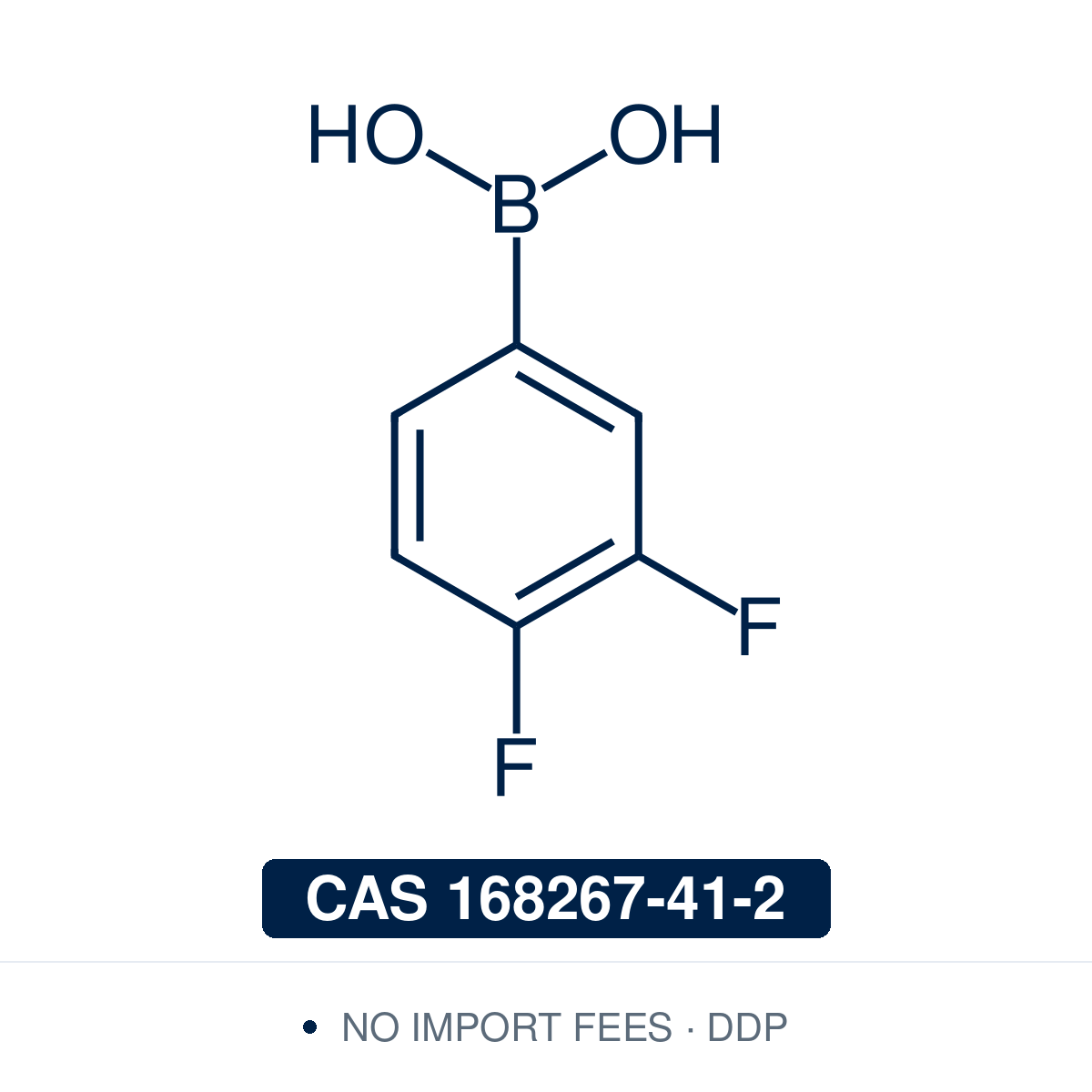
3,4-Difluorophenylboronic Acid
3,4-Difluorophenylboronic Acid | CAS 168267-41-2 | ≥98%
Couldn't load pickup availability
Technical Specifications
| CAS Number | 168267-41-2 |
| EC / EINECS Number | 605-510-2 |
| MDL Number | MFCD00807405 |
| SMILES | B(C1=CC(=C(C=C1)F)F)(O)O |
| InChI | InChI=1S/C6H5BF2O2/c8-5-2-1-4(7(10)11)3-6(5)9/h1-3,10-11H |
| InChIKey | RMGYQBHKEWWTOY-UHFFFAOYSA-N |
| PubChem CID | 2734337 |
| Molecular Formula | C₆H₅BF₂O₂ |
| Molecular Weight | 157.91 g/mol |
| Melting Point | 289-290 °C |
| Solubility | Slightly soluble in water; soluble in alcoholic solvents, acetonitrile, DMF, DMSO. |
| Purity | ≥98%. May contain small variable amounts of boron anhydrides |
| Physical Form | White to off-white crystalline powder |
| HS Code | 2931.90 |
| Shelf Life | Retest period: 36 months from date of manufacture |
| Storage Conditions | Store at room temperature. Keep container tightly closed in a dry place. Mildly hygroscopic — protect from moisture |
Product Description & Scientific Applications
3,4-Difluorophenylboronic Acid (3,4-difluorobenzeneboronic acid) carries adjacent fluorines at the 3- and 4-positions: the meta-fluorine contributes strong inductive withdrawal at the boron-bearing carbon, while the para-fluorine adds a weaker net withdrawal. The 3,4-difluorophenyl C–F pair tunes lipophilicity, metabolic stability, dipole, conformational preference, π-stacking, and molecular recognition in derived products, and acts as a built-in 19F NMR tracer. Used as a 3,4-difluorophenyl building block in medicinal chemistry, agrochemicals, fluorinated π-conjugated materials, and liquid-crystal precursors.
May contain small amounts of the cyclic anhydride 3,4-difluorophenylboroxine. Under aqueous or basic coupling conditions the two forms re-equilibrate and the impact on yield is minor.
Applications and Reactions
- Suzuki–Miyaura coupling: with aryl, heteroaryl, or alkenyl electrophiles to give 3,4-difluorophenyl biaryls, heterobiaryls, terphenyls, and styrenyl products; reported in fluorinated nucleoside scaffolds, enzyme-inhibitor intermediates, and π-conjugated materials.
- Chan–Lam coupling: copper-mediated C–N and C–O arylation onto amines, amides, sulfonamides, carbamates, N–H heterocycles, and phenols.
- Petasis borono-Mannich reaction: three-component coupling with an amine and a carbonyl to give α-aryl amines, α-amino acids, or β-amino alcohols bearing the 3,4-difluorophenyl group, metal-free.
- Nickel-catalysed aryl transfer to aldehydes: addition to aryl aldehydes giving fluorinated diarylmethanols and access to difluorinated benzhydryl alcohol motifs.
- Diazaborinine formation: condensation with diamines to give conjugated fluorinated diazaborinine systems.
- Liebeskind–Srogl-type coupling: aryl partner in oxo-directed coupling with α-oxo ketene dithioacetal substrates.
- Substitution with enyne derivatives: reported with selected enyne acetates and carbonates.
- Non-classical arylation: with arenediazonium salts, diaryliodonium salts, and hypervalent iodine reagents.
- 19F NMR tracer: the installed 3,4-difluorophenyl group serves as a 19F reporter for tracking the target molecule in binding studies, metabolism, and complex mixtures.
- Materials and liquid-crystal precursors: 3,4-difluorophenyl source for biaryl, terphenyl, chromophore, ligand, and liquid-crystal intermediates.
- Protected boronate esters: precursor to pinacol (Bpin), neopentyl glycol, and MIDA esters for iterative cross-coupling.
- Ipso-halodeboronation: to 4-bromo-, 4-chloro-, or 4-iodo-1,2-difluorobenzene under electrophilic halogenation.
- Oxidative hydroxylation: to 3,4-difluorophenol under aerobic photoredox, peroxide, or copper-catalysed conditions.
Further Reading
Shipping Destinations
- EU & UK: Priority delivery, 2–5 business days.
- United States (DDP): 3–7 business days, duties and taxes prepaid.
- EFTA Countries (DDP): 3–7 business days, duties and taxes prepaid.
- Worldwide: 7–14 business days, selected locations.
Safety Information
| GHS Pictograms |

|
| Signal Word | Warning |
| Hazard Class | None — not subject to transport regulations |
| Transport Category | Not classified as dangerous goods for transport (ADR/IATA/IMDG) |
| H-Statements | H302 - H315 - H319 - H335 |
| P-Statements | P261 - P264 - P270 - P271 - P280 - P301+P312 - P302+P352 - P304+P340 - P305+P351+P338 - P330 - P332+P313 - P337+P313 - P362+P364 - P501 |
Documentation
| Safety Data Sheet | Download PDF |