NorrChemica™
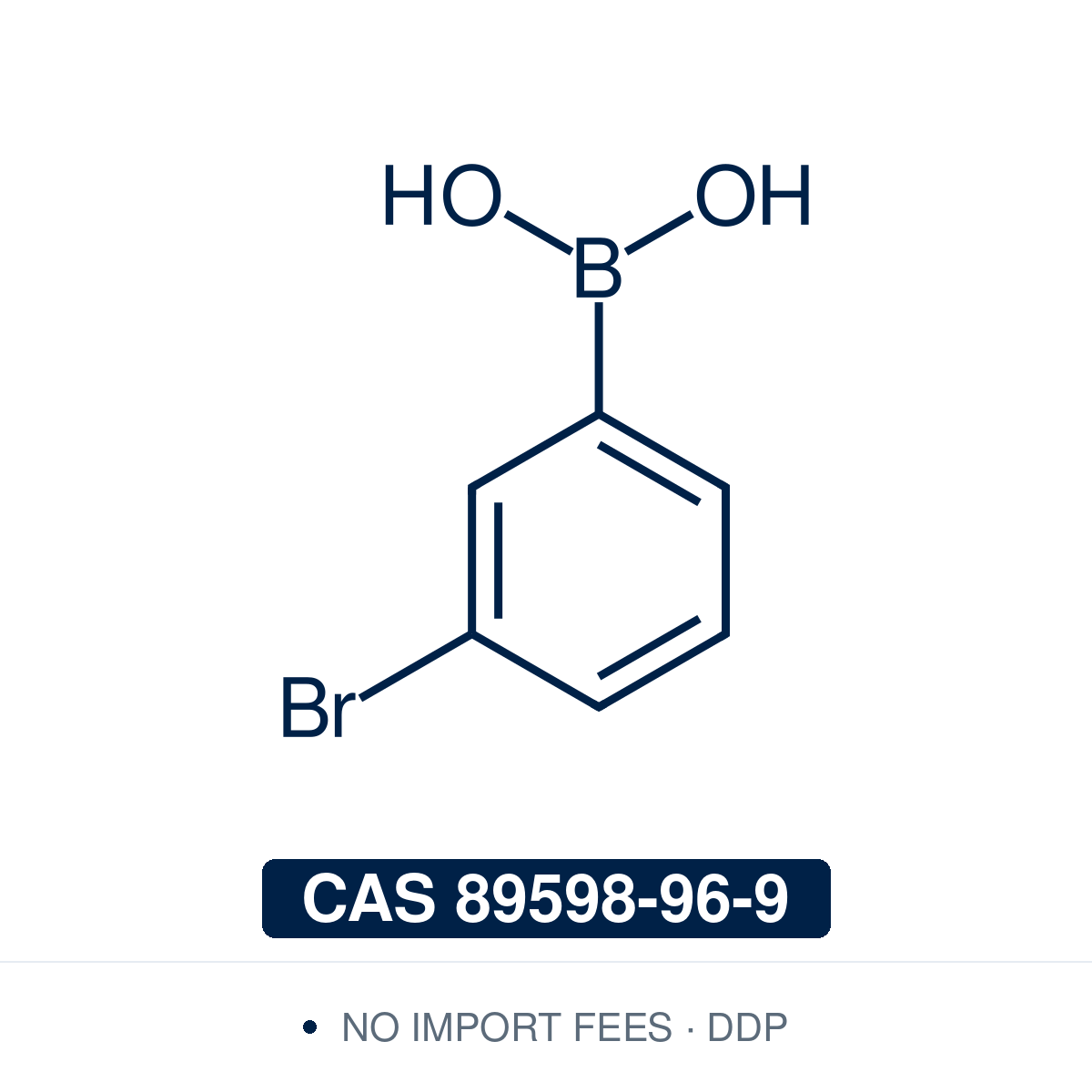
3-Bromophenylboronic Acid
3-Bromophenylboronic Acid | CAS 89598-96-9 | ≥97%
Couldn't load pickup availability
Technical Specifications
| CAS Number | 89598-96-9 |
| EC / EINECS Number | 677-281-7 |
| MDL Number | MFCD00239386 |
| SMILES | B(C1=CC(=CC=C1)Br)(O)O |
| InChI | InChI=1S/C6H6BBrO2/c8-6-3-1-2-5(4-6)7(9)10/h1-4,9-10H |
| InChIKey | AFSSVCNPDKKSRR-UHFFFAOYSA-N |
| PubChem CID | 2734318 |
| Molecular Formula | C₆H₆BBrO₂ |
| Molecular Weight | 200.83 g/mol |
| Melting Point | 164-168 °C |
| Solubility | Slightly soluble in water; soluble in alcoholic solvents, acetonitrile, DMF, DMSO |
| Purity | ≥97%. May contain small variable amounts of boron anhydrides |
| Physical Form | White to light yellow crystalline powder |
| HS Code | 2931.90 |
| Shelf Life | Retest period: 36 months under recommended storage conditions |
| Storage Conditions | Store at room temperature. Keep container tightly closed in a dry place. Mildly hygroscopic — protect from moisture |
Product Description & Scientific Applications
3-Bromophenylboronic Acid (3-bromobenzeneboronic acid, m-bromophenylboronic acid) is a bifunctional arylboronic acid carrying both a boronic acid and an aryl bromide at meta positions on the same ring. The meta-Br is inductively electron-withdrawing (Hammett σₘ ≈ +0.39). The estimated pKa is ≈ 8.0, below the parent phenylboronic acid (8.76). The boronic acid is the nucleophilic coupling handle and the aryl bromide the electrophilic one. The two react under different conditions and can be cross-coupled to separate partners in sequential steps.
The product may contain small amounts of the cyclic anhydride 3-bromophenylboroxine. Under aqueous or basic coupling conditions the two forms re-equilibrate and the impact on yield is minor.
Applications and Reactions
- Suzuki–Miyaura coupling at the boronic acid: couples with aryl and heteroaryl electrophiles to install a meta-bromoaryl group on the coupled scaffold. When the aryl bromide is intended for later use, catalyst and electrophile are chosen to avoid premature oxidative addition at the retained Ar–Br bond.
- Iterative cross-coupling using the retained aryl bromide: the meta-Ar–Br in a Suzuki product can be used in a second Pd-catalysed cross-coupling. In the reverse sequence, the boronic acid can first be masked as its anthranilamide (AAM) boronate; the AAM-protected boronyl group is inactive under Suzuki conditions, allowing coupling at the aryl bromide before deprotection reveals the boronic acid for the next step.
- Rh-catalysed asymmetric 1,4-addition: under Hayashi–Miyaura-type Rh(I)/chiral ligand catalysis, 3-bromophenylboronic acid serves as the aryl donor in conjugate addition to α,β-unsaturated ketones, giving enantioenriched β-(3-bromoaryl) carbonyl products.
- Gold-salt-catalysed homocoupling: gold-catalysed homocoupling of arylboronic acids provides symmetrical biaryls; for 3-bromophenylboronic acid this gives access to the corresponding 3,3'-dibromobiphenyl framework from a single boronic-acid reagent.
- C–H functionalisation of quinones: under catalytic AgNO₃ with K₂S₂O₈ as oxidant at room temperature, 3-bromophenylboronic acid arylates quinone C–H positions through a radical pathway, giving meta-bromoaryl-substituted quinones without prior halogenation of the quinone substrate.
Further Reading
For boronic acids, boronic esters, protodeboronation, boroxine content, and Suzuki–Miyaura reagent selection, see NorrChemica's Lab Journal guide: Choosing Your Boron Source for Suzuki–Miyaura Coupling.
Shipping Destinations
- EU & UK: Priority delivery, 2–5 business days.
- United States (DDP): 3–7 business days, duties and taxes prepaid.
- EFTA Countries (DDP): 3–7 business days, duties and taxes prepaid.
- Worldwide: 7–14 business days, selected locations.
Safety Information
| GHS Pictograms |

|
| Signal Word | Warning |
| Hazard Class | None — not subject to transport regulations |
| Transport Category | Not classified as dangerous goods for transport (ADR/IATA/IMDG) |
| H-Statements | H315 - H319 - H335 |
| P-Statements | P261 - P264 - P271 - P280 - P302+P352 - P304+P340 - P305+P351+P338 - P332+P313 - P337+P313 - P362+P364 - P501 |
Documentation
| Safety Data Sheet | Download PDF |