NorrChemica™
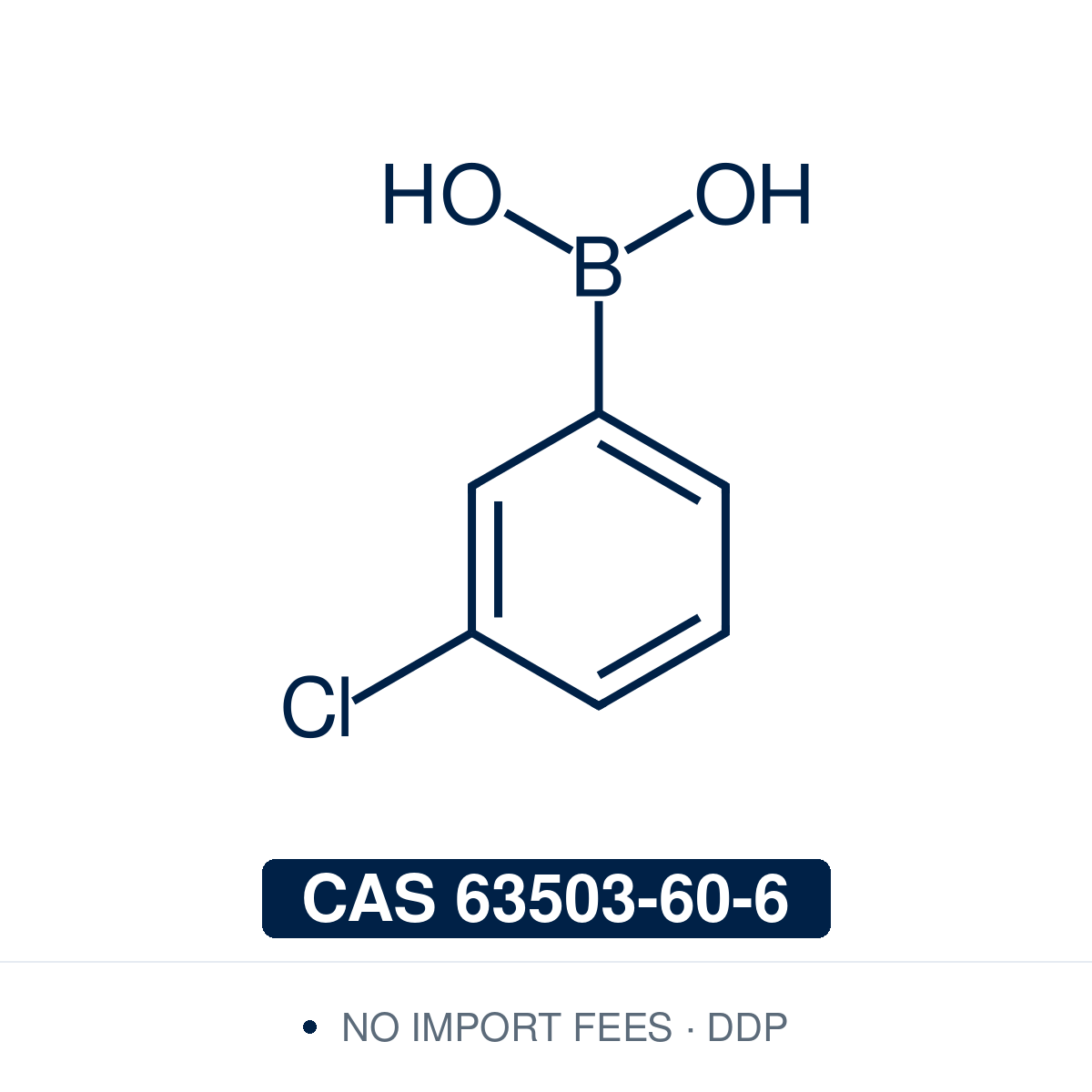
3-Chlorophenylboronic Acid
3-Chlorophenylboronic Acid | CAS 63503-60-6 | ≥98%
Couldn't load pickup availability
Technical Specifications
| CAS Number | 63503-60-6 |
| EC / EINECS Number | 628-786-6 |
| MDL Number | MFCD00161354 |
| SMILES | B(C1=CC(=CC=C1)Cl)(O)O |
| InChI | InChI=1S/C6H6BClO2/c8-6-3-1-2-5(4-6)7(9)10/h1-4,9-10H |
| InChIKey | SDEAGACSNFSZCU-UHFFFAOYSA-N |
| PubChem CID | 2734323 |
| Molecular Formula | C₆H₆BClO₂ |
| Molecular Weight | 156.37 g/mol |
| Melting Point | 185–189 °C (lit.) |
| Solubility | Soluble in alcoholic solvents, acetonitrile, DMF, DMSO |
| Purity | ≥98%. May contain varying amounts of the corresponding boronic acid anhydrides. |
| Physical Form | White to off-white crystalline powder |
| HS Code | 2931.90 |
| Shelf Life | Retest period: 36 months from date of manufacture |
| Storage Conditions | Store in a cool, dry place in a tightly sealed container. |
Product Description & Scientific Applications
3-Chlorophenylboronic acid (3-chlorobenzeneboronic acid; m-chlorophenylboronic acid) is a meta-substituted arylboronic acid bearing a chloro substituent at the 3-position of the ring.
May contain small amounts of the cyclic anhydride 3-chlorophenylboroxine. Under aqueous or basic coupling conditions the two forms re-equilibrate and the impact on yield is minor.
Reactivity: the meta-chloro group is moderately electron-withdrawing and sterically unobtrusive. With no ortho substituent or ring heteroatom adjacent to boron, it sits with the parent and simple 3-/4-substituted phenylboronic acids at the slow end of the protodeboronation scale, away from the labile ortho-disubstituted, polyfluoro, and 2-heteroaryl classes. Its defining feature is bifunctionality: in a standard Suzuki coupling the boron reacts while the aryl C–Cl is retained as a second handle.
Applications and Reactions
Suzuki–Miyaura cross-coupling and sequential functionalisation: installs the 3-chlorophenyl group into biaryls and heterobiaryls from aryl, heteroaryl, and vinyl halides or pseudohalides. The retained meta C–Cl bond then serves as an orthogonal handle for a second Suzuki coupling, Buchwald–Hartwig amination, or palladium-catalysed cyanation, giving stepwise access to polysubstituted biaryls and terphenyls from a single building block. It has also been coupled with dibromo(trifluoromethyl)benzene to give CF₃-substituted chlorobiphenyls.
Pharmaceutical building block — vadadustat and PDE4 inhibitors: a documented building block in the synthesis of the HIF-prolyl-hydroxylase (HIF-PHD) inhibitor vadadustat, developed for anaemia of chronic kidney disease, where Suzuki coupling installs the 3-chlorophenyl group onto the pyridine core. It is also used to introduce the 3-chloroaryl fragment into PDE4 (phosphodiesterase-4) inhibitor scaffolds.
Biaryl ketones and phthalides: carbonylative Suzuki coupling under carbon monoxide gives biaryl ketones; the compound is also used in the synthesis of phthalide (isobenzofuran-1(3H)-one) scaffolds.
1,4-Conjugate addition to ethenesulfonamides: serves as the aryl donor in Rh- or Pd-catalysed conjugate addition to ethenesulfonamides, giving arylethanesulfonamides; the meta-chlorine is retained in the product for further derivatisation.
Coupling with diazoesters: palladium-catalysed coupling with α-diazoesters proceeds through a metal-carbene migratory insertion to give α-aryl α,β-unsaturated esters (diarylacrylates); chloro- and bromo-substituted arylboronic acids are tolerated and retained intact under these oxidative conditions.
Coupling with potassium cyanate: copper-catalysed coupling with potassium cyanate in an alcohol gives aryl carbamates via an aryl isocyanate intermediate.
Chan–Lam C–N and C–O coupling: as an arylboronic acid it can transfer the 3-chlorophenyl group to amine, amide, and phenol nucleophiles under mild copper-mediated aerobic conditions.
Oxidative ipso-hydroxylation: oxidation of the C–B bond (peroxide, persulfate, N-oxide, or photoredox) replaces boron with a hydroxyl to give 3-chlorophenol.
Further Reading
For boronic acids, boronic esters, protodeboronation, boroxine content, and Suzuki–Miyaura reagent selection, see NorrChemica's Lab Journal guide: Choosing Your Boron Source for Suzuki–Miyaura Coupling.
Shipping Destinations
- EU & UK: Priority delivery, 2–5 business days.
- United States (DDP): 3–7 business days, duties and taxes prepaid.
- EFTA Countries (DDP): 3–7 business days, duties and taxes prepaid.
- Worldwide: 7–14 business days, selected locations.
Safety Information
| GHS Pictograms |

|
| Signal Word | Warning |
| Hazard Class | None — not subject to transport regulations |
| Transport Category | Not classified as dangerous goods for transport (ADR/IATA/IMDG) |
| H-Statements | H302 - H315 - H319 - H335 |
| P-Statements | P261 - P264 - P270 - P271 - P280 - P301+P312 - P302+P352 - P304+P340 - P305+P351+P338 - P330 - P332+P313 - P337+P313 - P362+P364 - P501 |
Documentation
| Safety Data Sheet | Download PDF |