NorrChemica™
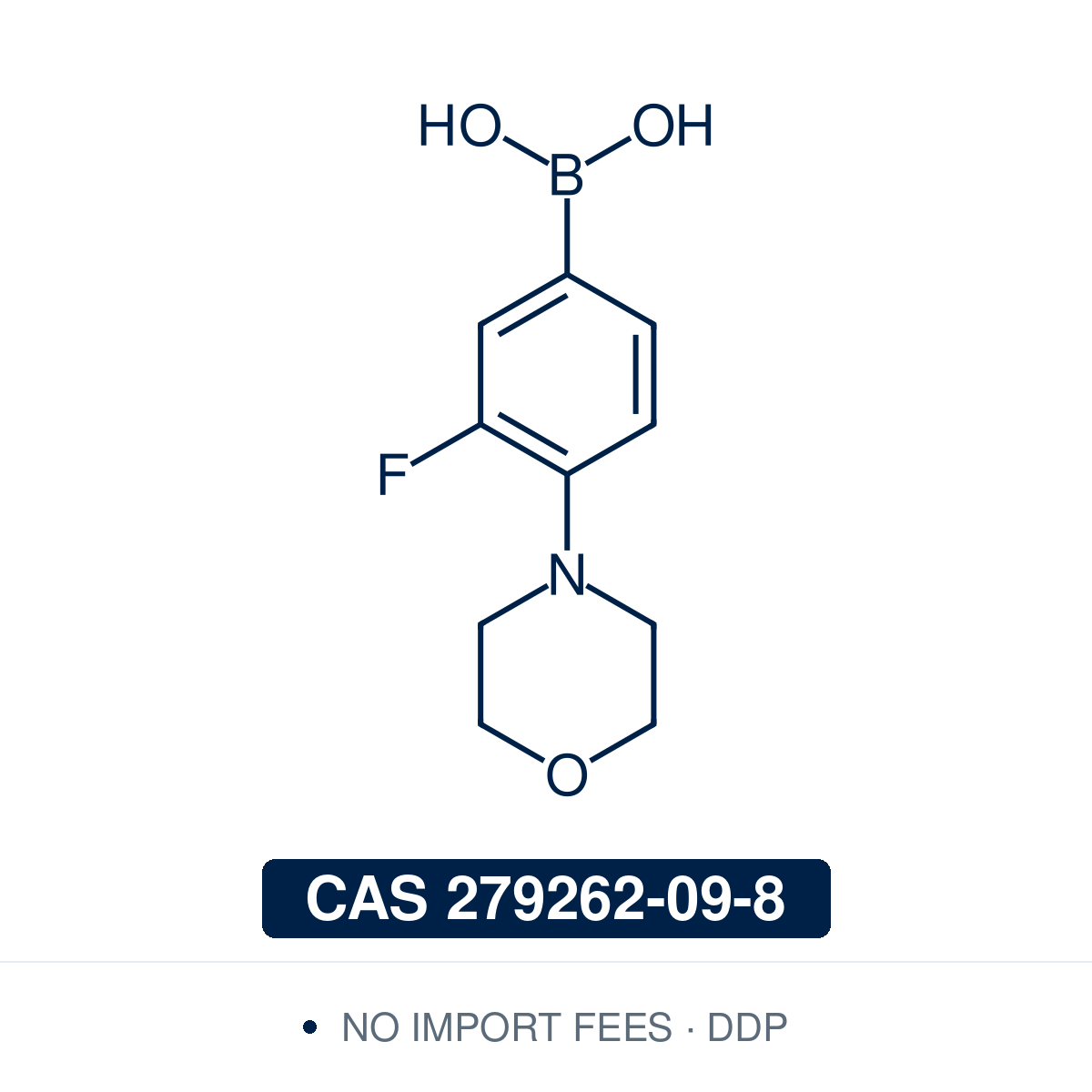
3-Fluoro-4-morpholinophenylboronic Acid
3-Fluoro-4-morpholinophenylboronic Acid | CAS 279262-09-8 | ≥95%
Couldn't load pickup availability
Technical Specifications
| CAS Number | 279262-09-8 |
| MDL Number | MFCD16883060 |
| SMILES | B(C1=CC(=C(C=C1)N2CCOCC2)F)(O)O |
| InChI | InChI=1S/C10H13BFNO3/c12-9-7-8(11(14)15)1-2-10(9)13-3-5-16-6-4-13/h1-2,7,14-15H,3-6H2 |
| InChIKey | JCGKJBDGVMLWBG-UHFFFAOYSA-N |
| PubChem CID | 53393407 |
| Molecular Formula | C₁₀H₁₃BFNO₃ |
| Molecular Weight | 225.03 g/mol |
| Melting Point | 141–145 °C |
| Solubility | Slightly soluble in water; soluble in alcoholic solvents, acetonitrile, DMF, DMSO |
| Purity | ≥95% |
| Physical Form | White to off-white crystalline powder |
| HS Code | 2931.90 |
| Shelf Life | Retest period: 36 months from date of manufacture |
| Storage Conditions | Store at 2–8°C under an inert atmosphere in a tightly sealed container. Protect from moisture and light. May contain varying amounts of boroxine anhydride |
Product Description & Scientific Applications
3-Fluoro-4-morpholinophenylboronic acid (3-fluoro-4-morpholin-4-ylphenylboronic acid) combines a boronic-acid coupling handle, a para-morpholine ring, and a meta-fluorine in one building block. It is a privileged 3-fluoro-4-morpholinophenyl motif in medicinal-chemistry scaffold design.
May contain small amounts of the cyclic anhydride 3-fluoro-4-morpholinophenylboroxine. Under aqueous or basic coupling conditions the two forms re-equilibrate and the impact on yield is minor.
Applications and Reactions
- Suzuki–Miyaura coupling: couples with aryl, heteroaryl, and alkenyl halides or pseudohalides under Pd catalysis to install the 3-fluoro-4-morpholinophenyl fragment onto biaryl, heterobiaryl, and styrenyl scaffolds. It couples with chloro-, bromo-, and iodo-substituted nitrogen heterocycles such as pyrimidines, pyridines, pyrazines, triazines, and pyridopyrimidines, giving morpholino-fluoroaryl heteroaromatic products in a convergent step.
- Medicinal-chemistry scaffold synthesis: the 3-fluoro-4-morpholinophenyl fragment builds heteroaryl-linked arylmorpholine libraries by Suzuki–Miyaura coupling, including kinase-inhibitor scaffolds in the PI3K, AKT, and mTOR family. The morpholine oxygen serves as the hydrogen-bond acceptor toward the conserved hinge-region backbone amide of the ATP-binding pocket, the morpholine nitrogen tethering the ring to the aryl scaffold; the precise binding role depends on the coupled heteroaryl core, substitution pattern, and molecular context.
- Substituent positioning and electronic profile: the 4-morpholino substituent is an electron-donating arylamino group (π-donation via the nitrogen lone pair); the 3-fluoro substituent is inductively electron-withdrawing relative to the boronic acid (σm ≈ +0.34). The fragment contributes hydrogen-bond-acceptor character and solubility tuning through the morpholine oxygen, an aryl-F ¹⁹F NMR reporter for tracking the fragment, and a ring position for blocking or redirecting oxidative aromatic metabolism.
- Protodeboronation and condition sensitivity: stability under aqueous-basic conditions depends on substituent, pH, base, concentration, and temperature; electron-rich aminated arylboronic acids are not assumed to tolerate prolonged warm aqueous-basic exposure without optimisation. For this compound, mild bases, controlled aqueous content, moderate temperatures, and limited reaction times are sensible Suzuki starting points; slow-release boron formats suit extended coupling.
- Chan–Lam coupling: the boronic acid acts as the aryl donor in copper-mediated C–N, C–O, and C–S bond formation under aerobic conditions, transferring the 3-fluoro-4-morpholinophenyl group to amines, anilines, amides, phenols, alcohols, or thiols.
- Petasis borono-Mannich reaction: arylboronic acids act as aryl donors in three-component reactions with an amine and an aldehyde, glyoxylic acid, or α-hydroxy aldehyde to give arylated amines, α-aryl glycine derivatives, or β-amino alcohol scaffolds.
- Protected boronate ester forms: the pinacol ester is commercially available as a protected form for handling and Suzuki–Miyaura coupling. MIDA boronates and potassium organotrifluoroborates improve shelf stability and enable controlled-release coupling.
Further Reading
For boronic acids, boronic esters, protodeboronation, boroxine content, and Suzuki–Miyaura reagent selection, see NorrChemica's Lab Journal guide: Choosing Your Boron Source for Suzuki–Miyaura Coupling.
Shipping Destinations
- EU & UK: Priority delivery, 2–5 business days.
- United States (DDP): 3–7 business days, duties and taxes prepaid.
- EFTA Countries (DDP): 3–7 business days, duties and taxes prepaid.
- Worldwide: 7–14 business days, selected locations.
Safety Information
| GHS Pictograms |

|
| Signal Word | Warning |
| Hazard Class | None — not subject to transport regulations |
| Transport Category | Not classified as dangerous goods for transport (ADR/IATA/IMDG) |
| H-Statements | H302 |
| P-Statements | P264 - P270 - P301+P312 - P330 - P501 |
Documentation
| Safety Data Sheet | Download PDF |