NorrChemica™
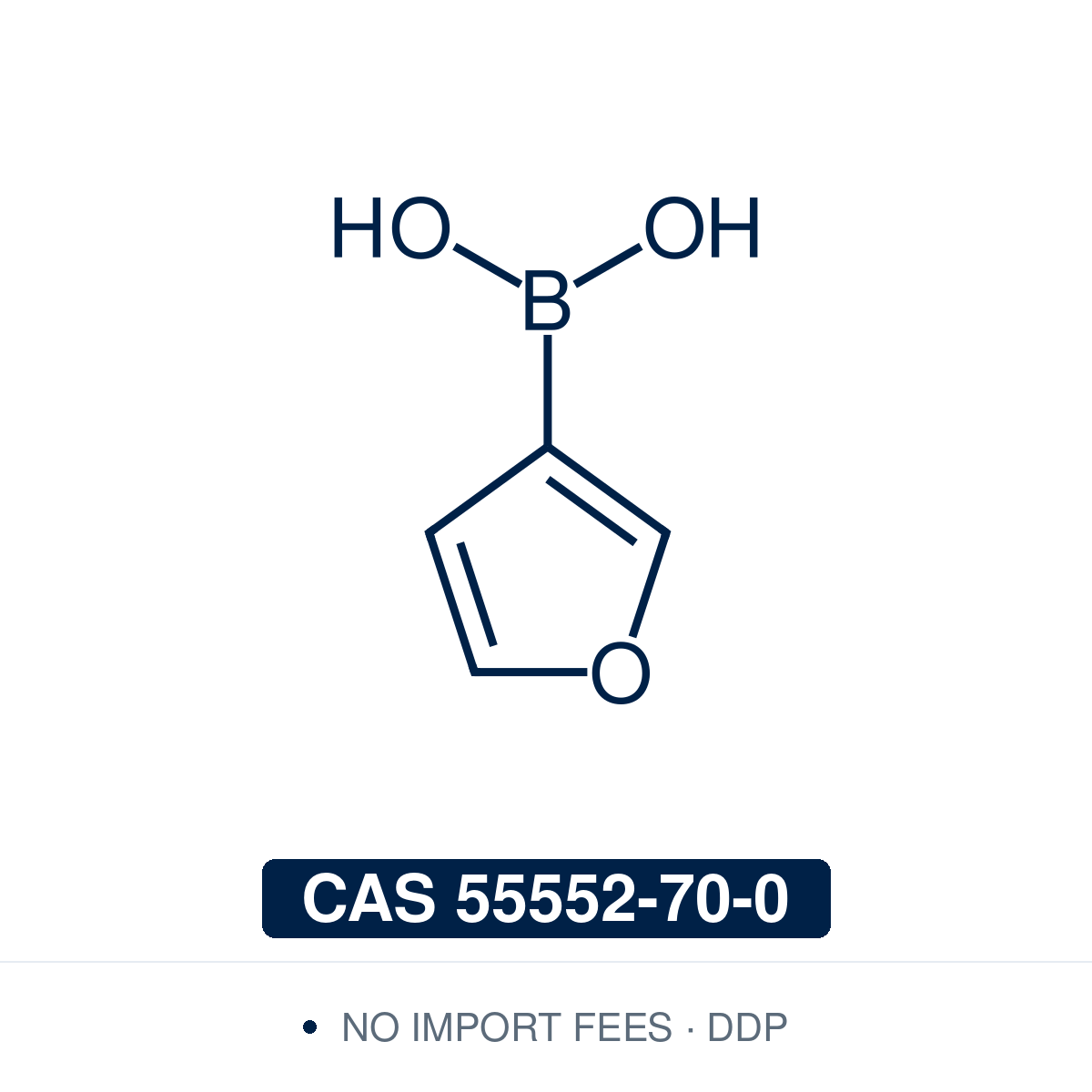
3-Furanboronic Acid
3-Furanboronic Acid | CAS 55552-70-0 | ≥97%
Couldn't load pickup availability
Technical Specifications
| CAS Number | 55552-70-0 |
| EC / EINECS Number | 672-302-6 |
| MDL Number | MFCD01319007 |
| SMILES | B(C1=COC=C1)(O)O |
| InChI | InChI=1S/C4H5BO3/c6-5(7)4-1-2-8-3-4/h1-3,6-7H |
| InChIKey | CYEFKCRAAGLNHW-UHFFFAOYSA-N |
| PubChem CID | 2734358 |
| Molecular Formula | C₄H₅BO₃ |
| Molecular Weight | 111.89 g/mol |
| Melting Point | 139-144 °C (dec.) |
| Solubility | Soluble in alcoholic solvents, acetonitrile, DMF, DMSO |
| Purity | ≥97%. May contain varying amounts of the corresponding boronic acid anhydrides |
| Physical Form | White to light yellow crystalline powder |
| HS Code | 2931.90 |
| Shelf Life | Retest period: 24 months from date of manufacture |
| Storage Conditions | Store refrigerated (2–8 °C) in a tightly sealed container, protected from moisture |
Product Description & Scientific Applications
3-Furanboronic acid (furan-3-ylboronic acid, 3-furylboronic acid) is a five-membered heteroarylboronic acid where the relative positioning of boron center and ring oxygen prevents the α-carbanion stabilisation pathway operative for the 2-isomer which translates into slower aqueous protodeboronation and the absence of disproportionation cascade processes.
The product may contain small amounts of the cyclic anhydride furan-3-ylboroxine; under aqueous or basic coupling conditions the two forms re-equilibrate and the impact on yield is minor.
Applications and Reactions
- Suzuki–Miyaura coupling: couples with aryl and N-heteroaryl halides (pyridines, pyrimidines, quinolines) using Pd or Ni catalysis. Compatible with activated/unactivated chlorides and biodegradable aqueous solvent systems.
- Heteroaryl–heteroaryl coupling: couples with N-heteroaryl halides — including bromo- and chloropyridines, halopyrimidines, and bromoquinolines — under suitably chosen Pd or Ni conditions, supporting its use for constructing mixed five/six-membered heterobiaryl motifs common in pharmaceutical and agrochemical intermediates.
- Protodeboronation behaviour: furan-2-boronic acid undergoes high-concentration disproportionation near its pKa, sequentially forming difurylborinic acid and trifurylborane before protodeboronation. In 3-furanboronic acid, the β-positioned boron prevents the arrangement required for this cascade. Nevertheless, the compound remains condition-sensitive; pH, base, concentration, and temperature must still be carefully controlled to avoid protodeboronation.
- Ni-catalysed Suzuki coupling: substrate for Suzuki–Miyaura coupling in green solvents to construct N-heteroaryl–furan biaryls (e.g., 5-(furan-3-yl)pyrimidine from 5-bromopyrimidine). Compatible with aryl/heteroaryl halides and phenol-derived electrophiles (carbamates, sulfamates, pivalates).
- Diol recognition and enzyme immobilisation: forms reversible cyclic boronate esters with cis-1,2- and 1,3-diols and glycan motifs in aqueous solutions. Oxidative electropolymerisation of a uricase–furan-3-boronic acid adduct on a Pd-plated multiwalled-carbon-nanotube/Au electrode yields a bionanocomposite functioning as an amperometric uric-acid biosensor and a uric-acid/O₂ enzymatic biofuel cell bioanode.
- Chan–Lam N-arylation: acts as the boron coupling partner in Cu(II)-mediated N-arylation of NH-heterocycles, anilines, and amides under mild aerobic conditions. Requires standard substrate-specific screening.
- Petasis borono-Mannich: participates in three-component coupling with amines and aldehydes (or glyoxylic / α-hydroxy aldehydes) to yield arylated amines, α-amino acid derivatives, or β-amino alcohols. Requires substrate-specific screening for optimal furan-3-yl transfer.
- Ipso-substitution (halodeboronation and hydroxylation): the B(OH)₂ group undergoes oxidative replacement by halogens (Cl, Br, I) via N-haloimides, or by OH via peroxide oxidation, yielding 3-halo- or 3-hydroxyfurans. Careful screening is required, as the furan 2,5-positions are highly sensitive to electrophilic oxidation and halogenation.
- Protected boronate esters: the pinacol ester (CAS 248924-59-6) offers a stable format for handling and cross-coupling. Other slow-release strategies — like MIDA boronates and potassium organotrifluoroborates — improve chromatographic handling, shelf stability, and iterative controlled-release Suzuki–Miyaura couplings (requires confirmed substrate-specific preparation protocols).
Further Reading
For comprehensive protocols on boronic acids, esters, protodeboronation, boroxine content, and reagent selection, refer to NorrChemica's Lab Journal guide: Choosing Your Boron Source for Suzuki–Miyaura Coupling.
Shipping Destinations
- EU & UK: Priority delivery, 2–5 business days.
- United States (DDP): 3–7 business days, duties and taxes prepaid.
- EFTA Countries (DDP): 3–7 business days, duties and taxes prepaid.
- Worldwide: 7–14 business days, selected locations.
Safety Information
| GHS Pictograms |

|
| Signal Word | Warning |
| Hazard Class | None — not subject to transport regulations |
| Transport Category | Not classified as dangerous goods for transport (ADR/IATA/IMDG) |
| H-Statements | H315 - H319 - H335 |
| P-Statements | P261 - P264 - P271 - P280 - P302+P352 - P304+P340 - P305+P351+P338 - P332+P313 - P337+P313 - P362+P364 - P501 |
Documentation
| Safety Data Sheet | Download PDF |