NorrChemica™
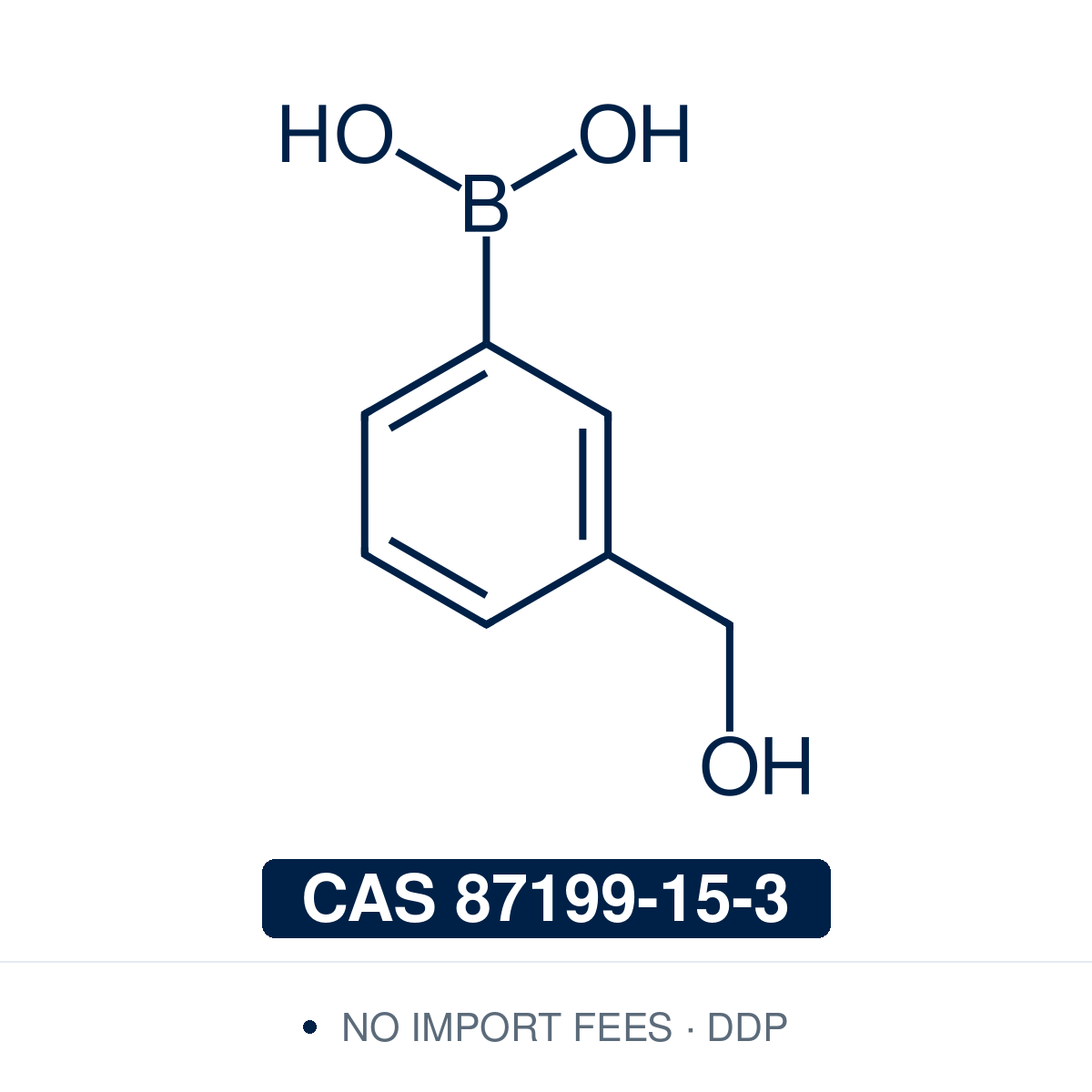
3-(Hydroxymethyl)phenylboronic Acid
3-(Hydroxymethyl)phenylboronic Acid | CAS 87199-15-3 | ≥98%
Couldn't load pickup availability
Technical Specifications
| CAS Number | 87199-15-3 |
| EC / EINECS Number | 672-931-6 |
| MDL Number | MFCD01317846 |
| SMILES | B(C1=CC(=CC=C1)CO)(O)O |
| InChI | InChI=1S/C7H9BO3/c9-5-6-2-1-3-7(4-6)8(10)11/h1-4,9-11H,5H2 |
| InChIKey | HGTDLKXUWVKLQX-UHFFFAOYSA-N |
| PubChem CID | 2734662 |
| Molecular Formula | C₇H₉BO₃ |
| Molecular Weight | 151.96 g/mol |
| Melting Point | 95-99 °C |
| Solubility | Soluble in alcoholic solvents, acetonitrile, DMF, DMSO |
| Purity | ≥98%. May contain varying amounts of the corresponding boronic acid anhydrides. |
| Physical Form | White to off-white crystalline powder |
| HS Code | 2931.90 |
| Shelf Life | Retest period: 36 months from date of manufacture |
| Storage Conditions | Store in a cool, dry place in a tightly sealed container. |
Product Description & Scientific Applications
3-(Hydroxymethyl)phenylboronic Acid is a bifunctional arylboronic acid building block with a meta-substitution pattern placing the boronic-acid and benzylic alcohol handles at a 120° relative disposition.
Applications and Reactions
Suzuki–Miyaura coupling: Couples with aryl, heteroaryl, and alkenyl halides or triflates under standard Pd-catalysed aqueous-basic conditions to give biaryl, heterobiaryl, and styrene-type products; the meta-benzylic alcohol is retained as a post-coupling functional handle.
Hydroxymethyl handle on the free boronic acid: Standard benzylic alcohol chemistry applies — Appel halogenation, mesylation, tosylation, Mitsunobu, etherification, esterification, carbamate formation, controlled oxidation to the aldehyde or acid — within the compatibility limits of any onward steps in the target molecule.
Reversible boronate ester formation with diols: Forms reversible covalent boronate esters with cis-1,2- and 1,3-diols, saccharides, and catechols in aqueous media. The meta-hydroxymethyl group provides an additional alcohol handle for scaffold attachment, surface attachment, or orthogonal modification.
Dynamic-covalent boronate–diol networks: The reversible boronate–diol bond underpins self-healing polymers, pH- and glucose-responsive hydrogels, and crosslinked dynamic networks.
Copper-catalysed transformations of arylboronic acids in water: The Cu2O/ammonia-in-water system converts arylboronic acids to aryl iodides, azides, sulfones, phenols, anilines, and nitroarenes under air, with inorganic salt and ammonia as the functional-group sources.
Copper-mediated trifluoromethylation: Substrate in copper-mediated trifluoromethylation of arylboronic acids, giving the meta-trifluoromethylbenzyl alcohol framework under Cu/CF3-source conditions outside the conventional Pd/aryl-halide manifold.
Chan–Lam-type C–N and C–O coupling: With Cu(OAc)2 or related Cu(II) systems and an amine, amide, sulfonamide, carbamate, phenol, or selected alcohol partner under mild aerobic conditions, gives the corresponding N-aryl or O-aryl product.
Petasis borono-Mannich reaction: The boronic acid acts as the aryl donor in a three-component coupling with an amine and an aldehyde, glyoxylic acid, or α-hydroxy aldehyde partner to give arylated amines, including α-aryl glycine and β-amino alcohol scaffolds.
Protected boronate derivatives: The pinacol ester (Bpin, CAS 443776-76-9) is commercially documented. Other protected forms include the MIDA boronate, neopentyl glycol ester, Bdan, trifluoroborate, and MEA boronate. The MIDA boronate is a chromatographically tractable, air-stable boron surrogate compatible with iterative Suzuki coupling under slow-release conditions; the Bpin ester is a common protected form for handling and cross-coupling.
Non-classical arylation pathways: Arylboronic acids participate in Suzuki–Miyaura-type coupling with arenediazonium salts under Pd catalysis and in base-free Suzuki-type arylation with pentavalent triarylantimony diacetates, giving biaryl products from electrophiles outside the usual aryl halide/triflate set.
Further Reading
Shipping Destinations
- EU & UK: Priority delivery, 2–5 business days.
- United States (DDP): 3–7 business days, duties and taxes prepaid.
- EFTA Countries (DDP): 3–7 business days, duties and taxes prepaid.
- Worldwide: 7–14 business days, selected locations.
Safety Information
| GHS Pictograms |

|
| Signal Word | Warning |
| Hazard Class | None — not subject to transport regulations |
| Transport Category | Not classified as dangerous goods for transport (ADR/IATA/IMDG) |
| H-Statements | H315 - H319 - H335 |
| P-Statements | P261 - P264 - P271 - P280 - P302+P352 - P304+P340 - P305+P351+P338 - P332+P313 - P337+P313 - P362+P364 - P501 |
Documentation
| Safety Data Sheet | Download PDF |