NorrChemica™
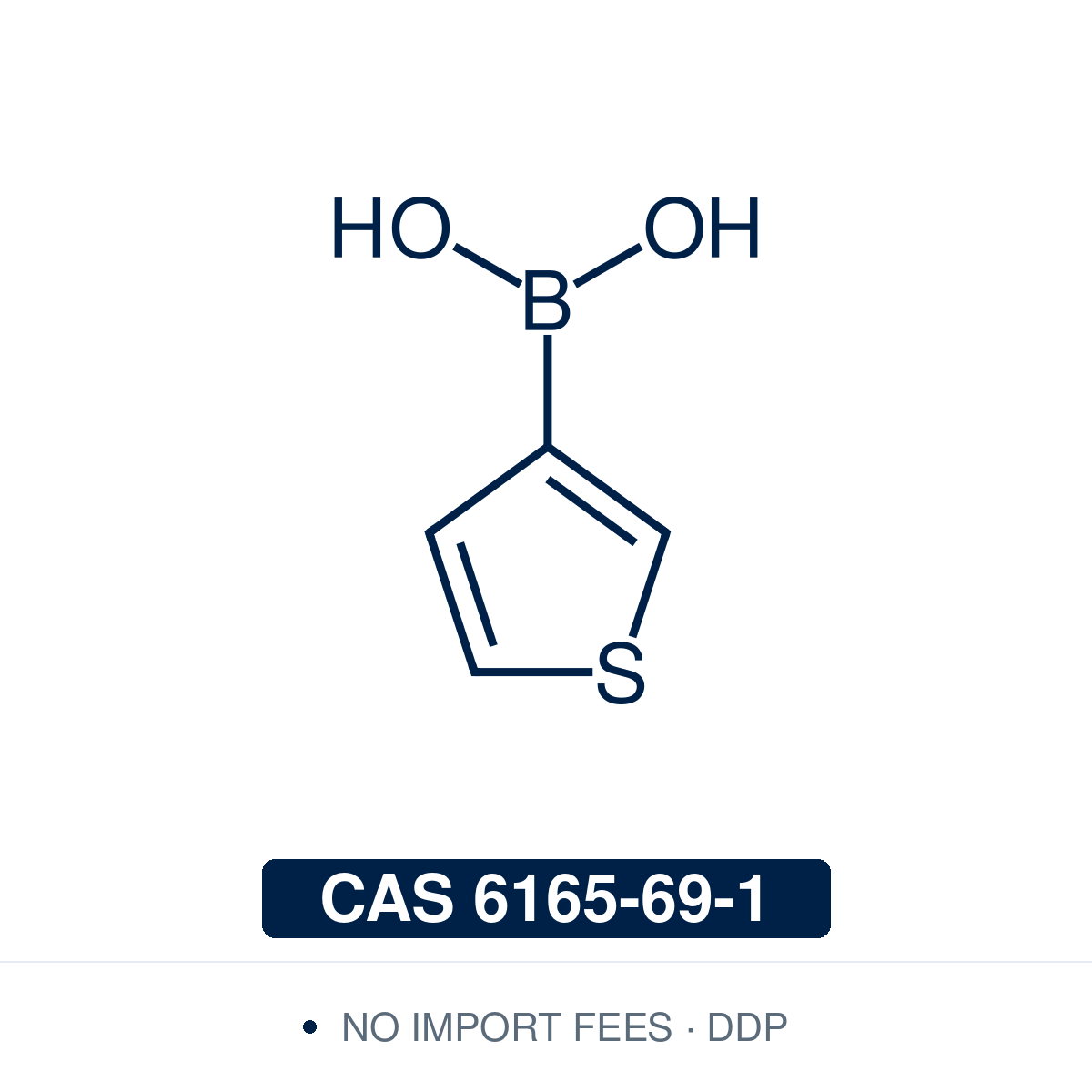
3-Thienylboronic Acid
3-Thienylboronic Acid | CAS 6165-69-1 | ≥98%
Couldn't load pickup availability
Technical Specifications
| CAS Number | 6165-69-1 |
| EC / EINECS Number | 629-166-8 |
| MDL Number | MFCD00151851 |
| SMILES | B(C1=CSC=C1)(O)O |
| InChI | InChI=1S/C4H5BO2S/c6-5(7)4-1-2-8-3-4/h1-3,6-7H |
| InChIKey | QNMBSXGYAQZCTN-UHFFFAOYSA-N |
| PubChem CID | 581760 |
| Molecular Formula | C₄H₅BO₂S |
| Molecular Weight | 127.96 g/mol |
| Melting Point | 164–169 °C (lit.) |
| Solubility | Soluble in alcoholic solvents, acetonitrile, DMF, DMSO |
| Purity | ≥98%. May contain varying amounts of the corresponding boronic acid anhydrides |
| Physical Form | White to light yellow powder |
| HS Code | 2931.90 |
| Shelf Life | Retest period: 36 months from date of manufacture |
| Storage Conditions | Store at 2–8°C in a tightly sealed container. Protect from moisture and light. May contain varying amounts of boroxine anhydride |
Product Description & Scientific Applications
3-Thienylboronic Acid (thiophene-3-boronic acid) is a sulfur-containing heteroarylboronic acid for installing the thiophen-3-yl unit into aromatic, heteroaromatic, and π-conjugated frameworks.
May contain small amounts of the cyclic anhydride 3-thienylboroxine. Under aqueous or basic coupling conditions the two forms re-equilibrate and the impact on yield is minor.
Applications and Reactions
Suzuki–Miyaura cross-coupling: couples with aryl, heteroaryl, or alkenyl electrophiles to give thiophen-3-yl biaryls, heterobiaryls, styrenyl thiophenes, and extended heteroaryl products.
Heteroaryl pharmaceutical intermediates: introduces a thiophene fragment into heteroaryl scaffolds used in medicinal-chemistry and agrochemical intermediate synthesis.
Porphyrin functionalisation: documented as a Suzuki partner for thienyl-substituted porphyrin synthesis, where the thiophene unit modifies the electronic structure of the macrocyclic chromophore.
Imidazole scaffold construction: used to prepare thiophen-3-yl-substituted imidazole derivatives by cross-coupling, giving access to N/S-heteroaryl frameworks for research libraries.
Conductive polymer precursor: electropolymerises to poly(3-thienylboronic acid), combining a polythiophene-type backbone with pendant boronic acid groups.
Boronate–diol recognition: the boronic acid group enables reversible interaction with saccharides and other diol-containing molecules in chemosensitive polymer and electrode systems.
Further Reading
For boronic acids, boronic esters, protodeboronation, boroxine content, and Suzuki–Miyaura reagent selection, see NorrChemica's Lab Journal guide: Choosing Your Boron Source for Suzuki–Miyaura Coupling
Shipping Destinations
- EU & UK: Priority delivery, 2–5 business days.
- United States (DDP): 3–7 business days, duties and taxes prepaid.
- EFTA Countries (DDP): 3–7 business days, duties and taxes prepaid.
- Worldwide: 7–14 business days, selected locations.
Safety Information
| GHS Pictograms |

|
| Signal Word | Warning |
| Hazard Class | None — not subject to transport regulations |
| Transport Category | Not classified as dangerous goods for transport (ADR/IATA/IMDG) |
| H-Statements | H302 - H315 - H319 - H335 |
| P-Statements | P261 - P264 - P270 - P271 - P280 - P301+P312 - P302+P352 - P304+P340 - P305+P351+P338 - P330 - P332+P313 - P337+P313 - P362+P364 - P501 |
Documentation
| Safety Data Sheet | Download PDF |