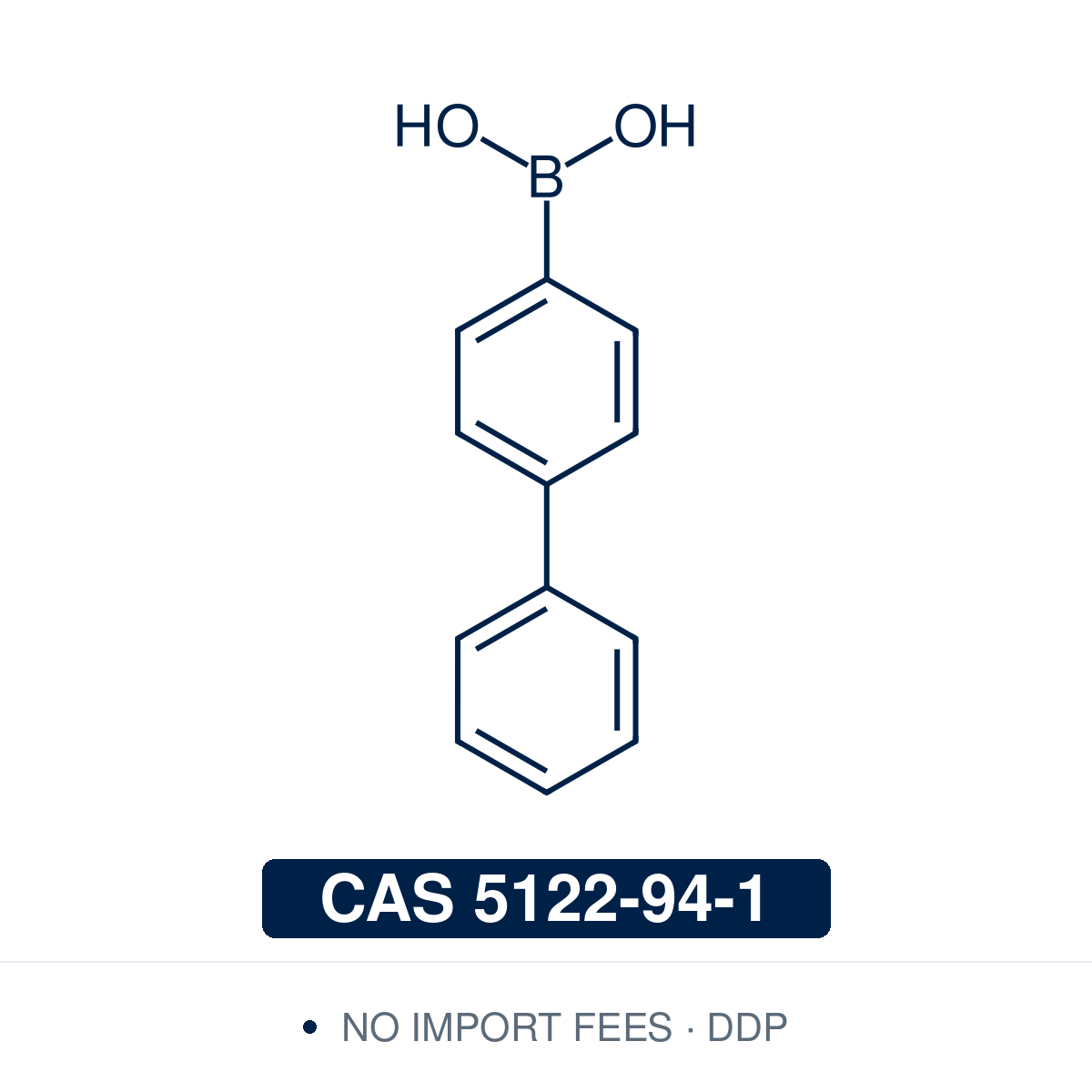
Skip to product information
1 of 3

NorrChemica™

4-Biphenylboronic Acid | CAS 5122-94-1 | ≥98%

4-Biphenylboronic Acid | CAS 5122-94-1 | ≥98%

Regular price €23,90 EUR
Regular price Sale price €23,90 EUR
Sale Sold out
Taxes included. Shipping calculated at checkout.
Weight
Quantity

Technical Specifications

CAS Number 5122-94-1
MDL Number MFCD00093311
SMILES OB(O)c1ccc(cc1)-c2ccccc2
InChI InChI=1S/C12H11BO2/c14-13(15)12-8-6-11(7-9-12)10-4-2-1-3-5-10/h1-9,14-15H
InChIKey XPEIJWZLPWNNOK-UHFFFAOYSA-N
PubChem CID 151253
Molecular Formula C₁₂H₁₁BO₂
Molecular Weight 198.03 g/mol
Melting Point 232-245 °C
Purity ≥98%
Physical Form White to off-white crystalline powder
HS Code 2931.90
Shelf Life Retest period: 36 months from date of manufacture.
Storage Conditions Store at room temperature. Protect from moisture. May contain varying amounts of boroxine anhydride.

4-Biphenylboronic acid ([1,1’-biphenyl]-4-ylboronic acid) is an extended arylboronic acid carrying a preformed biphenyl unit. In Suzuki–Miyaura cross-coupling reactions, a single coupling step extends the conjugated system by two aromatic rings, providing direct access to p-terphenyl and higher oligophenylene frameworks. This makes it a key building block in liquid crystal synthesis, where rod-shaped terphenyl mesogens form the core of nematic and smectic phases, and in organic electronics, where linear oligoaryl scaffolds serve as precursors to OLED emitters, organic photovoltaic absorbers, and charge transport materials for organic field-effect transistors. Additional applications include its use as a chemiluminescence enhancer in horseradish peroxidase-catalysed immunoassays and as a saccharide recognition element via reversible boronate–diol complexation.

Common Scientific Applications

Suzuki–Miyaura cross-coupling for terphenyl and oligoaryl synthesis — 4-biphenylboronic acid is a building block for palladium-catalysed Suzuki–Miyaura reactions, coupling with aryl and heteroaryl halides to form p-terphenyl and higher oligoaryl frameworks. Because the boronic acid already carries a preformed biphenyl unit, a single cross-coupling step extends the conjugated system by two aromatic rings, providing efficient access to linear oligophenylenes. These extended π-systems are of central importance in organic electronics, liquid crystal chemistry, and materials science (Miyaura, N.; Suzuki, A. Chem. Rev. 1995, 95, 2457).

Liquid crystal intermediates — 4-biphenylboronic acid is used in the synthesis of rod-shaped mesogens for liquid crystal displays. Suzuki coupling with halogenated arenes bearing terminal alkyl or alkoxy chains generates 4,4’’-disubstituted terphenyls, a core structural motif in nematic and smectic liquid crystal materials. The high linearity and rigidity of the terphenyl axis, combined with tuneable peripheral substituents, makes this boronic acid a preferred starting material for liquid crystal research and development (ChemicalBook, CAS 5122-94-1).

Conjugated oligomer and polymer synthesis — 4-biphenylboronic acid serves as a monomer or end-capping reagent in the synthesis of conjugated oligomers and polymers for organic light-emitting diodes (OLEDs), organic photovoltaics (OPVs), and organic field-effect transistors (OFETs). Suzuki polycondensation of diboronic acids with dihalides is one of the principal routes to poly(para-phenylene) and related conjugated polymers, and 4-biphenylboronic acid provides a bifunctional extension unit compatible with this methodology.

Thienyl–phenylene hybrid materials — ChemicalBook documents the use of 4-biphenylboronic acid in the Suzuki coupling with 2-(4-bromophenyl)thiophene and 2,5-diiodothiophene to prepare thienyl-substituted terphenyls and quinquephenyls. These thiophene–phenylene hybrid oligomers are investigated as organic semiconductors with tuneable HOMO–LUMO gaps and charge transport properties for thin-film transistor applications.

Chemiluminescence enhancement — 4-biphenylboronic acid has been identified as an effective enhancer of horseradish peroxidase (HRP)-catalysed chemiluminescent oxidation of luminol and pyridopyridazine derivatives. In comparative studies, 4-biphenylboronic acid produced enhancement comparable to 4-iodophenylboronic acid and demonstrated synergistic enhancement when combined with 4-iodophenol, increasing light emission intensity by 25% beyond the sum of individual effects. This property makes it useful in the development of ultrasensitive immunoassays and biosensor systems (Nozaki, O.; Ji, X.; Kricka, L. J. J. Biolumin. Chemilumin. 1995, 10, 151).

Saccharide recognition by capillary electrophoresis — 4-biphenylboronic acid forms reversible covalent complexes with diol groups of mono- and disaccharides, enabling molecular recognition and separation of sugars by capillary electrophoresis with chemiluminescence detection. Apparent stability constants between the boronic acid and saccharides including 1-methyl-D-glucoside, D-sucrose, and D-fructose have been determined using this system.

Shipping Destinations

  • EU & UK: Priority delivery, 2–5 business days.
  • United States (DDP): 3–7 business days, duties and taxes prepaid.
  • EFTA Countries (DDP): 3–7 business days, duties and taxes prepaid.
  • Worldwide: 7–14 business days, selected locations.

The NorrChemica™ Standard

Identity Verified — Batch-verified via analytical QC; documentation available on request.

Direct EU Distribution — Dispatched from Finland for fast delivery to EU-based laboratories.

Professional Logistics — Tracked courier shipping via UPS / Matkahuolto / Posti.

Packaging & Storage

  • Supplied in tightly sealed containers suitable for laboratory handling.
  • Store under recommended conditions as specified on the product label and SDS.
  • Retest period per lot-specific CoA / label under recommended conditions.

Technical Documentation

  • Batch-specific Certificate of Analysis (CoA) included with every order.
  • GHS-compliant Safety Data Sheet (SDS) provided with every shipment.
  • Batch documentation available for institutional procurement.
Payment: Wise (Bank Transfer) or Manual Invoice.
Disclaimer: Research Use Only (RUO) — not for human or veterinary use. Sold strictly for laboratory research and technical applications. By purchasing this item, the buyer confirms professional intent and compliance with applicable regulations.

Safety Information

GHS Pictograms
GHS07 Harmful/Irritant
Signal Word Warning
Hazard Class None — not subject to transport regulations
Transport Category Not classified as dangerous goods for transport (ADR/IATA/IMDG)
H-Statements H302 — Harmful if swallowed
H315 — Causes skin irritation
H319 — Causes serious eye irritation
H335 — May cause respiratory irritation
P-Statements P261 — Avoid breathing dust/fume/gas/mist/vapours/spray
P264 — Wash thoroughly after handling
P271 — Use only outdoors or in a well-ventilated area
P301 + P312 — IF SWALLOWED: Call a POISON CENTER/doctor if you feel unwell
P302 + P352 — IF ON SKIN: Wash with plenty of water
P305 + P351 + P338 — IF IN EYES: Rinse cautiously with water for several minutes. Remove contact lenses, if present and easy to do. Continue rinsing

NorrChemica™ is a Finnish supplier of niche research reagents — focused on reliable EU distribution, transparent analytical documentation, and specialist technical support.

View full details