NorrChemica™
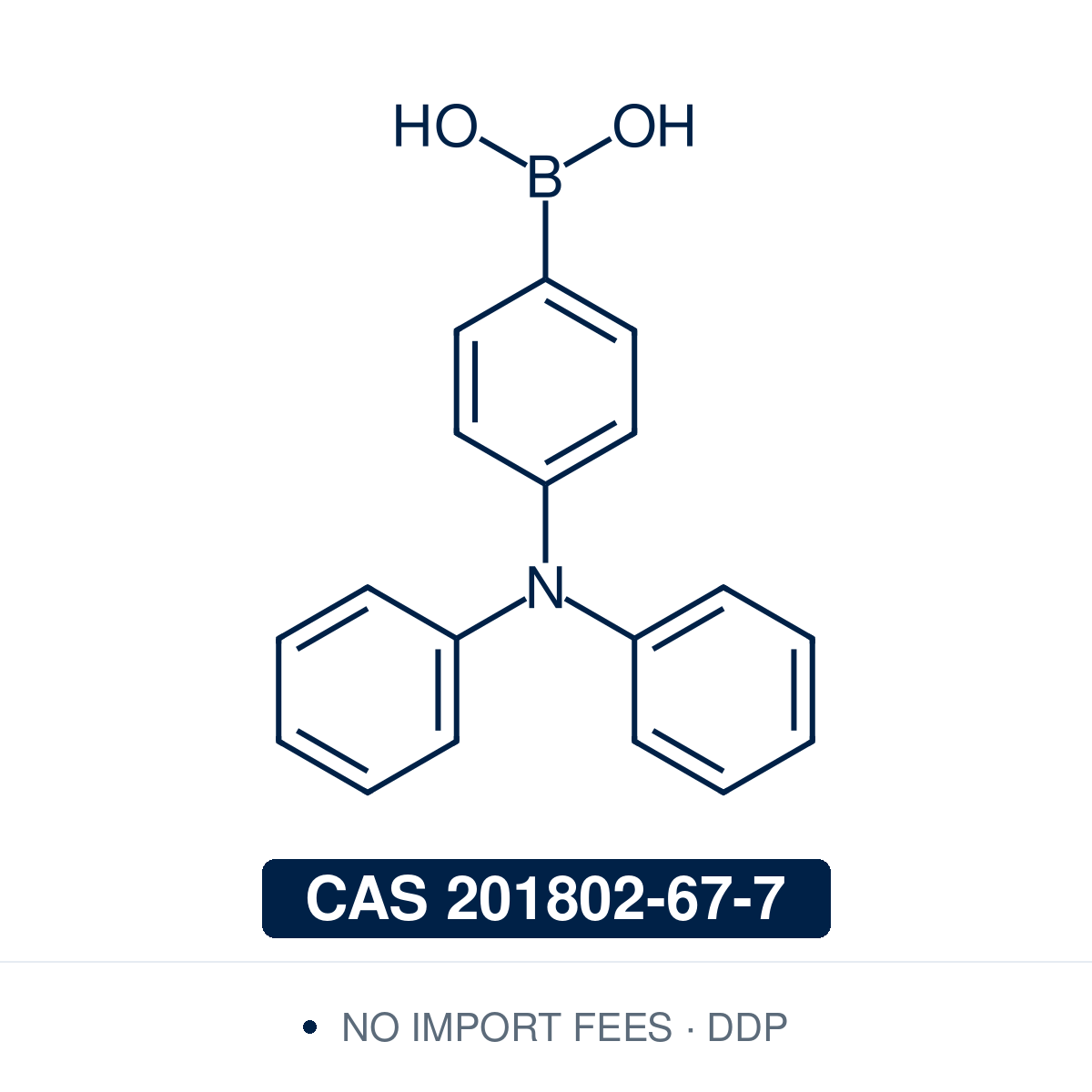
Triphenylamine-4-boronic Acid
Triphenylamine-4-boronic Acid | CAS 201802-67-7 | ≥98%
Couldn't load pickup availability
Technical Specifications
| CAS Number | 201802-67-7 |
| EC / EINECS Number | 627-214-2 |
| MDL Number | MFCD06798117 |
| SMILES | B(C1=CC=C(C=C1)N(C2=CC=CC=C2)C3=CC=CC=C3)(O)O |
| InChI | InChI=1S/C18H16BNO2/c21-19(22)15-11-13-18(14-12-15)20(16-7-3-1-4-8-16)17-9-5-2-6-10-17/h1-14,21-22H |
| InChIKey | TWWQCBRELPOMER-UHFFFAOYSA-N |
| PubChem CID | 12166934 |
| Molecular Formula | C₁₈H₁₆BNO₂ |
| Molecular Weight | 289.14 g/mol |
| Melting Point | 110-115 °C |
| Solubility | Soluble in DMF, DMSO, insoluble in water |
| Purity | ≥98%. May contain varying amounts of the corresponding boronic acid anhydrides |
| Physical Form | White to light green crystalline powder |
| HS Code | 2931.90 |
| Shelf Life | Retest period: 36 months from date of manufacture |
| Storage Conditions | Store in a cool, dry place in a tightly sealed container |
Product Description & Scientific Applications
4-(Diphenylamino)phenylboronic acid (triphenylamine-4-boronic acid, 4-DPBA) is an arylboronic acid that installs an electron-rich triphenylamine donor into extended π-conjugated architectures by Suzuki–Miyaura coupling. The triphenylamine moiety is a propeller-shaped donor used in hole-transporting and emissive organic electronic materials; its geometry reduces π-stacking and supports amorphous film formation.
May contain small amounts of the cyclic anhydride 4-(diphenylamino)phenylboroxine. Under aqueous or basic coupling conditions the two forms re-equilibrate and the impact on yield is minor.
Applications and Reactions
Suzuki–Miyaura coupling: couples with aryl and heteroaryl halides under Pd catalysis to give biaryls bearing the triphenylamine donor. The electron-rich diphenylamino group builds extended π-conjugated systems including p-quaterphenyl, oligoarylene, and optoelectronic donor architectures.
End-capping of oligofluorenes for blue OLED / PLED materials: Suzuki coupling at fluorene chain termini installs the diphenylamino group as a hole-transporting end-cap, lowering the first ionisation potential, enhancing thermal stability, and inducing amorphous morphological stability of blue-emitting fluorene oligomers.
Perylene dye functionalisation: Suzuki coupling of multi-brominated perylene monoimide cores gives tri- and tetra-(triphenylamine)-substituted perylene monoimides with broad absorption extending to ~750 nm. The corresponding perylene monoanhydrides serve as light-harvesting sensitisers in dye-sensitised solar cells, the tetra-substituted derivative giving the highest power conversion efficiency in that family.
Solid-state blue emitters with dimesitylboryl acceptors: Suzuki coupling installs the diphenylamino donor onto p-quaterphenyl frameworks bearing a bulky dimesitylboryl acceptor, giving twisted bipolar D–A architectures with intramolecular charge-transfer emission, large Stokes shift, suppressed π-stacking, high thermal stability, and bright blue fluorescence with high solid-state quantum yields.
Multiphoton blue photoluminescence and lasing: diphenylamino end-caps on ladder-type oligo(p-phenylene) scaffolds give strong multiphoton-excited (two- to five-photon) upconverted blue photoluminescence and efficient blue lasing.
Suzuki polycondensation and end-capping for conjugated polymers: as a monofunctional building block or end-capper, it introduces triphenylamine units into conjugated polymer backbones, side chains, or termini. These p-type, hole-transporting polymers are investigated as active or transport layers in OLEDs, OFETs, and bulk-heterojunction organic photovoltaics.
Protodeboronation and condition sensitivity: stability under aqueous-basic conditions depends on substituent, pH, base, concentration, and temperature. For electron-rich triarylamine substrates, conditions and exposure time are matched to the coupling partner; slow-release boron formats suit prolonged aqueous-basic exposure.
Protected boronate ester forms: the pinacol (Bpin) ester is commercially available as an electron-rich protected form for handling and Suzuki–Miyaura coupling. MIDA boronates and potassium organotrifluoroborates are slow-release formats for chromatographic handling, shelf stability, or controlled-release coupling.
Further Reading
For boronic acids, boronic esters, protodeboronation, boroxine content, and Suzuki–Miyaura reagent selection, see NorrChemica's Lab Journal guide: Choosing Your Boron Source for Suzuki–Miyaura Coupling.
Shipping Destinations
- EU & UK: Priority delivery, 2–5 business days.
- United States (DDP): 3–7 business days, duties and taxes prepaid.
- EFTA Countries (DDP): 3–7 business days, duties and taxes prepaid.
- Worldwide: 7–14 business days, selected locations.
Safety Information
| GHS Pictograms |

|
| Signal Word | Warning |
| Hazard Class | None — not subject to transport regulations |
| Transport Category | Not classified as dangerous goods for transport (ADR/IATA/IMDG) |
| H-Statements | H315 - H319 - H335 |
| P-Statements | P261 - P264 - P271 - P280 - P302+P352 - P304+P340 - P305+P351+P338 - P332+P313 - P337+P313 - P362+P364 - P501 |
Documentation
| Safety Data Sheet | Download PDF |