NorrChemica™
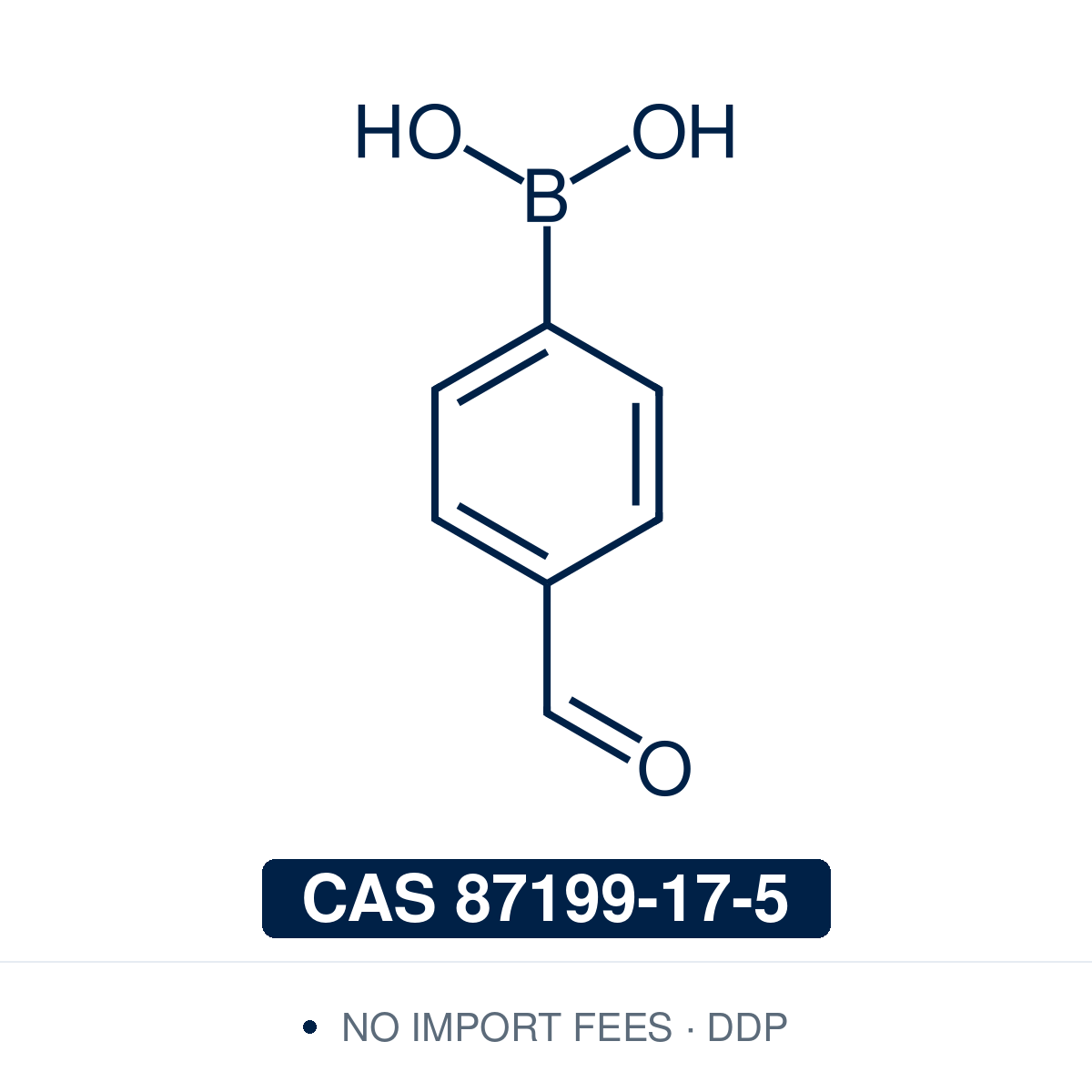
4-Formylphenylboronic Acid
4-Formylphenylboronic Acid | CAS 87199-17-5 | ≥98%
Couldn't load pickup availability
Technical Specifications
| CAS Number | 87199-17-5 |
| EC / EINECS Number | 617-982-7 |
| MDL Number | MFCD00151823 |
| SMILES | B(C1=CC=C(C=C1)C=O)(O)O |
| InChI | InChI=1S/C7H7BO3/c9-5-6-1-3-7(4-2-6)8(10)11/h1-5,10-11H |
| InChIKey | VXWBQOJISHAKKM-UHFFFAOYSA-N |
| PubChem CID | 591073 |
| Molecular Formula | C₇H₇BO₃ |
| Molecular Weight | 149.94 g/mol |
| Melting Point | 237–242 °C (lit.) (Sigma) |
| Solubility | Soluble in alcoholic solvents, acetonitrile, DMF, DMSO |
| Purity | ≥98%. May contain varying amounts of the corresponding boronic acid anhydrides |
| Physical Form | White to light yellow crystalline powder |
| HS Code | 2931.90 |
| Shelf Life | Retest period: 36 months from date of manufacture |
| Storage Conditions | Store in a cool, dry place in a tightly sealed container |
Product Description & Scientific Applications
4-Formylphenylboronic acid (4-boronobenzaldehyde; 4-(dihydroxyboryl)benzaldehyde; p-formylphenylboronic acid) is a bifunctional arylboronic acid bearing a formyl group para to the boronic acid. The two groups are mutually compatible and can be addressed independently — the boronic acid in C–C cross-coupling, the aldehyde in reductive amination and imine formation — so a single compact reagent supports modular, sequential assembly. The para-formyl group is moderately electron-withdrawing (σp ≈ +0.42), which lowers the boronic acid pKa relative to phenylboronic acid (≈ 8.8–9.0) and favours boronate (diol-binding) formation at lower pH — useful for saccharide and catecholamine recognition. It serves as a building block across pharmaceutical, materials, sensor, and dye-sensitised solar-cell research.
May contain small amounts of the cyclic anhydride 4-formylphenylboroxine. Under aqueous or basic coupling conditions the two forms re-equilibrate and the impact on yield is minor.
Applications and Reactions
Suzuki–Miyaura cross-coupling: installs the 4-formylphenyl group into biaryls and heteroaryls, with reactions proceeding even in aqueous media. The aldehyde survives the coupling intact and is then a handle for reductive amination or imine (Schiff-base) condensation.
Ketone synthesis and oxidative coupling: palladacycle-catalysed cross-coupling with carboxylic anhydrides or acyl chlorides gives aryl ketones; the compound also serves as the aryl nucleophile in palladium-catalysed aerobic oxidative cross-coupling.
ipso-substitution of the boron: the C–B bond can be replaced while the aldehyde is retained — copper-mediated ligandless aerobic fluoroalkylation with (per)fluoroalkyl iodides gives 4-(perfluoroalkyl)benzaldehydes; copper-catalysed ipso-nitration gives 4-nitrobenzaldehyde; ligand-free copper-catalysed coupling with nitroarenes furnishes unsymmetrical diaryl ethers (C–O bond, the oxygen derived from water); and chemoselective oxidation of the C–B bond gives 4-hydroxybenzaldehyde.
Hantzsch dihydropyridine synthesis: serves as the aldehyde (carbonyl) component in triethylamine-catalysed three-component Hantzsch condensations, giving boronic-acid-substituted 1,4-dihydropyridines that retain a coupling handle.
Scaffold and macrocycle construction: serves as the aryl source in Suzuki aryl–aryl coupling on the upper rim of hexahomotrioxacalix[3]arene and in rhodium-catalysed arylative cyclisation of 1,5-enynes to cyclopentenes and spiro-cyclopentenes.
Biocatalytic alkene cleavage: a reagent in the oxidative mono-cleavage of dialkenes catalysed by the fungus Trametes hirsuta.
Pharmaceutical building block: a Suzuki building block for biaryl pharmaceutical intermediates, including the angiotensin-II (AT1) receptor antagonist telmisartan, and for a reported protein-synthesis inhibitor active against Gram-positive bacteria.
Serine-hydrolase engagement and enzyme stabilisation: like other arylboronic acids it reversibly engages the catalytic serine of serine hydrolases — the broader arylboronic-acid chemistry behind reversible inhibition of serine β-lactamases, including the class C enzyme AmpC, in antibiotic-resistance research. The same reversible binding makes it a preferred industrial stabiliser for proteases and lipases in liquid-detergent formulations, markedly more effective than boric acid, suppressing autolysis during storage and releasing the enzyme on dilution in use.
Diol recognition and biosensors: the boronic acid binds 1,2- and 1,3-diols, giving a recognition element for saccharides (glucose, fructose) and catecholamines, while the aldehyde anchors the molecule to amine-functionalised supports by Schiff-base condensation (often followed by reduction). Both handles are used together to build boronic-acid-functionalised self-assembled monolayers on electrodes — for example a cysteamine monolayer grafted with the reagent for dopamine sensing — and to functionalise magnetic nanoparticles for catecholamine capture.
Dynamic covalent and stimuli-responsive materials: the aldehyde forms reversible imines and acylhydrazones while the boronic acid forms reversible boronate esters, giving doubly dynamic networks; combined with diol- or hydrazide-bearing polymers it yields self-healing gels responsive to pH, glucose, and redox state.Dye-sensitised solar cells: used to prepare push–pull (D–π–A) sensitisers built on dithiafulvenyl electron-donor units, where the boronic acid builds the conjugated π-bridge by Suzuki coupling and the aldehyde is a condensation handle.
Further Reading
For boronic acids, boronic esters, protodeboronation, boroxine content, and Suzuki–Miyaura reagent selection, see NorrChemica's Lab Journal guide: Choosing Your Boron Source for Suzuki–Miyaura Coupling.
Shipping Destinations
- EU & UK: Priority delivery, 2–5 business days.
- United States (DDP): 3–7 business days, duties and taxes prepaid.
- EFTA Countries (DDP): 3–7 business days, duties and taxes prepaid.
- Worldwide: 7–14 business days, selected locations.
Safety Information
| GHS Pictograms |

|
| Signal Word | Warning |
| Hazard Class | None — not subject to transport regulations |
| Transport Category | Not classified as dangerous goods for transport (ADR/IATA/IMDG) |
| H-Statements | H317 |
| P-Statements | P261 - P272 - P280 - P302+P352 - P333+P313 - P362+P364 - P501 |
Documentation
| Safety Data Sheet | Download PDF |