NorrChemica™
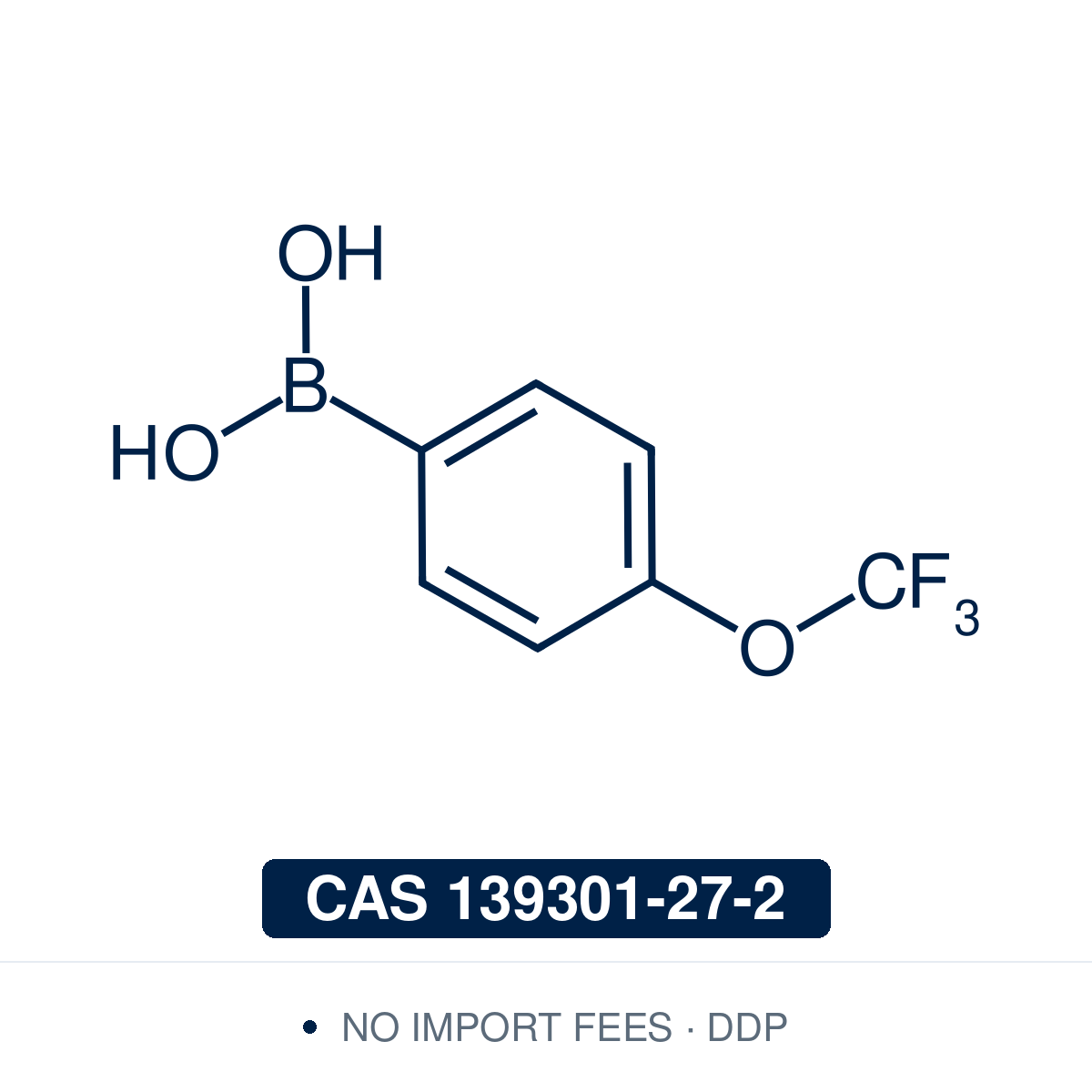
4-Trifluoromethoxyphenylboronic Acid
4-Trifluoromethoxyphenylboronic Acid | CAS 139301-27-2 | ≥98%
Couldn't load pickup availability
Technical Specifications
| CAS Number | 139301-27-2 |
| EC / EINECS Number | 642-479-4 |
| MDL Number | MFCD01074648 |
| SMILES | B(C1=CC=C(C=C1)OC(F)(F)F)(O)O |
| InChI | InChI=1S/C7H6BF3O3/c9-7(10,11)14-6-3-1-5(2-4-6)8(12)13/h1-4,12-13H |
| InChIKey | HUOFUOCSQCYFPW-UHFFFAOYSA-N |
| PubChem CID | 2734386 |
| Molecular Formula | C₇H₆BF₃O₃ |
| Molecular Weight | 205.93 g/mol |
| Melting Point | 123–127 °C (lit.) |
| Solubility | Slightly soluble in water; soluble in alcoholic solvents, acetonitrile, DMF, DMSO |
| Purity | ≥98%. May contain varying amounts of the corresponding boronic acid anhydrides |
| Physical Form | White to off-white crystalline powder |
| HS Code | 2931.90 |
| Shelf Life | Retest period: 36 months from date of manufacture |
| Storage Conditions | Store in a cool, dry place in a tightly sealed container |
Product Description & Scientific Applications
4-(Trifluoromethoxy)phenylboronic acid (4-(trifluoromethoxy)benzeneboronic acid) is a fluorinated arylboronic acid bearing the trifluoromethoxy (OCF₃) group at the para position. OCF₃ is moderately electron-withdrawing and highly lipophilic, a useful 4-(trifluoromethoxy)phenyl substituent for medicinal-chemistry, agrochemical, and fluorinated-materials research.
May contain small amounts of the cyclic anhydride 4-(trifluoromethoxy)phenylboroxine. Under aqueous or basic coupling conditions the two forms re-equilibrate and the impact on yield is minor.
Applications and Reactions
- Suzuki–Miyaura coupling: couples with aryl, heteroaryl, and alkenyl halides or pseudohalides under Pd catalysis to install the 4-(trifluoromethoxy)phenyl fragment onto biaryl, heterobiaryl, and styrenyl scaffolds.
- Boronate–water equilibrium and acidity: pKa 8.11 ± 0.04 (spectrophotometric) and 8.03 ± 0.07 (potentiometric), roughly 0.7 units below the parent phenylboronic acid (pKa ≈ 8.8) but less acidic than the 4-trifluoromethyl analogue (7.82 / 7.90). The narrower gap relative to CF₃ reflects partial oxygen lone-pair donation attenuating the inductive effect of OCF₃.
- Liquid-crystal building block: Suzuki–Miyaura coupling via the 1,3,2-dioxaborinane or pinacol boronate ester installs the 4-(trifluoromethoxy)phenyl fragment into biphenyl, ethynyl-biphenyl, and ester-linked rod-like mesogenic cores. Infrared-oriented liquid-crystal studies on these intermediates evaluate mesomorphic behaviour, phase-transition temperatures, refractive indices, birefringence, and mid-wave infrared properties.
- Perovskite solar-cell interface modifier: investigated as a fluorinated phenylboronic-acid modifier at the perovskite/C₆₀ interface in inverted (CsFAMA)Pb(IBr)₃ cells, alongside its 4-trifluoromethyl analogue. Modifiers of this class passivate interfacial defects, suppress non-radiative recombination, enhance charge extraction, and reduce trap-state density; the 4-trifluoromethyl analogue showed stronger device performance than the 4-(trifluoromethoxy) analogue.
- Chan–Lam coupling: the boronic acid acts as the aryl donor in copper-mediated C–N, C–O, and C–S bond formation under aerobic conditions, transferring the 4-(trifluoromethoxy)phenyl group to amines, anilines, amides, phenols, alcohols, or thiols.
- Petasis borono-Mannich reaction: arylboronic acids act as aryl donors in three-component reactions with an amine and an aldehyde, glyoxylic acid, or α-hydroxy aldehyde to give arylated amines, α-aryl glycine derivatives, or β-amino alcohol scaffolds.
- Protodeboronation and condition sensitivity: stability under aqueous-basic conditions depends on substituent, pH, base, concentration, and temperature; pH-controlled speciation influences decomposition. Prolonged warm aqueous-basic exposure is managed by base, concentration, temperature, and time; slow-release boron formats suit extended coupling.
- Protected boronate ester forms: the pinacol ester is commercially available as a protected form for handling and Suzuki–Miyaura coupling. MIDA boronates and potassium organotrifluoroborates improve shelf stability and enable controlled-release coupling.
Further Reading
For boronic acids, boronic esters, protodeboronation, boroxine content, and Suzuki–Miyaura reagent selection, see NorrChemica's Lab Journal guide: Choosing Your Boron Source for Suzuki–Miyaura Coupling.
Shipping Destinations
- EU & UK: Priority delivery, 2–5 business days.
- United States (DDP): 3–7 business days, duties and taxes prepaid.
- EFTA Countries (DDP): 3–7 business days, duties and taxes prepaid.
- Worldwide: 7–14 business days, selected locations.
Safety Information
| GHS Pictograms |

|
| Signal Word | Warning |
| Hazard Class | None — not subject to transport regulations |
| Transport Category | Not classified as dangerous goods for transport (ADR/IATA/IMDG) |
| H-Statements | H315 - H319 - H335 |
| P-Statements | P261 - P264 - P271 - P280 - P302+P352 - P304+P340 - P305+P351+P338 - P332+P313 - P337+P313 - P362+P364 - P501 |
Documentation
| Safety Data Sheet | Download PDF |