NorrChemica™
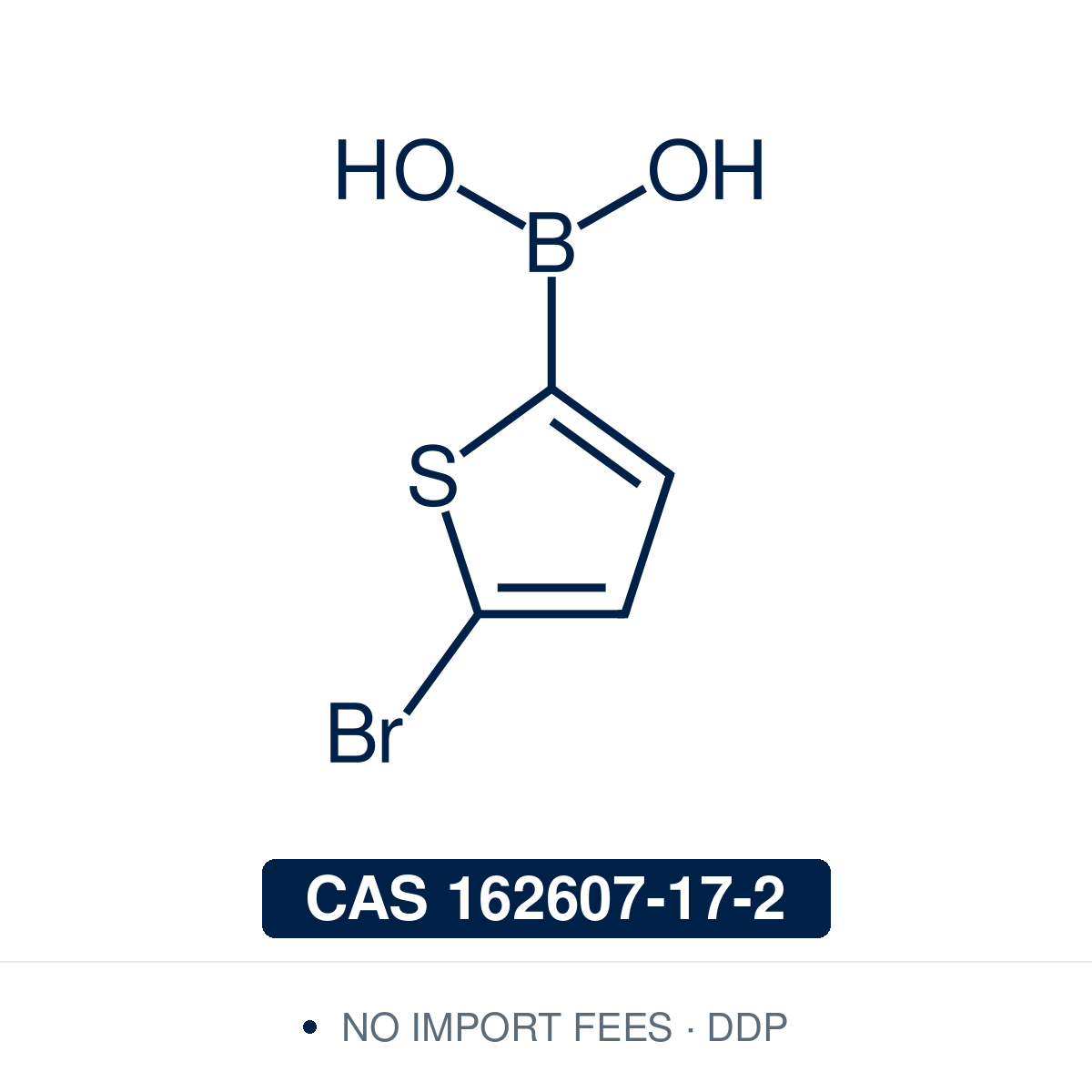
(5-Bromothiophen-2-yl)boronic Acid | CAS 162607-17-2 | ≥96%
Couldn't load pickup availability
Technical Specifications
| CAS Number | 162607-17-2 |
| EC / EINECS Number | 678-207-6 |
| MDL Number | MFCD02094028 |
| SMILES | OB(O)C1=CC=C(Br)S1 |
| InChI | InChI=1S/C4H4BBrO2S/c6-4-2-1-3(9-4)5(7)8/h1-2,7-8H |
| InChIKey | USJPOBDLWVCPGG-UHFFFAOYSA-N |
| PubChem CID | 2734319 |
| Molecular Formula | C₄H₄BBrO₂S |
| Molecular Weight | 206.85 g/mol |
| Melting Point | 95–100 °C |
| Solubility | Soluble in alcoholic solvents, acetonitrile, DMF, DMSO |
| Purity | ≥98% |
| Physical Form | White to off-white crystalline powder |
| HS Code | 2931.90 |
| Shelf Life | 36 months under recommended storage conditions |
| Storage Conditions | Store at –20°C in a tightly sealed container. Protect from moisture and light. May contain varying amounts of boroxine anhydride |
(5-Bromothiophen-2-yl)boronic acid (5-bromo-2-thienylboronic acid, 5-bromothiophene-2-boronic acid) is a bifunctional heteroaromatic boronic acid bearing a boronic acid at C2 and a bromine at C5 of the thiophene ring. The orthogonal reactivity of these two functional groups — the boronic acid reactive under palladium-catalysed Suzuki conditions, the bromide reactive under Sonogashira, Buchwald–Hartwig, or a second Suzuki coupling — enables modular, step-by-step construction of complex 2,5-disubstituted thiophene frameworks from a single starting material. This compound is documented in the synthesis of ratanhine, benzotriazole-containing DSSC sensitizers, meso-polyarylamide–BODIPY hybrids, and ethynylarylboronates via microwave-assisted Sonogashira coupling. It is also a key monomer for regioregular Suzuki polycondensation in the preparation of conjugated polymers for organic field-effect transistors and organic photovoltaics. This product contains varying amounts of the corresponding boronic acid anhydride.
Common Scientific Applications
Suzuki–Miyaura Cross-Coupling: Bifunctional Building Block
- Widely applied bifunctional heteroarylboronic acid for palladium-catalysed Suzuki–Miyaura cross-coupling — the boronic acid at C2 reacts efficiently with aryl and heteroaryl halides under standard conditions, introducing one aryl partner at C2 while the C5 bromide remains fully intact and available for a second independent transformation. This orthogonal reactivity enables modular, step-by-step construction of complex 2,5-disubstituted thiophene frameworks from a single starting material, avoiding the need for separate regioselective thiophene functionalisation steps.
- Compatible with a broad range of palladium catalyst systems, bases, and solvents including aqueous, microwave-assisted, and flow chemistry conditions. The retained C5–Br after Suzuki coupling at C2 can subsequently be engaged in a second Suzuki coupling, Sonogashira alkynylation, Buchwald–Hartwig amination, or carbonylative coupling — providing direct access to a diverse range of 2,5-disubstituted thiophene products from one bifunctional precursor.
Natural Product Synthesis: Ratanhine
- Documented Suzuki–Miyaura coupling partner in the synthesis of ratanhine — a naturally occurring acetylenic compound isolated from Krameria species with reported antifungal and antibacterial biological activity. The boronic acid at C2 provides the key C–C bond-forming step in the ratanhine synthesis, establishing the thienyl-aryl connectivity of the natural product scaffold with high efficiency and functional group tolerance.
DSSC Sensitizers & BODIPY Hybrids for Photovoltaics & Imaging
- Documented building block in Suzuki coupling reactions for the construction of benzotriazole-containing organic sensitizers for dye-sensitised solar cells (DSSCs) — benzotriazole is a widely used electron-withdrawing acceptor unit in D-π-A DSSC dye architectures, and the 5-bromothiophen-2-yl boronic acid provides the thienyl π-bridge unit that connects the donor and acceptor components of the dye scaffold via sequential cross-coupling at C2 and C5.
- Applied in the synthesis of meso-polyarylamide–BODIPY hybrid materials — BODIPY (boron-dipyrromethene) dyes are among the brightest and most photostable fluorescent dyes known, and polyarylamide–BODIPY hybrids combining the 5-bromothienyl unit are of direct interest for fluorescence imaging, photosensitiser, and light-harvesting applications. The bifunctional boronic acid enables precise incorporation of the thienyl linker between the polyarylamide backbone and the BODIPY chromophore.
Sonogashira Coupling & Ethynylarylboronate Synthesis
- Applied in microwave-assisted Sonogashira reactions exploiting the C5–Br as the electrophilic coupling partner — the boronic acid at C2 is retained intact under standard Sonogashira conditions (Pd/Cu, amine base), enabling the synthesis of 5-ethynylthiophen-2-ylboronic acid derivatives and ethynylarylboronates. These alkyne-bearing boronic acids serve as versatile bifunctional monomers for further downstream Suzuki coupling, click chemistry (CuAAC azide-alkyne cycloaddition), or incorporation into conjugated polymer backbones.
π-Conjugated Materials & Organic Electronics
- Key bifunctional monomer for the synthesis of 2,5-disubstituted thiophene-containing π-conjugated oligomers and polymers — the regiospecific C2-boronic acid / C5-bromide pattern enables regioregular Suzuki polycondensation with complementary bifunctional monomers, giving conjugated polymers with well-defined donor–acceptor alternation and maximised π–π stacking for high charge-carrier mobility in organic field-effect transistors (OFETs) and organic photovoltaics (OPVs). The thiophene ring is present in approved drugs including clopidogrel and rivaroxaban, making this compound equally relevant to pharmaceutical fragment synthesis alongside its materials science applications.
Shipping Destinations
- EU & UK: Priority delivery, 2–5 business days.
- United States (DDP): 3–7 business days, duties and taxes prepaid.
- EFTA Countries (DDP): 3–7 business days, duties and taxes prepaid.
- Worldwide: 7–14 business days, selected locations.
The NorrChemica™ Standard
Identity Verified — Batch-verified via analytical QC; documentation available on request.
Direct EU Distribution — Dispatched from Finland for fast delivery to EU-based laboratories.
Professional Logistics — Tracked courier shipping via UPS / Matkahuolto / Posti.
Packaging & Storage
- Supplied in tightly sealed containers suitable for laboratory handling.
- Store under recommended conditions as specified on the product label and SDS.
- Retest period per lot-specific CoA / label under recommended conditions.
Technical Documentation
- Batch-specific Certificate of Analysis (CoA) included with every order.
- GHS-compliant Safety Data Sheet (SDS) provided with every shipment.
- Batch documentation available for institutional procurement.
| Payment: Wise (Bank Transfer) or Manual Invoice. |
| Disclaimer: Research Use Only (RUO) — not for human or veterinary use. Sold strictly for laboratory research and technical applications. By purchasing this item, the buyer confirms professional intent and compliance with applicable regulations. |
Safety Information
| GHS Pictograms |
|
| Signal Word | Warning |
| Hazard Class | Not classified as dangerous for transport (ADR/IATA/IMDG) |
| Transport Category | Not regulated |
| H-Statements | H302 (Harmful if swallowed), H315 (Causes skin irritation), H319 (Causes serious eye irritation), H335 (May cause respiratory irritation) |
| P-Statements | P261, P264, P271, P301+P312, P302+P352, P305+P351+P338, P330, P501 |
NorrChemica™ is a Finnish supplier of niche research reagents — focused on reliable EU distribution, transparent analytical documentation, and specialist technical support.
Share