NorrChemica™
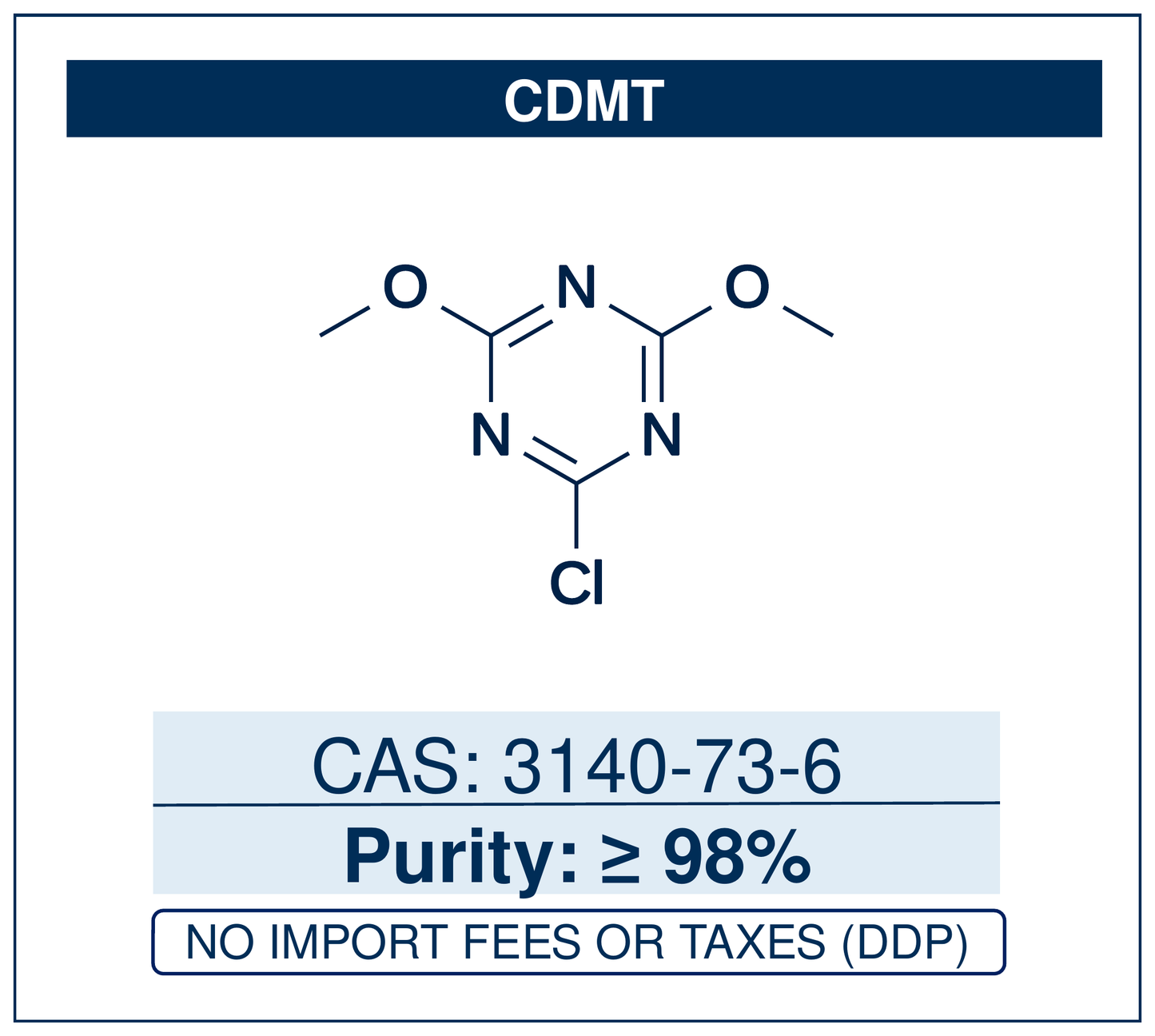
CDMT | CAS 3140-73-6 | ≥98%
CDMT | CAS 3140-73-6 | ≥98%
Couldn't load pickup availability
Technical Specifications
| CAS Number | 3140-73-6 |
| EC / EINECS Number | 221-541-0 |
| MDL Number | MFCD00075607 |
| SMILES | COC1=NC(=NC(=N1)Cl)OC |
| InChI | InChI=1S/C5H6ClN3O2/c1-10-4-7-3(6)8-5(9-4)11-2/h1-2H3 |
| InChIKey | GPIQOFWTZXXOOV-UHFFFAOYSA-N |
| PubChem CID | 18450 |
| Molecular Formula | C₅H₆ClN₃O₂ |
| Molecular Weight | 175.57 g/mol |
| Melting Point | 71–74 °C |
| Solubility | Soluble in THF, DCM, and acetone. Expected to be soluble in DMSO and DMF. Sparingly soluble in water. |
| Purity | ≥98% |
| Physical Form | White to off-white crystalline powder |
| HS Code | 2933.69 |
| Shelf Life | Retest period: 36 months from date of manufacture |
| Storage Conditions | Store in a cool, dry place in a tightly sealed container, protected from moisture. |
Product Description & Scientific Applications
CDMT — 2-chloro-4,6-dimethoxy-1,3,5-triazine — is a triazine-based condensing reagent for amide, ester and peptide bond formation in solution. With a tertiary amine base such as N-methylmorpholine (NMM), it activates carboxylic acids through a 2-acyloxy-4,6-dimethoxy-1,3,5-triazine active ester, which is then aminolysed or alcoholysed in the same pot to give amides or esters. The same activation chemistry underlies DMTMM, the pre-formed triazinylammonium coupling salt obtained from CDMT and NMM. CDMT is supplied as a white crystalline solid, soluble in many organic solvents; it is moisture-sensitive and should be stored dry.
Common Scientific Applications
- Amide bond formation (CDMT/NMM): CDMT and a tertiary amine base, typically N-methylmorpholine, convert a carboxylic acid into a 2-acyloxy-4,6-dimethoxytriazine active ester that is aminolysed in situ, giving the amide in a one-pot procedure.
- Peptide synthesis: couples N-protected amino acids in solution under mild conditions, with low epimerisation in suitable non-hindered cases.
- Esterification: the same active ester acylates alcohols to give esters; added magnesium chloride is often used to broaden the alcohol scope.
- DMTMM and triazinylammonium salts: reaction with N-methylmorpholine gives DMTMM, the pre-formed water- and protic-solvent-compatible coupling salt; other tertiary amines give the corresponding 2-(4,6-dimethoxytriazinyl)trialkylammonium reagents.
- Enantiodifferentiating coupling: with selected chiral tertiary amines, CDMT forms chiral triazinylammonium species used for enantiodifferentiating coupling of racemic N-protected amino acids.
- Carboxylic-acid reduction: beyond acylation, CDMT activates carboxylic acids for reduction to the corresponding aldehydes or alcohols via the triazine active ester.
Further Reading
For guidance on selecting between carbodiimides, aminium/uronium salts, phosphonium salts and other reagent classes for amide and peptide bond formation, see NorrChemica's Lab Journal guide: Choosing a Coupling Reagent for Amide and Peptide Bond Formation.
Shipping Destinations
- EU & UK only: 3–7 business days.
Safety Information
| GHS Pictograms |


|
| Signal Word | Danger |
| Hazard Class | DG, UN 1759, Class 8, PG II |
| Transport Category | Class 8, PG II (ADR/IATA/IMDG) |
| H-Statements | H314 - H317 - H318 - H401 - H411 |
| P-Statements | P260 - P261 - P264 - P272 - P273 - P280 - P301+P330+P331 - P303+P361+P353 - P304+P340 - P305+P351+P338 - P310 - P333+P313 - P362+P364 - P363 - P391 - P405 - P501 |