NorrChemica™
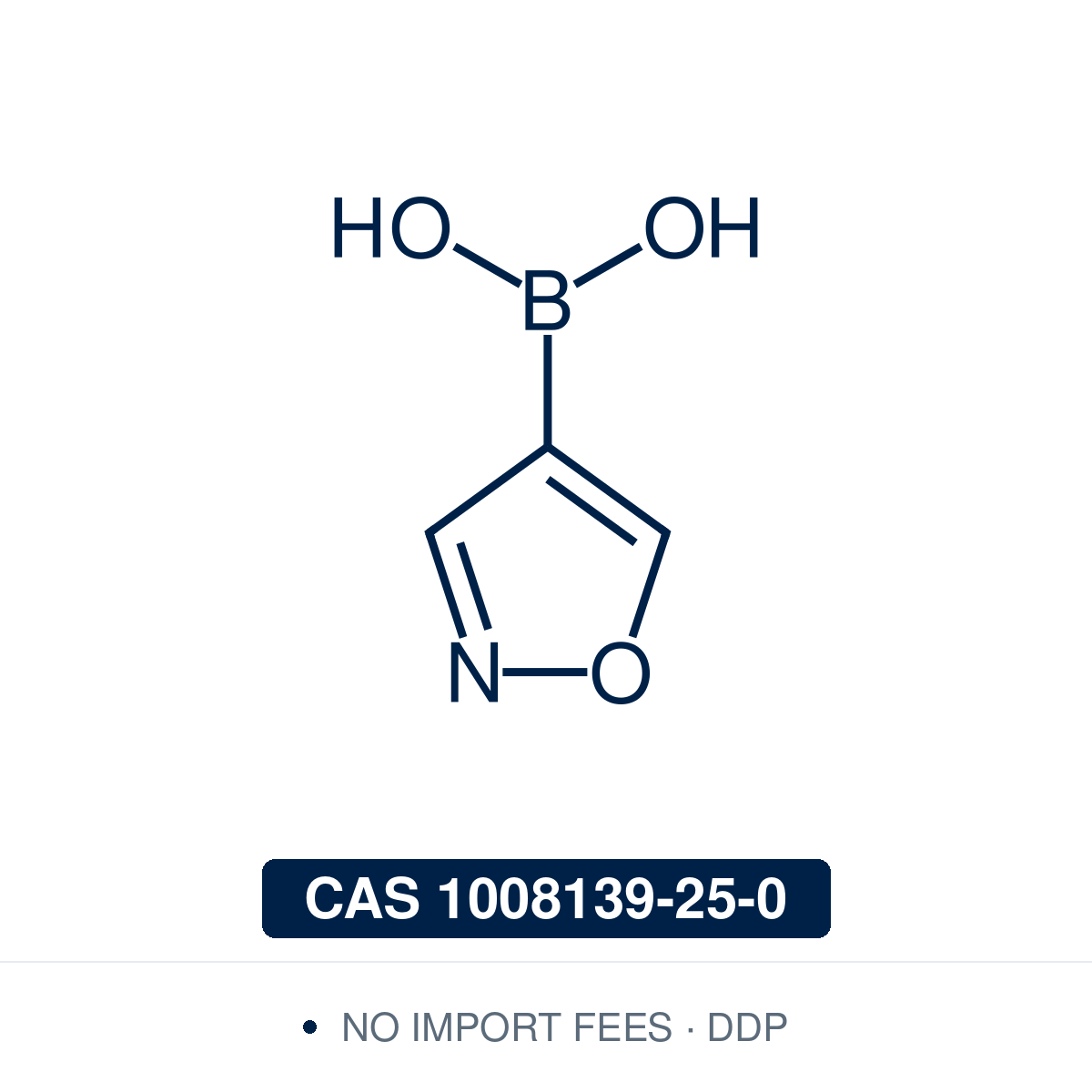
Isoxazol-4-ylboronic Acid
Isoxazol-4-ylboronic Acid | CAS 1008139-25-0 | ≥98%
Couldn't load pickup availability
Technical Specifications
| CAS Number | 1008139-25-0 |
| EC / EINECS Number | 696-473-1 |
| MDL Number | MFCD06657892 |
| SMILES | B(C1=CON=C1)(O)O |
| InChI | InChI=1S/C3H4BNO3/c6-4(7)3-1-5-8-2-3/h1-2,6-7H |
| InChIKey | HANPIZQMFCWPKY-UHFFFAOYSA-N |
| PubChem CID | 46739468 |
| Molecular Formula | C₃H₄BNO₃ |
| Molecular Weight | 112.88 g/mol |
| Solubility | Soluble in alcoholic solvents, acetonitrile, DMF, DMSO |
| Purity | ≥98%. May contain varying amounts of the corresponding boronic acid anhydrides. |
| Physical Form | White to beige crystalline powder |
| HS Code | 2931.90 |
| Shelf Life | Retest period: 36 months from date of manufacture |
| Storage Conditions | Store refrigerated (2–8 °C) in a tightly sealed container |
Product Description & Scientific Applications
Isoxazol-4-ylboronic acid (isoxazole-4-boronic acid; (1,2-oxazol-4-yl)boronic acid; 4-isoxazolylboronic acid) is a heteroaromatic boronic acid bearing boron at the 4-position of the isoxazole (1,2-oxazole) ring.
May contain small amounts of the cyclic anhydride isoxazol-4-ylboroxine. Under aqueous or basic coupling conditions the two forms re-equilibrate and the impact on yield is minor.
Stability and protodeboronation: with boron at C-4 — remote from the ring O and N — it is not one of the fast-decomposing heteroatom-adjacent heteroaryl boronic acids (such as 2-pyridyl or 2-thienyl). It is used directly in DNA-compatible cyanomethylation, where productive chemistry proceeds through Suzuki coupling followed by base-promoted isoxazole fragmentation. As for boronic acids generally, protodeboronation is promoted by strong base, elevated temperature, and prolonged aqueous exposure. Supplied for cold storage under inert atmosphere; a pinacol ester or trifluoroborate is the usual surrogate where a sensitive boronic acid needs extra stability.
Applications and Reactions
Suzuki–Miyaura cross-coupling: under milder bases and lower temperatures the intact 4-isoxazolyl group transfers to aryl, heteroaryl, and alkenyl halides or triflates to give 4-substituted isoxazoles; stronger base diverts the reagent into the cyanomethylation fragmentation below.
Tandem cyanomethylation: a one-pot Pd-catalysed domino sequence — Suzuki coupling, base-promoted isoxazole fragmentation, then deformylation — converts (hetero)aryl halides into arylacetonitriles (ArCH₂CN), the isoxazole serving as a masked cyanomethyl equivalent.
Two-step cyanomethylation variant: the coupling and the fragmentation are run as separate steps, for substrates incompatible with the high-temperature one-pot conditions.
DNA-compatible cyanomethylation: the tandem process runs on DNA-tagged (hetero)aryl halides and triflates without significant DNA damage, supplying arylacetonitriles and derived arylacetic acids for DNA-encoded library (DEL) screening collections.
Chan–Lam C–N and C–O coupling: as an arylboronic acid it can transfer the 4-isoxazolyl group to amine, amide, and phenol nucleophiles under mild copper-mediated aerobic conditions, without a halide partner.
Rhodium-catalysed 1,4-addition: as an arylboronic acid it can add the 4-isoxazolyl group to α,β-unsaturated carbonyl acceptors, with chiral ligands giving enantioenriched products.
Oxidative ipso-hydroxylation: as a heteroarylboronic acid, the C–B bond can be oxidised to C–OH under peroxide, persulfate, N-oxide, or photoredox conditions to give isoxazol-4-ol.
Pinacol ester format: the corresponding pinacol boronate is the form used in the original one-pot arylacetonitrile work and serves as a masked, bench-stable boronate when a less reactive format is preferred.
Covalent fragment for screening: boronic acid coupling reagents are repurposed as directed covalent-fragment libraries for serine hydrolases and related enzymes (autotaxin among the documented examples), the boron orming a reversible covalent adduct with the active-site serine or threonine.
Isoxazole building block and bioisostere: installs the isoxazole ring — an established amide and ester bioisostere — at C-4 for pharmaceutical, agrochemical, and heteroaryl-analogue synthesis.
Further Reading
For boronic acids, boronic esters, protodeboronation, boroxine content, and Suzuki–Miyaura reagent selection, see NorrChemica's Lab Journal guide: Choosing Your Boron Source for Suzuki–Miyaura Coupling.
Shipping Destinations
- EU & UK: Priority delivery, 2–5 business days.
- United States (DDP): 3–7 business days, duties and taxes prepaid.
- EFTA Countries (DDP): 3–7 business days, duties and taxes prepaid.
- Worldwide: 7–14 business days, selected locations.
Safety Information
| GHS Pictograms |

|
| Signal Word | Warning |
| Hazard Class | None — not subject to transport regulations |
| Transport Category | Not classified as dangerous goods for transport (ADR/IATA/IMDG) |
| H-Statements | H302 - H315 - H319 - H335 |
| P-Statements | P261 - P264 - P270 - P271 - P280 - P301+P312 - P302+P352 - P304+P340 - P305+P351+P338 - P330 - P332+P313 - P337+P313 - P362+P364 - P501 |
Documentation
| Safety Data Sheet | Download PDF |