Skip to product information
1 of 3

NorrChemica™

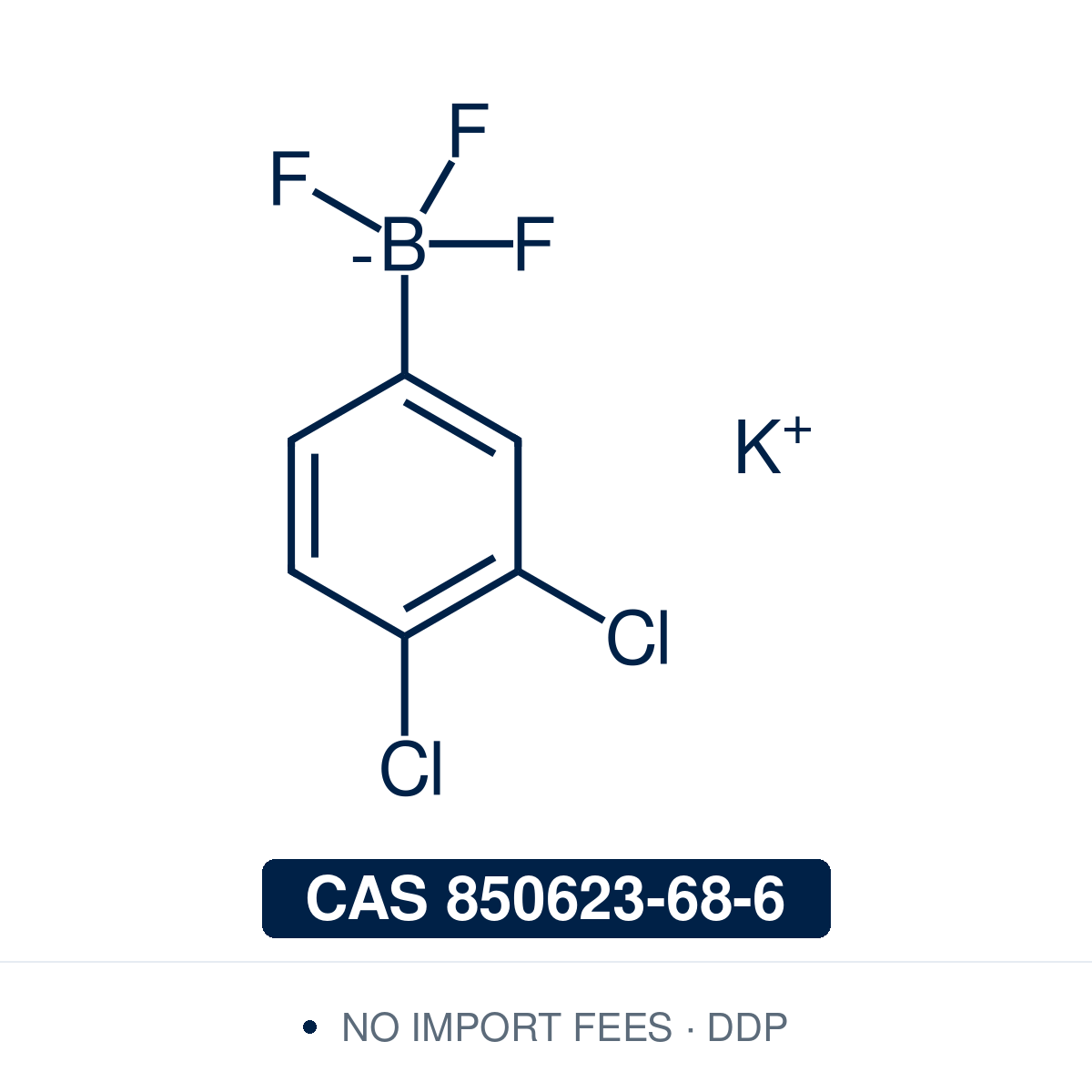
Potassium (3,4-Dichlorophenyl)trifluoroborate | CAS 850623-68-6 | ≥98%

Potassium (3,4-Dichlorophenyl)trifluoroborate | CAS 850623-68-6 | ≥98%

Regular price €66,00 EUR
Regular price Sale price €66,00 EUR
Sale Sold out
Taxes included. Shipping calculated at checkout.
Weight
Quantity

Technical Specifications

CAS Number 850623-68-6
MDL Number MFCD04115763
SMILES ClC1=CC([B-](F)(F)F)=CC=C1Cl.[K+]
InChI InChI=1S/C6H3BCl2F3.K/c7-4-2-1-3(5(4,10)11)6(8)9;/h1-2,6H;/q-1;+1
InChIKey RTZOKQYJVLRZFW-UHFFFAOYSA-N
PubChem CID 44717229
Molecular Formula C₆H₃BCl₂F₃K
Molecular Weight 252.9 g/mol
Melting Point 270–275 °C (dec.)
Solubility Soluble in water, methanol, DMF, DMSO. Poorly soluble in nonpolar organic solvents.
Purity ≥97%
Physical Form White to off-white crystalline powder
HS Code 2931.90
Shelf Life Retest period: 36 months from date of manufacture
Storage Conditions Store at room temperature in a tightly sealed container under inert atmosphere

Potassium (3,4-dichlorophenyl)trifluoroborate is an air-stable and bench-stable organotrifluoroborate salt used as a boronic acid surrogate in palladium-catalysed Suzuki-Miyaura cross-coupling reactions. The 3,4-dichloro substitution pattern is one of the most frequently encountered halogenated aryl motifs in pharmaceutical and agrochemical structures, where adjacent chlorine atoms modulate electron density, lipophilicity, and metabolic stability of the target molecule. This trifluoroborate salt offers precise stoichiometry, indefinite shelf stability at room temperature, and controlled hydrolytic release of the reactive boronate species during coupling. It participates in couplings with aryl halides and pseudohalides, rhodium-catalysed conjugate additions, and copper-mediated Chan-Lam reactions.

Common Scientific Applications

Suzuki-Miyaura Cross-Coupling for Dichlorinated Biaryls

  • Potassium (3,4-dichlorophenyl)trifluoroborate is an effective nucleophilic coupling partner in palladium-catalysed Suzuki-Miyaura reactions for the construction of 3,4-dichlorobiaryl scaffolds. The trifluoroborate salt undergoes controlled hydrolysis under aqueous basic conditions, releasing the active boronate species at a rate that suppresses protodeboronation and homocoupling side reactions. Standard catalytic systems including Pd(PPh₃)₄, Pd(dppf)Cl₂, and Pd(OAc)₂ with SPhos or XPhos ligands are effective, and coupling proceeds with a broad range of aryl bromides, chlorides, triflates, and tosylates to deliver the desired dichlorobiaryl products in high yield.
  • Molander and Biolatto (J. Org. Chem. 2003, 68, 4302) established the general utility of potassium aryltrifluoroborates in Suzuki-Miyaura coupling, demonstrating their compatibility with electron-poor and halogenated aryl substrates.

3,4-Dichlorophenyl Motif in Pharmaceutical Research

  • The 3,4-dichlorophenyl group is one of the most widely encountered halogenated aryl substituents in bioactive molecules, appearing in numerous marketed pharmaceuticals and clinical candidates across therapeutic areas including oncology, infectious disease, and central nervous system disorders. The adjacent chlorine atoms provide a combination of steric and electronic effects that enhance binding affinity, modulate lipophilicity for improved membrane permeability, and block metabolically vulnerable positions on the aromatic ring. Potassium (3,4-dichlorophenyl)trifluoroborate enables reliable and reproducible installation of this pharmacophoric element via cross-coupling, with the bench-stable crystalline salt format being ideally suited for parallel library synthesis and high-throughput screening campaigns.

Rhodium-Catalysed Conjugate Addition

  • Potassium (3,4-dichlorophenyl)trifluoroborate participates in rhodium-catalysed 1,4-conjugate additions to α,β-unsaturated ketones, esters, and amides. Using [Rh(cod)OH]₂ or Rh(acac)(CO)₂ with chiral bisphosphine ligands, the 3,4-dichlorophenyl group is transferred to the β-position of Michael acceptors with high enantioselectivity. The controlled nucleophilicity of the trifluoroborate salt compared to the free boronic acid provides cleaner reaction profiles and minimises the formation of protodeboronation by-products that can complicate purification and reduce isolated yields.
  • Batey and Quach (Org. Lett. 2003, 5, 4397) established potassium organotrifluoroborates as effective substrates for rhodium-catalysed additions to carbonyl compounds and conjugate acceptors.

Chan-Lam Coupling and C–Heteroatom Bond Formation

  • In copper-mediated Chan-Lam coupling reactions, potassium (3,4-dichlorophenyl)trifluoroborate transfers the dichloroaryl group to nitrogen and oxygen nucleophiles under mild conditions at room temperature in open air. This transformation provides practical access to N-(3,4-dichlorophenyl) amines, amides, and heterocycles as well as diaryl ethers bearing the dichlorophenyl motif. These products are valuable intermediates in agrochemical synthesis, where the 3,4-dichloroaniline substructure is a core element of several herbicide and fungicide classes.

Advantages of Trifluoroborate Salts over Boronic Acids

  • Potassium aryltrifluoroborates offer significant practical advantages over the corresponding boronic acids for both discovery and process chemistry. The crystalline salts have precisely defined molecular weights and stoichiometries, eliminating the variable boroxine and hydrate content that complicates accurate weighing of boronic acids. They are indefinitely stable under ambient storage conditions without refrigeration or inert atmosphere, simplifying inventory management and reducing waste from degraded reagents. In the case of dichlorophenyl derivatives, the trifluoroborate salt avoids the moderate instability of 3,4-dichlorophenylboronic acid, which can undergo slow protodeboronation during prolonged storage.
  • Darses and Genet (Chem. Rev. 2008, 108, 288) provide a comprehensive review of organotrifluoroborate chemistry covering preparation methods, stability, and applications across the full spectrum of transition metal-catalysed transformations.

Shipping Destinations

  • EU & UK: Priority delivery, 2–5 business days.
  • United States (DDP): 3–7 business days, duties and taxes prepaid.
  • EFTA Countries (DDP): 3–7 business days, duties and taxes prepaid.
  • Worldwide: 7–14 business days, selected locations.

The NorrChemica™ Standard

Identity Verified — Batch-verified via analytical QC; documentation available on request.

Direct EU Distribution — Dispatched from Finland for fast delivery to EU-based laboratories.

Professional Logistics — Tracked courier shipping via UPS / Matkahuolto / Posti.

Packaging & Storage

  • Supplied in tightly sealed containers suitable for laboratory handling.
  • Store under recommended conditions as specified on the product label and SDS.
  • Retest period per lot-specific CoA / label under recommended conditions.

Technical Documentation

  • Batch-specific Certificate of Analysis (CoA) included with every order.
  • GHS-compliant Safety Data Sheet (SDS) provided with every shipment.
  • Batch documentation available for institutional procurement.
Payment: Wise (Bank Transfer) or Manual Invoice.
Disclaimer: Research Use Only (RUO) — not for human or veterinary use. Sold strictly for laboratory research and technical applications. By purchasing this item, the buyer confirms professional intent and compliance with applicable regulations.

Safety Information

GHS Pictograms
GHS07 Harmful/Irritant
Signal Word Warning
Hazard Class None — not subject to transport regulations
Transport Category Not classified as dangerous goods for transport (ADR/IATA/IMDG)
H-Statements H315 — Causes skin irritation
H319 — Causes serious eye irritation
H335 — May cause respiratory irritation
P-Statements P261 — Avoid breathing dust/fume/gas/mist/vapours/spray
P264 — Wash hands thoroughly after handling
P271 — Use only outdoors or in a well-ventilated area
P280 — Wear protective gloves/protective clothing/eye protection/face protection
P302 + P352 — IF ON SKIN: Wash with plenty of soap and water
P305 + P351 + P338 — IF IN EYES: Rinse cautiously with water for several minutes. Remove contact lenses, if present and easy to do. Continue rinsing
P332 + P313 — If skin irritation occurs: Get medical advice/attention
P337 + P313 — If eye irritation persists: Get medical advice/attention
P362 + P364 — Take off contaminated clothing and wash it before reuse
P403 + P233 — Store in a well-ventilated place. Keep container tightly closed
P501 — Dispose of contents/container in accordance with local regulations

NorrChemica™ is a Finnish supplier of niche research reagents — focused on reliable EU distribution, transparent analytical documentation, and specialist technical support.

View full details