Skip to product information
1 of 3

NorrChemica™

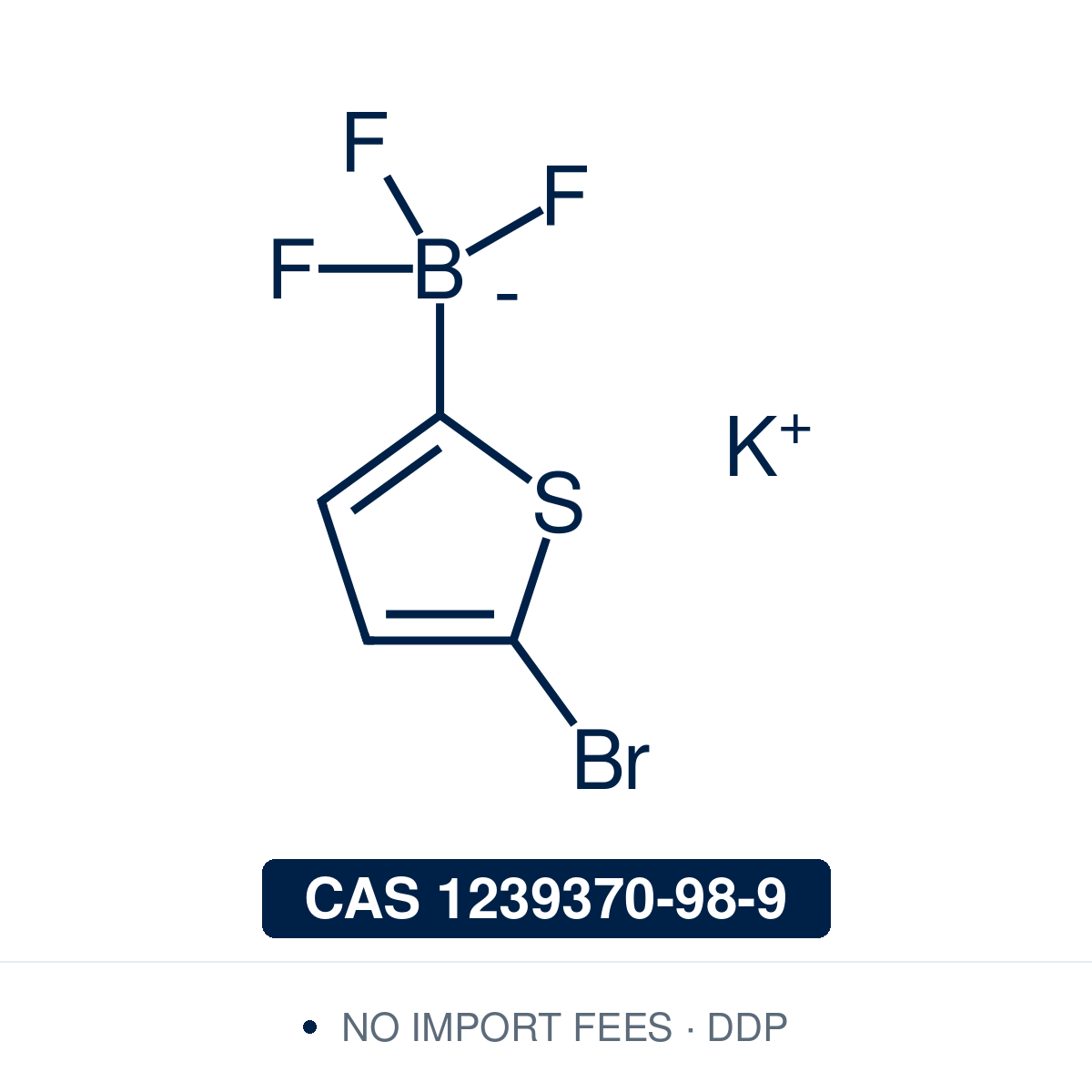
Potassium (5-Bromothiophen-2-yl)trifluoroborate | CAS 1239370-98-9 | ≥98%

Potassium (5-Bromothiophen-2-yl)trifluoroborate | CAS 1239370-98-9 | ≥98%

Regular price €69,00 EUR
Regular price Sale price €69,00 EUR
Sale Sold out
Taxes included. Shipping calculated at checkout.
Weight
Quantity

Technical Specifications

CAS Number 123970-98-9
MDL Number MFCD17015269
SMILES BrC1=CC=C([B-](F)(F)F)S1.[K+]
InChI InChI=1S/C4H2BBrF3S.K/c6-4-2-1-3(10-4)5(7,8)9;/h1-2H;/q-1;+1
InChIKey LNJIZRITMDDEGQ-UHFFFAOYSA-N
PubChem CID 49834929
Molecular Formula C₄H₂BBrF₃KS
Molecular Weight 268.93 g/mol
Solubility Soluble in water, methanol, acetone, acetonitrile, DMF. Poorly soluble in nonpolar organic solvents.
Purity ≥98%
Physical Form White to off-white crystalline powder
HS Code 2931.90
Shelf Life Retest period: 36 months from date of manufacture.
Storage Conditions Store under inert atmosphere at 2–8°C in a tightly sealed container. Protect from moisture and light

Potassium (5-bromothiophen-2-yl)trifluoroborate (potassium 5-bromo-2-thiophenetrifluoroborate) is a bifunctional organotrifluoroborate salt combining a reactive C–Br bond with an air-stable trifluoroborate nucleophile on a thiophene scaffold. This dual reactivity enables sequential cross-coupling strategies: the trifluoroborate participates in Suzuki–Miyaura coupling under standard palladium catalysis, while the C–Br bond remains available for a second, independent coupling step. This makes the compound a versatile linchpin building block for the rapid assembly of oligothiophene and thienyl–aryl architectures used in organic semiconductors, OLED emitters, and conjugated polymer synthesis. The trifluoroborate salt offers precise stoichiometric control and superior bench stability compared to the corresponding boronic acid, which is prone to protodeboronation and anhydride formation. As with all potassium organotrifluoroborates, it exists as a well-defined crystalline solid with an exact molecular weight, ensuring reproducible results in methodology development and process chemistry.

Common Scientific Applications

Suzuki–Miyaura Cross-Coupling: Trifluoroborate Advantages

  • Applied as a bench-stable, air-stable alternative to the corresponding boronic acid in palladium-catalysed Suzuki–Miyaura cross-coupling — the trifluoroborate undergoes in situ hydrolysis to the active boronic acid species under aqueous base conditions, enabling standard Suzuki coupling at the C2 position of the thiophene ring while the C5 bromide remains intact. Unlike boronic acids, potassium aryltrifluoroborates exist exclusively as monomeric species and do not form boroxine anhydrides — enabling precise stoichiometric control and consistent reactivity across batches, a significant advantage for small-scale, automated, and parallel synthesis workflows.
  • Compatible with a broad range of palladium catalyst systems and base/solvent combinations including aqueous, microwave-assisted, and flow chemistry conditions — the crystalline salt form provides superior handling properties, shelf stability, and ease of weighing compared to hygroscopic boronic acids, making it the preferred reagent form for high-throughput screening library synthesis.

Bifunctional Monomer: Sequential Cross-Coupling

  • The defining synthetic feature of this compound is its dual functionality — the trifluoroborate at C2 and the aryl bromide at C5 are independently reactive under different metal-catalysed conditions, enabling step-by-step construction of complex thiophene-containing scaffolds from a single bifunctional starting material. In a typical sequence, the trifluoroborate is engaged first under Suzuki conditions to introduce one aryl partner at C2, and the C–Br is subsequently used for a second Suzuki coupling, Buchwald–Hartwig amination, carbonylative coupling, or other palladium-catalysed transformation at C5 — providing direct, modular access to 2,5-disubstituted thiophene frameworks that are otherwise difficult to assemble regioselectively.
  • Applied as a bifunctional monomer in Suzuki polycondensation for the synthesis of alternating π-conjugated copolymers — the trifluoroborate and C–Br termini allow iterative chain growth in a defined sequence, enabling precise control of the regiochemistry and composition of the resulting conjugated polymer backbone, which directly determines its optical bandgap, charge-carrier mobility, and device performance.

π-Conjugated Materials & Organic Electronics

  • Key bifunctional monomer for the construction of thiophene-containing π-conjugated oligomers and polymers for organic semiconductor applications — 2,5-disubstituted thiophene units are among the most important repeating units in organic field-effect transistors (OFETs), organic photovoltaics (OPVs), and electrochromic devices. The precise regiochemical control offered by the C2-trifluoroborate / C5-bromide combination enables regioregular polymer synthesis that maximises π–π stacking and charge-transport efficiency in thin-film devices.
  • Applied in the synthesis of donor–acceptor (D-A) conjugated polymers where the electron-rich thiophene unit is paired with electron-deficient acceptor monomers — the sequential coupling strategy enabled by this bifunctional building block allows systematic variation of the donor–acceptor ratio and sequence for bandgap engineering in solution-processable organic photovoltaic materials.

Medicinal Chemistry & Pharmaceutical Building Blocks

  • Applied in the synthesis of 2,5-disubstituted thiophene-containing pharmaceutical scaffolds — the thiophene ring is present in approved drugs including clopidogrel, ticlopidine, olanzapine, and rivaroxaban, and the 2,5-disubstituted substitution pattern is particularly prevalent in kinase inhibitors and GPCRs ligands where the thiophene serves as a planar, sulfur-containing bioisostere for phenyl or furan rings. The trifluoroborate / C–Br bifunctionality provides a streamlined two-step coupling route to these scaffolds without requiring separate regioselective functionalisation of the thiophene ring.

Shipping Destinations

  • EU & UK: Priority delivery, 2–5 business days.
  • United States (DDP): 3–7 business days, duties and taxes prepaid.
  • EFTA Countries (DDP): 3–7 business days, duties and taxes prepaid.
  • Worldwide: 7–14 business days, selected locations.

The NorrChemica™ Standard

Identity Verified — Batch-verified via analytical QC; documentation available on request.

Direct EU Distribution — Dispatched from Finland for fast delivery to EU-based laboratories.

Professional Logistics — Tracked courier shipping via UPS / Matkahuolto / Posti.

Packaging & Storage

  • Supplied in tightly sealed containers suitable for laboratory handling.
  • Store under recommended conditions as specified on the product label and SDS.
  • Retest period per lot-specific CoA / label under recommended conditions.

Technical Documentation

  • Batch-specific Certificate of Analysis (CoA) included with every order.
  • GHS-compliant Safety Data Sheet (SDS) provided with every shipment.
  • Batch documentation available for institutional procurement.
Payment: Wise (Bank Transfer) or Manual Invoice.
Disclaimer: Research Use Only (RUO) — not for human or veterinary use. Sold strictly for laboratory research and technical applications. By purchasing this item, the buyer confirms professional intent and compliance with applicable regulations.

Safety Information

GHS Pictograms
GHS07 Harmful/Irritant
Signal Word Warning
Hazard Class None — not subject to transport regulations
Transport Category Not classified as dangerous goods for transport (ADR/IATA/IMDG)
H-Statements H315 — Causes skin irritation
H319 — Causes serious eye irritation
H335 — May cause respiratory irritation
P-Statements P261 — Avoid breathing dust/fume/gas/mist/vapours/spray
P264 — Wash hands thoroughly after handling
P271 — Use only outdoors or in a well-ventilated area
P280 — Wear protective gloves/protective clothing/eye protection/face protection
P302 + P352 — IF ON SKIN: Wash with plenty of soap and water
P305 + P351 + P338 — IF IN EYES: Rinse cautiously with water for several minutes. Remove contact lenses, if present and easy to do. Continue rinsing
P332 + P313 — If skin irritation occurs: Get medical advice/attention
P337 + P313 — If eye irritation persists: Get medical advice/attention
P362 + P364 — Take off contaminated clothing and wash it before reuse
P403 + P233 — Store in a well-ventilated place. Keep container tightly closed
P501 — Dispose of contents/container in accordance with local regulations

NorrChemica™ is a Finnish supplier of niche research reagents — focused on reliable EU distribution, transparent analytical documentation, and specialist technical support.

View full details