Skip to product information
1 of 3

NorrChemica™

Potassium Cyclopropyltrifluoroborate | CAS 1065010-87-8 | ≥98%

Potassium Cyclopropyltrifluoroborate | CAS 1065010-87-8 | ≥98%

Regular price €29,00 EUR
Regular price Sale price €29,00 EUR
Sale Sold out
Taxes included. Shipping calculated at checkout.
Weight
Quantity

Technical Specifications

CAS Number 1065010-87-8
MDL Number MFCD09265031
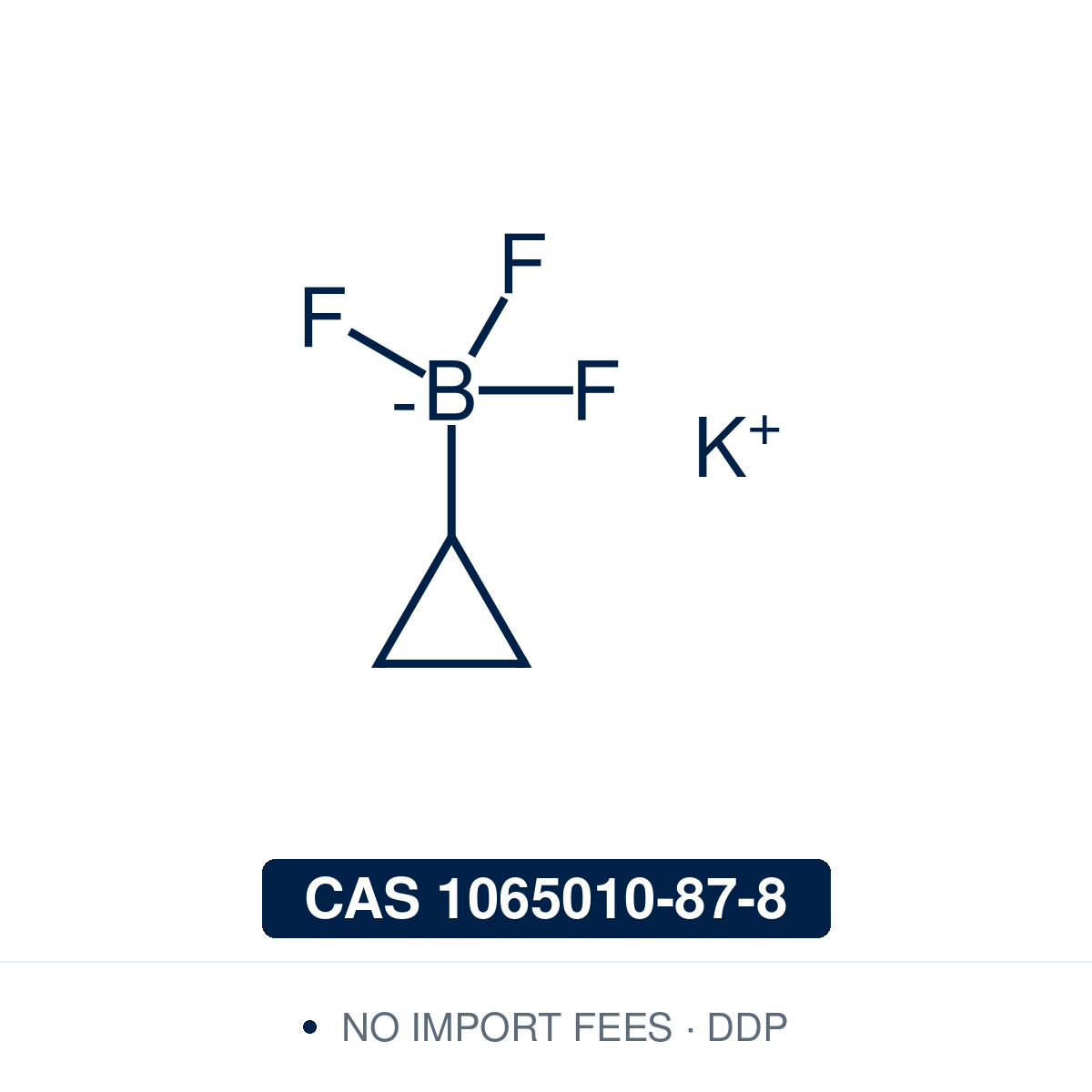
SMILES [K+].F[B-](F)(F)C1CC1
InChI InChI=1S/C3H5BF3.K/c5-4(6,7)3-1-2-3;/h3H,1-2H2;/q-1;+1
InChIKey CFMLURFHOSOXRC-UHFFFAOYSA-N
PubChem CID 23697338
Molecular Formula C₃H₅BF₃K
Molecular Weight 147.98 g/mol
Melting Point 348–350 °C
Solubility Soluble in water, methanol, acetone, acetonitrile, DMF. Poorly soluble in nonpolar organic solvents.
Purity ≥98%
Physical Form White crystalline powder
HS Code 2931.90
Shelf Life Retest period: 36 months from date of manufacture.
Storage Conditions Store in a cool, dry place in a tightly sealed container.

Potassium cyclopropyltrifluoroborate (cyclopropyltrifluoroborate potassium salt), is an air-stable organotrifluoroborate salt developed as a bench-friendly alternative to cyclopropylboronic acid for palladium-catalysed cross-coupling reactions. Pioneered by Molander and colleagues at the University of Pennsylvania, potassium organotrifluoroborates offer superior shelf stability, resistance to protodeboronation, and precise stoichiometric control compared to their boronic acid counterparts. This compound is widely used in Suzuki–Miyaura cross-coupling with aryl, heteroaryl, and benzyl halides for the introduction of the cyclopropyl group — one of the most frequently encountered small carbocyclic motifs in approved pharmaceuticals and clinical candidates. Beyond classical Suzuki coupling, it has been employed in synergistic photoredox/nickel dual catalysis for ketone synthesis, copper-catalysed Chan–Lam cyclopropylation of phenols and azaheterocycles, and visible-light-promoted radical additions to imines.

Common Scientific Applications

Suzuki–Miyaura cross-coupling with aryl and heteroaryl chlorides: Potassium cyclopropyltrifluoroborate is an organotrifluoroborate salt developed as a stable, bench-friendly surrogate for cyclopropylboronic acid in palladium-catalysed Suzuki–Miyaura cross-coupling reactions. Molander and Gormisky (J. Org. Chem. 2008, 73, 7481) demonstrated efficient coupling of this reagent with a range of aryl and heteroaryl chlorides, tolerating functional groups including ketones, esters, aldehydes, and nitriles. The trifluoroborate salt offers superior handling characteristics and shelf stability compared to cyclopropylboronic acid, which is prone to protodeboronation.

Csp³–Csp³ Suzuki coupling with benzyl chlorides: Colombel, Rombouts, Oehlrich, and Molander (J. Org. Chem. 2012, 77, 2966), working at Janssen Pharmaceutica and the University of Pennsylvania, demonstrated efficient Csp³–Csp³ bond formation between potassium cyclopropyltrifluoroborate and substituted benzyl chlorides using Pd₂(dba)₃/RuPhos catalysis. This represents a challenging bond disconnection in organic synthesis, as sp³–sp³ Suzuki couplings are significantly more difficult than conventional sp²–sp² couplings. The reaction was demonstrated at gram scale with 72% yield.

Cross-coupling with aryl mesylates: Potassium cyclopropyltrifluoroborate has been used in C–O activation of mesylated phenol derivatives via palladium catalysis. Both electron-rich and electron-deficient aryl mesylates served as effective coupling partners, with heteroaryl mesylates achieving yields up to 94%. This methodology expands the range of electrophilic partners beyond traditional aryl halides and triflates.

Synergistic photoredox/nickel catalysis: Amani and Molander (J. Org. Chem. 2017, 82, 1856) demonstrated the use of potassium cyclopropyltrifluoroborate in synergistic photoredox/nickel-catalysed coupling with acyl chlorides for dialkyl ketone synthesis. This dual-catalytic approach exploits single-electron transfer from the trifluoroborate under visible light irradiation to generate cyclopropyl radicals, which are then captured by a nickel catalyst.

Copper-catalysed Chan–Lam cyclopropylation: Derosa et al. (J. Org. Chem. 2018, 83, 3417) reported the copper-catalysed Chan–Lam coupling of potassium cyclopropyltrifluoroborate with phenols and azaheterocycles, providing a transition-metal-catalysed route to cyclopropyl ethers and N-cyclopropyl heterocycles without the need for palladium.

Shipping Destinations

  • EU & UK: Priority delivery, 2–5 business days.
  • United States (DDP): 3–7 business days, duties and taxes prepaid.
  • EFTA Countries (DDP): 3–7 business days, duties and taxes prepaid.
  • Worldwide: 7–14 business days, selected locations.

The NorrChemica™ Standard

Identity Verified — Batch-verified via analytical QC; documentation available on request.

Direct EU Distribution — Dispatched from Finland for fast delivery to EU-based laboratories.

Professional Logistics — Tracked courier shipping via UPS / Matkahuolto / Posti.

Packaging & Storage

  • Supplied in tightly sealed containers suitable for laboratory handling.
  • Store under recommended conditions as specified on the product label and SDS.
  • Retest period per lot-specific CoA / label under recommended conditions.

Technical Documentation

  • Batch-specific Certificate of Analysis (CoA) included with every order.
  • GHS-compliant Safety Data Sheet (SDS) provided with every shipment.
  • Batch documentation available for institutional procurement.
Payment: Wise (Bank Transfer) or Manual Invoice.
Disclaimer: Research Use Only (RUO) — not for human or veterinary use. Sold strictly for laboratory research and technical applications. By purchasing this item, the buyer confirms professional intent and compliance with applicable regulations.

Safety Information

GHS Pictograms
GHS07 Harmful/Irritant
Signal Word Warning
Hazard Class None — not subject to transport regulations
Transport Category Not classified as dangerous goods for transport (ADR/IATA/IMDG)
H-Statements H315 — Causes skin irritation
H319 — Causes serious eye irritation
H335 — May cause respiratory irritation
P-Statements P261 — Avoid breathing dust
P280 — Wear protective gloves/eye protection
P304+P340 — IF INHALED: Remove person to fresh air and keep comfortable for breathing
P305+P351+P338 — IF IN EYES: Rinse cautiously with water for several minutes. Remove contact lenses, if present and easy to do. Continue rinsing
P337+P313 — If eye irritation persists: Get medical advice/attention

NorrChemica™ is a Finnish supplier of niche research reagents — focused on reliable EU distribution, transparent analytical documentation, and specialist technical support.

View full details