NorrChemica™
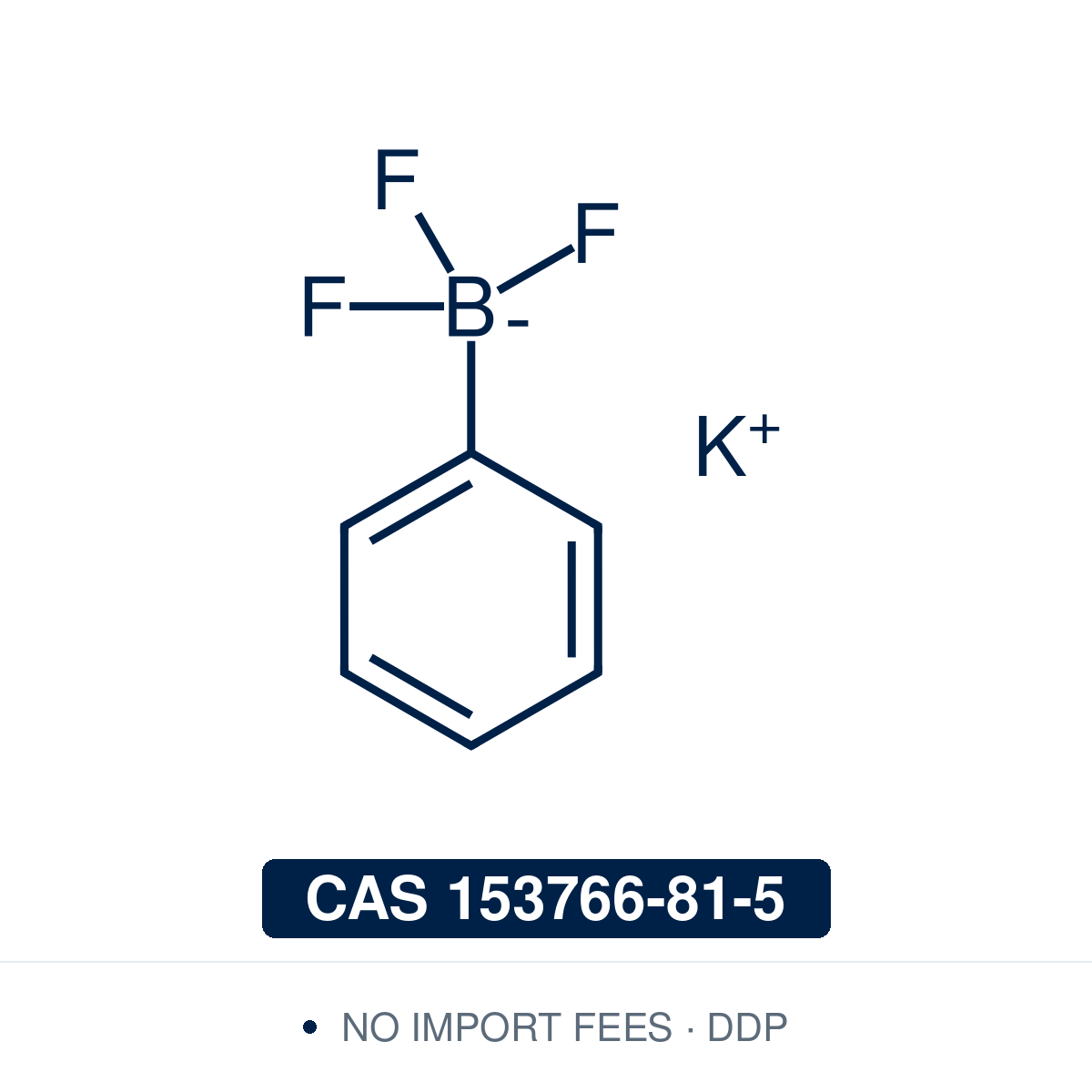
Potassium Phenyltrifluoroborate
Potassium Phenyltrifluoroborate | CAS 153766-81-5 | ≥97%
Couldn't load pickup availability
Technical Specifications
| CAS Number | 153766-81-5 |
| EC / EINECS Number | 627-190-3 |
| MDL Number | MFCD01318172 |
| SMILES | [B-](C1=CC=CC=C1)(F)(F)F.[K+] |
| InChI | InChI=1S/C6H5BF3.K/c8-7(9,10)6-4-2-1-3-5-6;/h1-5H;/q-1;+1 |
| InChIKey | DVAFPKUGAUFBTJ-UHFFFAOYSA-N |
| PubChem CID | 23675248 |
| Molecular Formula | C₆H₅BF₃K |
| Molecular Weight | 184.01 g/mol |
| Melting Point | 296–301 °C |
| Solubility | Soluble in methanol, acetone, acetonitrile, DMF. Poorly soluble in nonpolar organic solvents |
| Purity | ≥97% |
| Physical Form | White to off-white crystalline powder |
| HS Code | 2931.90 |
| Shelf Life | Retest period: 36 months from date of manufacture |
| Storage Conditions | Store in a cool, dry place in a tightly sealed container |
Product Description & Scientific Applications
Potassium phenyltrifluoroborate (PhBF₃K) is the potassium salt of the phenyltrifluoroborate anion, an air- and moisture-stable organoboron reagent that transfers a phenyl group in carbon–carbon, carbon–oxygen and carbon–nitrogen bond formation.
Common Scientific Applications
Suzuki–Miyaura cross-coupling. PhBF₃K is the phenylating partner in palladium-catalysed Suzuki–Miyaura coupling across a wide range of electrophiles: benzylic chlorides, giving diarylmethanes in water; dihalogenated heteroarenes, arylating an isothiazole regiospecifically; aryl sulfamates, coupling at a carbon–oxygen bond; and 2-bromoglycals, furnishing 2-C-aryl branched carbohydrates. The coupling tolerates sensitive functionality: an azide on a bromoconduritol survives the reaction and is carried into a subsequent click cycloaddition.
Hydrolytic slow release. In palladium coupling the trifluoroborate does not itself transfer the phenyl group to the metal; it hydrolyses to phenylboronic acid under the reaction conditions, and that boronic acid is the active partner. Matching this release to the rate of catalytic turnover keeps the boronic acid from accumulating, suppressing oxidative homocoupling and protodeboronation.
Rhodium-catalysed conjugate addition. Under rhodium catalysis PhBF₃K adds the phenyl group to the β-position of α,β-unsaturated ketones; with chiral ligands the conjugate addition to cyclohexenone gives 3-phenylcyclohexanone in high enantioselectivity.
Copper-catalysed amination. Copper catalysis couples aryltrifluoroborates with nitrogen nucleophiles: Chan–Lam-type N-arylation joins them to amines, and reaction with aqueous ammonia delivers primary arylamines.
Oxidative hydroxylation. Treatment with hydrogen peroxide and a citric-acid catalyst in water converts PhBF₃K to phenol.
Copper-catalysed carboesterification. PhBF₃K is among the trifluoroborates that act as the carbon source in a copper-catalysed three-component addition of dienes and carboxylic acids, giving allylic esters.
Lewis-acid arylation of acetals. Under boron trifluoride activation, aryltrifluoroborates add to acetal-derived oxocarbenium ions, replacing one alkoxy group with the aryl group to give substituted ethers.
Further applications. The phenyltrifluoroborate anion serves as a weakly coordinating counterion in functional salts, including photoresponsive spin-crossover iron(III) complexes and fluorescent imidazolium salts.
Shipping Destinations
- EU & UK: Priority delivery, 2–5 business days.
- United States (DDP): 3–7 business days, duties and taxes prepaid.
- EFTA Countries (DDP): 3–7 business days, duties and taxes prepaid.
- Worldwide: 7–14 business days, selected locations.
Safety Information
| GHS Pictograms |

|
| Signal Word | Warning |
| Hazard Class | None — not subject to transport regulations |
| Transport Category | Not classified as dangerous goods for transport (ADR/IATA/IMDG) |
| H-Statements | H315 - H319 - H335 |
| P-Statements | P261 - P264 - P271 - P280 - P302 + P352 - P305 + P351 + P338 - P332 + P313 - P337 + P313 - P362 + P364 - P403 + P233 - P501 |
Documentation
| Safety Data Sheet | Download PDF |