NorrChemica™
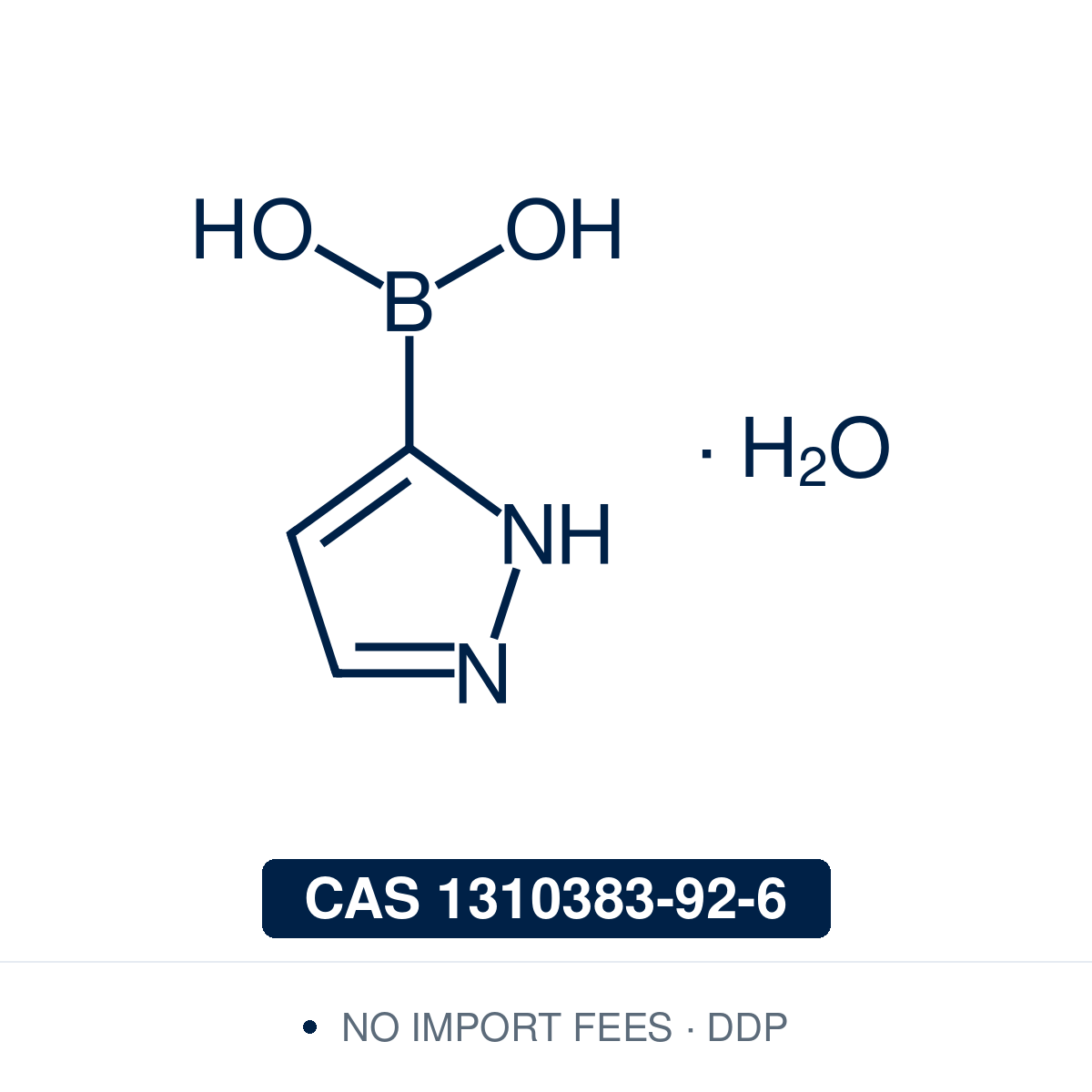
Pyrazole-3-boronic Acid Hydrate | CAS 1310383-92-6 | ≥98%
Couldn't load pickup availability
Technical Specifications
| CAS Number | 1310383-92-6 |
| MDL Number | MFCD11044442 |
| SMILES | B(C1=CC=NN1)(O)O.O |
| InChI | InChI=1S/C3H5BN2O2.H2O/c7-4(8)3-1-2-5-6-3;/h1-2,7-8H,(H,5,6);1H2 |
| InChIKey | NXQCQMBEFQLICU-UHFFFAOYSA-N |
| PubChem CID | 46739739 |
| Molecular Formula | C₃H₇BN₂O₃ |
| Molecular Weight | 129.91 g/mol |
| Solubility | Soluble in alcoholic solvents, DMF, DMSO |
| Purity | ≥98%. May contain varying amounts of the corresponding boronic acid anhydrides. |
| Physical Form | White to off-white or light brown crystalline powder |
| HS Code | 2931.90 |
| Shelf Life | Retest period: 36 months from date of manufacture. |
| Storage Conditions | Store under inert atmosphere at –20°C in a tightly sealed container, in a dark place. Protect from moisture and light |
Pyrazole-3-boronic acid hydrate (1H-pyrazol-3-ylboronic acid hydrate, pyrazol-3-ylboronic acid monohydrate) is a heteroaromatic boronic acid bearing the boronic acid group at the 3-position of an unprotected pyrazole ring, supplied as the crystalline hydrate. The pyrazole ring is one of the most prevalent nitrogen heterocycles in FDA-approved kinase inhibitors, where its NH group forms critical hydrogen bonds with the kinase hinge region. This compound is applied in Suzuki–Miyaura cross-coupling under specialist conditions (bulky phosphine ligands, elevated temperature) to introduce the pyrazol-3-yl fragment into drug-like scaffolds. It is also widely used as a bioisosteric replacement for phenol, offering improved metabolic stability by avoiding Phase II glucuronidation and sulfation. Additional applications include fluorescent material synthesis and agrochemical intermediate construction. This product contains varying amounts of the corresponding boronic acid anhydride.
Common Scientific Applications
Suzuki–Miyaura cross-coupling — specialist conditions required: Pyrazole-3-boronic acid hydrate is applied in palladium-catalysed Suzuki–Miyaura cross-coupling to introduce the pyrazol-3-yl unit into aryl and heteroaryl halide scaffolds — an important but technically demanding transformation. The unprotected pyrazole NH can partially inhibit palladium catalysis by coordinating to the metal centre, so successful coupling requires specialist conditions: bulky phosphine ligands (SPhos, XPhos) with second-generation Pd precatalysts, elevated temperatures (100 °C), and slightly increased reagent loadings. These conditions are thoroughly optimised in the literature and are reliably reproducible, but should be followed carefully for best results with this substrate class. For researchers seeking more straightforward Suzuki conditions, the corresponding protected form (N-Boc or N-THP protected pyrazole boronate ester) or the potassium trifluoroborate salt are available as alternatives that avoid the NH inhibition issue — however, these require additional protecting group steps. The unprotected boronic acid hydrate remains the most atom-economical and cost-effective option when the specialist coupling protocol is applied correctly. Clapham et al. (Org. Biomol. Chem. 2009, 7, 2155) documented the synthesis and Suzuki–Miyaura coupling of pyrazolylboronic acids and esters.
Kinase inhibitor drug discovery: The pyrazole ring is one of the five most prevalent nitrogen heterocycles in FDA-approved small molecule drugs, and a particularly important scaffold in kinase inhibitor design — where the pyrazole NH forms critical hydrogen bonds with the kinase hinge region or acts as a pharmacophoric anchor in the ATP binding site. Applied in library synthesis campaigns for kinase hinge-binding fragment exploration — the pyrazol-3-yl group is a documented hinge-binding fragment that has been included in parallel Suzuki coupling panels alongside pyridyl, azaindolyl, and quinolinyl boronic acids for systematic kinase selectivity profiling. Its hydrogen bond donor/acceptor combination via the NH and ring nitrogen makes it an unusually versatile fragment for ATP-site engagement across multiple kinase families including JAK, ALK, CSF1R, and MET.
Phenol bioisostere in medicinal chemistry: Widely applied as a bioisostere for the phenol group in drug candidates. The pyrazole NH acts as a hydrogen bond donor similarly to a phenolic OH, while the ring nitrogen at N2 provides an additional hydrogen bond acceptor, giving a combined donor/acceptor profile that can enhance target binding relative to simple phenol. Crucially, the pyrazole ring is not subject to glucuronidation or sulfation — the main Phase II metabolic pathways that rapidly inactivate phenol-containing drugs — providing dramatically improved metabolic stability and longer half-life in vivo. Used in lead optimisation campaigns to replace metabolically labile phenol groups in drug candidates, the pyrazole bioisostere typically improves oral bioavailability, reduces clearance, and extends plasma half-life while maintaining or improving binding affinity. Applied in matched molecular pair (MMP) analyses comparing phenol vs pyrazolyl analogues across kinase, GPCR, and enzyme inhibitor series.
Optics, materials science, and agrochemical building block: Applied in the synthesis of pyrazole-containing fluorescent and luminescent materials for optics applications — pyrazole-aryl conjugates are used as fluorescent chromophores, optical brighteners, and ligands in luminescent metal complexes. The boronic acid provides direct Suzuki coupling access to 3-arylpyrazole frameworks without requiring pre-formed organolithium or Grignard reagents. Also applied as a building block for pyrazole-containing agrochemical active ingredients — the pyrazole ring is a recurring motif in commercial fungicides, insecticides, and herbicides across multiple compound classes, making this boronic acid a relevant intermediate for both agrochemical synthesis and crop protection research programmes.
Shipping Destinations
- EU & UK: Priority delivery, 2–5 business days.
- United States (DDP): 3–7 business days, duties and taxes prepaid.
- EFTA Countries (DDP): 3–7 business days, duties and taxes prepaid.
- Worldwide: 7–14 business days, selected locations.
The NorrChemica™ Standard
Identity Verified — Batch-verified via analytical QC; documentation available on request.
Direct EU Distribution — Dispatched from Finland for fast delivery to EU-based laboratories.
Professional Logistics — Tracked courier shipping via UPS / Matkahuolto / Posti.
Packaging & Storage
- Supplied in tightly sealed containers suitable for laboratory handling.
- Store under recommended conditions as specified on the product label and SDS.
- Retest period per lot-specific CoA / label under recommended conditions.
Technical Documentation
- Batch-specific Certificate of Analysis (CoA) included with every order.
- GHS-compliant Safety Data Sheet (SDS) provided with every shipment.
- Batch documentation available for institutional procurement.
| Payment: Wise (Bank Transfer) or Manual Invoice. |
| Disclaimer: Research Use Only (RUO) — not for human or veterinary use. Sold strictly for laboratory research and technical applications. By purchasing this item, the buyer confirms professional intent and compliance with applicable regulations. |
Safety Information
| GHS Pictograms |
|
| Signal Word | Warning |
| Hazard Class | None — not subject to transport regulations |
| Transport Category | Transport Category: Not classified as dangerous goods for transport (ADR/IATA/IMDG) |
| H-Statements | H315 — Causes skin irritation H319 — Causes serious eye irritation H335 — May cause respiratory irritation |
| P-Statements | P261 — Avoid breathing dust P280 — Wear protective gloves/eye protection P304+P340 — IF INHALED: Remove person to fresh air and keep comfortable for breathing P305+P351+P338 — IF IN EYES: Rinse cautiously with water for several minutes. Remove contact lenses, if present and easy to do. Continue rinsing P337+P313 — If eye irritation persists: Get medical advice/attention P501 — Dispose of contents/container in accordance with local/national regulations |
NorrChemica™ is a Finnish supplier of niche research reagents — focused on reliable EU distribution, transparent analytical documentation, and specialist technical support.
Share