NorrChemica™
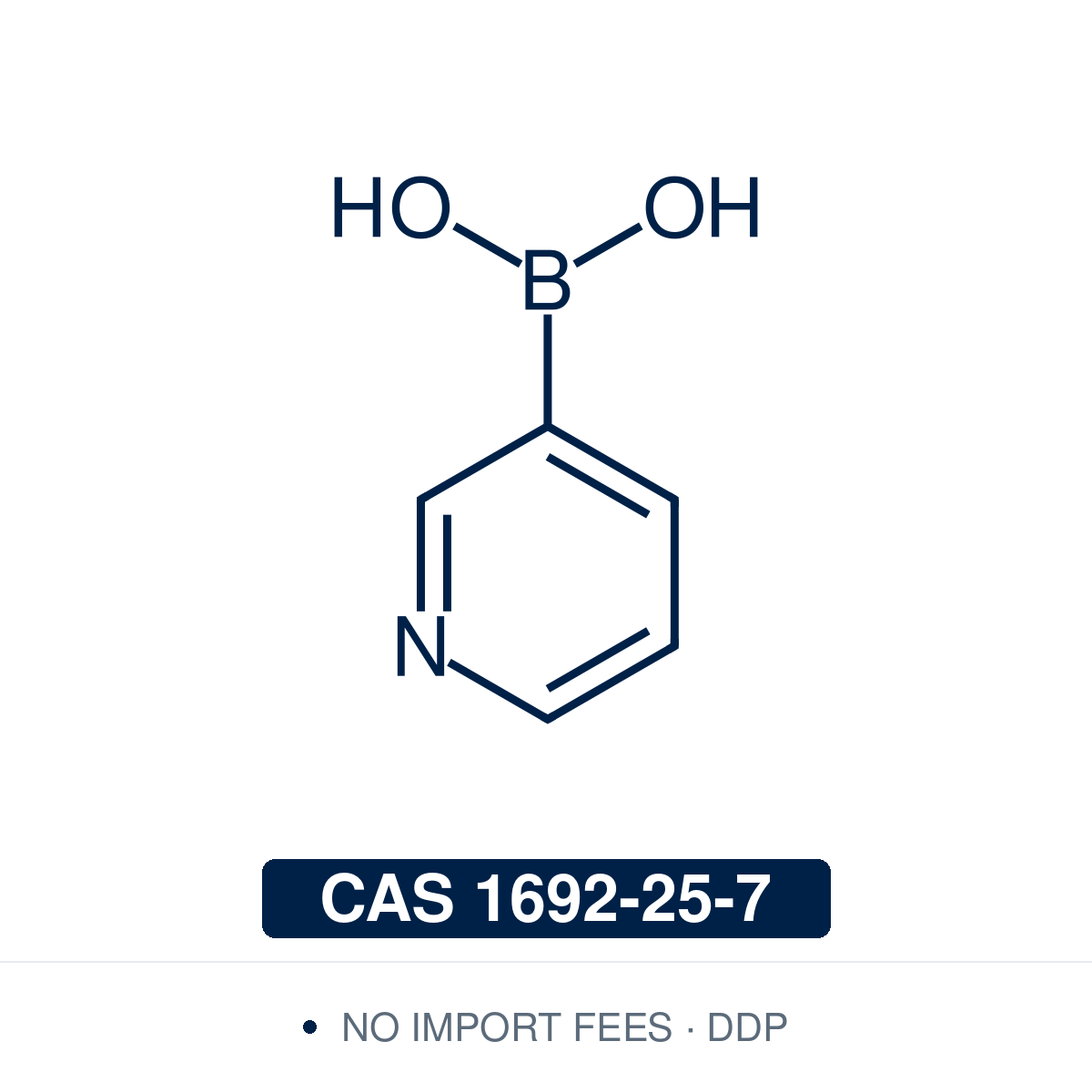
Pyridin-3-ylboronic Acid
Pyridin-3-ylboronic Acid | CAS 1692-25-7 | ≥95%
Couldn't load pickup availability
Technical Specifications
| CAS Number | 1692-25-7 |
| EC / EINECS Number | 605-544-8 |
| MDL Number | MFCD00674177 |
| SMILES | B(C1=CN=CC=C1)(O)O |
| InChI | InChI=1S/C5H6BNO2/c8-6(9)5-2-1-3-7-4-5/h1-4,8-9H |
| InChIKey | ABMYEXAYWZJVOV-UHFFFAOYSA-N |
| PubChem CID | 2734378 |
| Molecular Formula | C₅H₆BNO₂ |
| Molecular Weight | 122.92 g/mol |
| Melting Point | >300 °C (lit.) |
| Solubility | Soluble in water; soluble in alcoholic solvents, DMF, DMSO |
| Purity | ≥95% |
| Physical Form | White to off-white crystalline powder |
| HS Code | 2931.90 |
| Shelf Life | Retest period: 36 months from date of manufacture |
| Storage Conditions | Store at room temperature in a tightly sealed container, in a dark place. Protect from moisture and light. May contain varying amounts of boroxine anhydride |
Product Description & Scientific Applications
Pyridin-3-ylboronic acid (3-pyridineboronic acid, 3-pyridylboronic acid, pyridine-3-boronic acid) is an electron-deficient heteroaryl boronic acid with boron at the pyridine 3-position, two bonds from the ring nitrogen.
It is frequently isolated and supplied partly as the cyclic anhydride tris(3-pyridyl)boroxine. Under aqueous or basic coupling conditions the two forms re-equilibrate and the impact on yield is minor.
Stability and coupling behaviour: Whilst the 2-pyridyl isomer the ring nitrogen sits adjacent to boron and drives rapid protodeboronation (the "2-pyridyl problem"). In the 3-pyridyl isomer, the C-3 the nitrogen is two bonds removed, so the acid is robust and couples directly under standard Pd(PPh₃)₄ or Pd(dppf)Cl₂ / K₂CO₃ conditions, without MIDA or trifluoroborate masking. As with other N-heteroaryls, the Lewis-basic nitrogen can coordinate palladium and slow turnover — including transmetalation and reductive elimination — so bulky electron-rich biarylphosphines are the standard remedy on demanding substrates.
Applications and Reactions
Suzuki–Miyaura cross-coupling: One of the most widely used pyridylboronic acids; installs the 3-pyridyl group onto aryl, heteroaryl, and vinyl halides — e.g. with halogenated quinolines to give 3-(pyridin-3-yl)quinolines and related heterobiaryls. Phosphine-free palladium protocols are also documented.
Tandem coupling–annulation: Combines regioselective Suzuki–Miyaura coupling with palladium-catalysed intramolecular aminocarbonylation and annulation to assemble fused nitrogen heterocycles in one sequence.
Copper-mediated functionalisation: Undergoes copper(II) acetylacetonate–catalysed N-arylation (Chan–Lam-type C–N bond formation) and copper-mediated cyanation, including regioselective cyanation of electron-rich arenes.
Pharmaceutical building block: Supplies the 3-pyridyl unit of Bcr–Abl tyrosine-kinase inhibitors such as nilotinib (chronic myeloid leukaemia), installed by Suzuki coupling.
Medicinal-chemistry motif: The 3-pyridyl group is among the most common nitrogen heterocycles in approved drugs and a frequent phenyl bioisostere: replacing phenyl raises aqueous solubility, adds a hydrogen-bond acceptor, and tempers lipophilicity.
Functional and supramolecular polymers: Prepares linear poly(phenylpyridyl) chains by iterative Suzuki coupling and oligopyridyl foldamers that mimic the α-helix twist.
Coordination chemistry and framework materials: The pyridyl nitrogen of the products is an N-donor site — a ligand in coordination complexes, a linker in metal–organic frameworks, and the metal-binding element in sensor materials.
Agrochemical and materials intermediates: Provides cross-coupling access to 3-pyridyl analogue libraries and electron-deficient arylpyridine intermediates for agrochemical and organic-electronics research.
Further Reading
For boronic acids, boronic esters, protodeboronation, boroxine content, and Suzuki–Miyaura reagent selection, see NorrChemica's Lab Journal guide: Choosing Your Boron Source for Suzuki–Miyaura Coupling.
Shipping Destinations
- EU & UK: Priority delivery, 2–5 business days.
- United States (DDP): 3–7 business days, duties and taxes prepaid.
- EFTA Countries (DDP): 3–7 business days, duties and taxes prepaid.
- Worldwide: 7–14 business days, selected locations.
Safety Information
| GHS Pictograms |

|
| Signal Word | Warning |
| Hazard Class | None — not subject to transport regulations |
| Transport Category | Not classified as dangerous goods for transport (ADR/IATA/IMDG) |
| H-Statements | H315 - H319 - H335 |
| P-Statements | P261 - P264 - P271 - P280 - P302+P352 - P304+P340 - P305+P351+P338 - P332+P313 - P337+P313 - P362+P364 - P501 |
Documentation
| Safety Data Sheet | Download PDF |