NorrChemica™
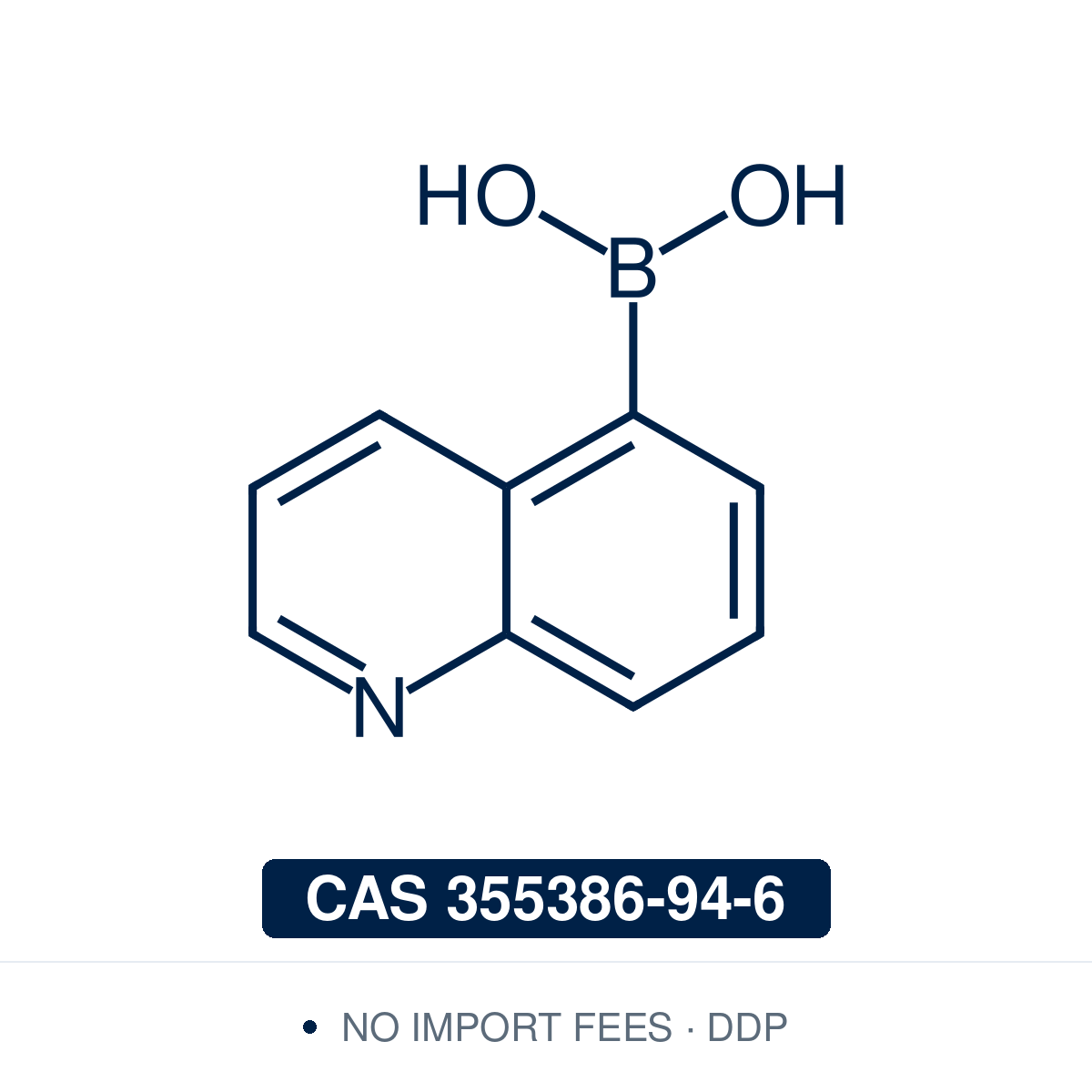
Quinolin-5-ylboronic Acid
Quinolin-5-ylboronic Acid | CAS 355386-94-6 | ≥97%
Couldn't load pickup availability
Technical Specifications
| CAS Number | 355386-94-6 |
| EC / EINECS Number | 670-357-0 |
| MDL Number | MFCD03095058 |
| SMILES | B(C1=C2C=CC=NC2=CC=C1)(O)O |
| InChI | InChI=1S/C9H8BNO2/c12-10(13)8-4-1-5-9-7(8)3-2-6-11-9/h1-6,12-13H |
| InChIKey | NWIJBOCPTGHGIK-UHFFFAOYSA-N |
| PubChem CID | 5153389 |
| Molecular Formula | C₉H₈BNO₂ |
| Molecular Weight | 172.98 g/mol |
| Melting Point | 144–148 °C |
| Solubility | Slightly soluble in water; soluble in alcoholic solvents, acetonitrile, DMF, DMSO |
| Purity | ≥97%. May contain varying amounts of the corresponding boronic acid anhydrides |
| Physical Form | Light yellow to brown powder |
| HS Code | 2931.90 |
| Shelf Life | Retest period: 36 months from date of manufacture |
| Storage Conditions | Store refrigerated (2–8 °C) in a tightly sealed container |
Product Description & Scientific Applications
Quinolin-5-ylboronic acid (5-quinolineboronic acid, 5-boronoquinoline) is a heteroaryl boronic acid bearing the quinoline scaffold, with boron at the 5-position on the carbocyclic ring.
May contain small amounts of the cyclic anhydride tris(quinolin-5-yl)boroxine. Under aqueous or basic coupling conditions the two forms re-equilibrate and the impact on yield is minor.
Position and stability: C-5 lies on the carbocyclic (benzene) ring of quinoline, not the pyridine ring. Boron there sits peri to C-4 across the ring junction — a naphthalene-like relationship — while the ring nitrogen lies on the far pyridine ring, remote from boron. Well separated from the nitrogen, the reagent behaves as a carbocyclic-ring arylboronic acid rather than a labile 2-pyridyl-type boron, coupling robustly without the protodeboronation and palladium-coordination liabilities of boron sited on or beside the pyridine ring. The C-4 peri-hydrogen imposes a steric demand on the C-5 biaryl bond, influencing the dihedral of the 5-arylquinoline product.
Applications and Reactions
Suzuki–Miyaura cross-coupling: Installs the 5-quinolyl fragment onto aryl, heteroaryl, and vinyl halides to give 5-arylquinolines and related heterobiaryls. Couples under standard conditions — Pd(PPh₃)₄ or Pd(dppf)Cl₂ with K₂CO₃ in aqueous dioxane — and is compatible with nickel-catalysed variants. The benzannulated quinoline contributes a rigid, nitrogen-containing aryl fragment for analogue and materials synthesis.
Heterocyclic building block for SAR campaigns: Builds 5-arylquinoline and bis(heterocyclic) scaffolds for structure–activity studies. The 5-quinolyl motif is a rigid, planar, nitrogen-containing biaryl whose ring nitrogen adds a hydrogen-bond acceptor and raises polarity and aqueous solubility relative to naphthalene, making it a favoured aza-naphthalene bioisostere for naphthyl and other fused carbocyclic aromatics in lead optimisation.
OLED and optoelectronic materials: The electron-poor, pyridine-type nitrogen makes quinoline a π-deficient, electron-accepting ring with a low-lying LUMO — the property behind its long record in organic electronics, exemplified by the archetypal OLED material tris(8-hydroxyquinolinato)aluminium (Alq₃), itself a quinoline metal chelate. 5-Arylquinolines accessed by Suzuki coupling form a distinct, covalently linked class of quinoline π-systems explored as electron-transport and hole-blocking layers, where the low LUMO promotes electron injection from the cathode and confines holes at the emissive interface. Emission tunes with the electronic character of the C-5 aryl group installed in the coupling.
Coordination chemistry and metal complexes: The quinoline nitrogen of the coupled products is an N-donor that binds transition metals — iridium, platinum, ruthenium, zinc — to give luminescent and electroluminescent complexes and ditopic bridging ligands for metal–organic framework construction. Quinoline-type N-donor ligands recur throughout phosphorescent and emissive metal-complex design.
Fluorescent probes and chemical sensors: The quinoline ring is an intrinsic UV/visible fluorophore with large, tunable Stokes shifts, its emission shifting with the electronic character of the C-5 substituent. The ring nitrogen acts as a proton-responsive switch — protonation shifts absorption and emission, enabling ratiometric pH sensing, a built-in advantage over carbocyclic fluorophores. Nitrogen coordination further supports colorimetric and fluorescent detection of metal cations such as Zn²⁺, Cu²⁺, and Fe³⁺, with use in biological imaging and environmental monitoring.
Further Reading
For boronic acids, boronic esters, protodeboronation, boroxine content, and Suzuki–Miyaura reagent selection, see NorrChemica's Lab Journal guide: Choosing Your Boron Source for Suzuki–Miyaura Coupling.
Shipping Destinations
- EU & UK: Priority delivery, 2–5 business days.
- United States (DDP): 3–7 business days, duties and taxes prepaid.
- EFTA Countries (DDP): 3–7 business days, duties and taxes prepaid.
- Worldwide: 7–14 business days, selected locations.
Safety Information
| GHS Pictograms |

|
| Signal Word | Warning |
| Hazard Class | None — not subject to transport regulations |
| Transport Category | Not classified as dangerous goods for transport (ADR/IATA/IMDG) |
| H-Statements | H315 - H319 - H335 |
| P-Statements | P261 - P264 - P271 - P280 - P302+P352 - P304+P340 - P305+P351+P338 - P332+P313 - P337+P313 - P362+P364 - P501 |
Documentation
| Safety Data Sheet | Download PDF |