NorrChemica™
Tris Base
Tris Base | CAS 77-86-1 | ≥99.0%
Couldn't load pickup availability
Technical Specifications
| CAS Number | 77-86-1 |
| EC / EINECS Number | 201-064-4 |
| MDL Number | MFCD00004679 |
| RTECS Number | TY2900000 |
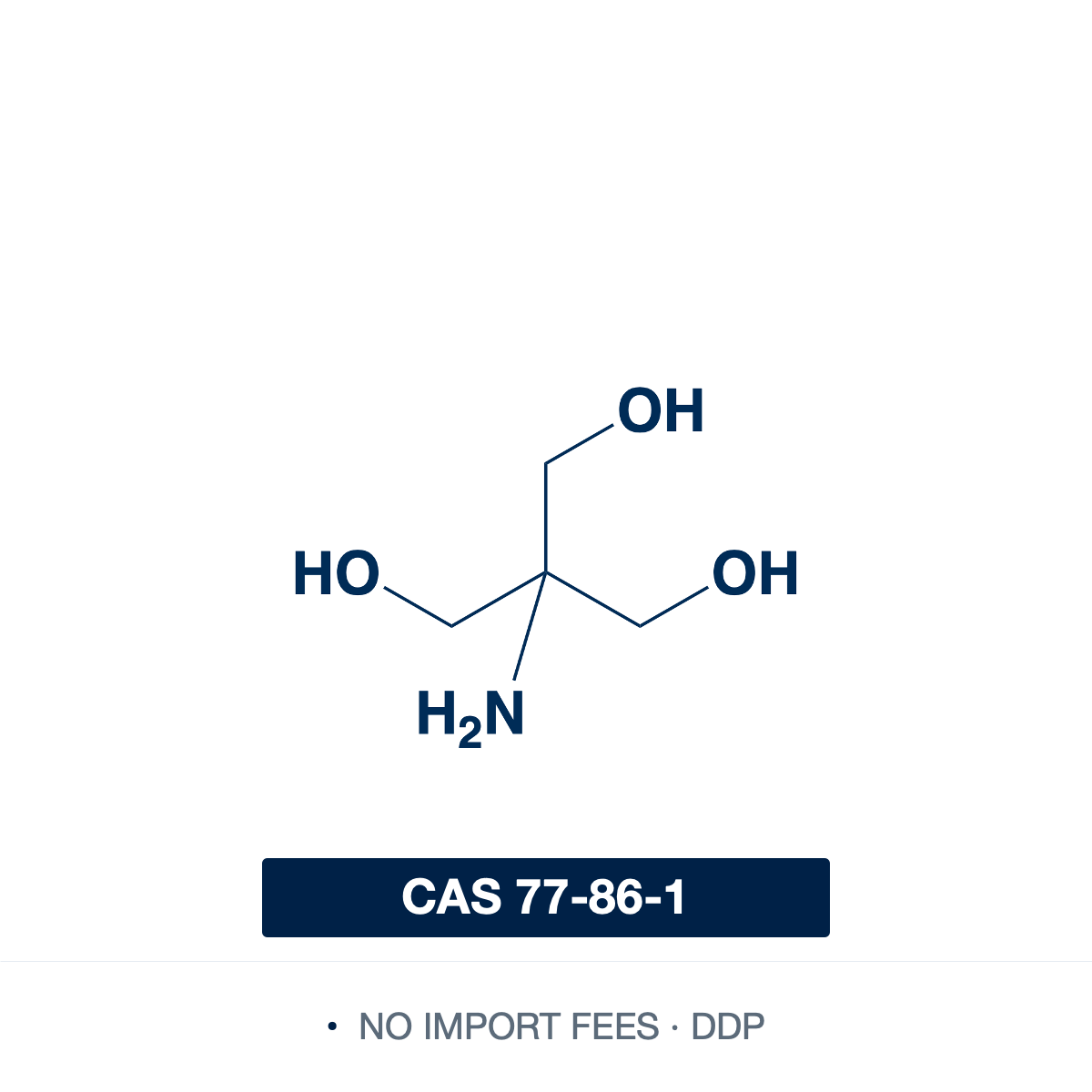
| SMILES | C(C(CO)(CO)N)O |
| InChI | InChI=1S/C4H11NO3/c5-4(1-6,2-7)3-8/h6-8H,1-3,5H2 |
| InChIKey | LENZDBCJOHFCAS-UHFFFAOYSA-N |
| PubChem CID | 6503 |
| Molecular Formula | C₄H₁₁NO₃ |
| Molecular Weight | 121.14 g/mol |
| Melting Point | 169 °C |
| Solubility | ~890 g/L in water (30 °C, ECHA) |
| Log Pow | −2.31 (20 °C) |
| Purity | ≥99.0% |
| Physical Form | White crystalline powder |
| HS Code | 2922.12 |
| Country of Origin | Finland |
| Shelf Life | Retest period: 36 months from date of manufacture |
| Storage Conditions | Store in a cool, dry place in a tightly sealed container, protected from moisture |
Product Description & Scientific Applications
Tris Base (tris(hydroxymethyl)aminomethane; THAM) is a primary aliphatic amine bearing three hydroxymethyl groups and one of the most widely used laboratory pH buffers. Its conjugate-acid pKa is ≈ 8.06–8.1 at 25 °C, giving a practical range around pH 7.0–9.1 across the mildly alkaline window of nucleic-acid, protein, and enzyme workflows. It is highly water-soluble and forms defined buffers with HCl, acetic acid, boric acid, or glycine.
Temperature dependence. Its high ionisation enthalpy makes the pKa strongly temperature-dependent (dpKa/dT ≈ −0.028 per °C): a buffer set at room temperature reads lower at 37 °C and higher at 4 °C — a common error source in enzymology, cell biology, electrophoresis, and temperature-sensitive assays, and sharper than for phosphate or zwitterionic Good's buffers. The apparent pKa also shifts with ionic strength and concentration.
Metal coordination. Its primary amine and triol coordinate metal ions — strongly with Cu²⁺ and Hg²⁺, more weakly with Co²⁺, Zn²⁺, and Cd²⁺, and only weakly with Mg²⁺ and Mn²⁺ under dilute biochemical conditions; broader Tris/metal-buffer studies also report complexes involving ions such as Pb²⁺. This is usually unimportant in routine electrophoresis or SDS-PAGE but relevant in copper-containing assays and metalloenzyme or metal-binding studies, where complexation affects speciation, kinetics, or apparent binding constants.
Nucleic-acid electrophoresis and enzyme buffers. Tris is the core base of TAE (Tris-acetate-EDTA) and TBE (Tris-borate-EDTA): TAE gives fast migration for preparative agarose gels and DNA recovery before enzymatic work; TBE gives higher capacity and sharper resolution for extended, high-voltage, and polyacrylamide runs, though borate can inhibit downstream enzymes; in both, EDTA chelates the divalent cations that support nuclease activity. Tris-HCl (pH 7.5–8.5) buffers restriction enzymes, polymerases, reverse transcriptases, ligases, kinases, and phosphatases; TE (pH 8.0) stores purified DNA/RNA, its mildly alkaline pH suppressing acid-catalysed degradation while EDTA inhibits residual nucleases.
Protein electrophoresis, transfer, and immunoblotting. The Laemmli discontinuous Tris-glycine SDS-PAGE system separates denatured proteins by apparent molecular weight and underpins Western blotting, proteomics sample prep, and band excision for mass spectrometry, exploiting the pH discontinuity between a Tris-HCl stacking gel (≈ pH 6.8) and resolving gel (≈ pH 8.8) with Tris-glycine running buffer (≈ pH 8.3) to stack proteins before size-based separation. Tris also serves SDS-PAGE sample buffers, Tris-buffered saline (TBS) and TBS-Tween wash and antibody-dilution buffers, native-PAGE buffers for non-denatured proteins and complexes, and the Towbin Tris-glycine-methanol transfer to nitrocellulose, with related Western-blot workflows also using PVDF membranes; Tris-tricine variants resolve peptides and low-molecular-weight proteins below the Tris-glycine range.
Analytical chemistry and acidimetry. Tris is a primary standard base for standardising HCl and other strong-acid titrants, its defined molecular weight, high purity, solid-state stability, non-volatility, and clean acid-base stoichiometry making it a reliable acidimetric reference. Tris and Tris-HCl are also used as buffers in capillary electrophoresis, protein-chromatography, and biomolecule-formulation workflows, and in reference-buffer development; because Tris interacts with some metal ions and silver pH-electrode systems, high-accuracy work should control electrode type, temperature, ionic strength, and matrix.
Further applications. Cell-lysis solutions for nucleic-acid extraction, plasmid prep, and protein purification; and protein-crystallography and enzyme storage/stability buffers.
Shipping Destinations
- EU & UK: Priority delivery, 2–5 business days.
- United States (DDP): 3–7 business days, duties and taxes prepaid.
- EFTA Countries (DDP): 3–7 business days, duties and taxes prepaid.
- Worldwide: 7–14 business days, selected locations.
Safety Information
| Hazard Class | None — not subject to transport regulations |
| Transport Category | Not classified as dangerous goods for transport (ADR/IATA/IMDG) |
Documentation
| Safety Data Sheet | Download PDF |
Share