NorrChemica™
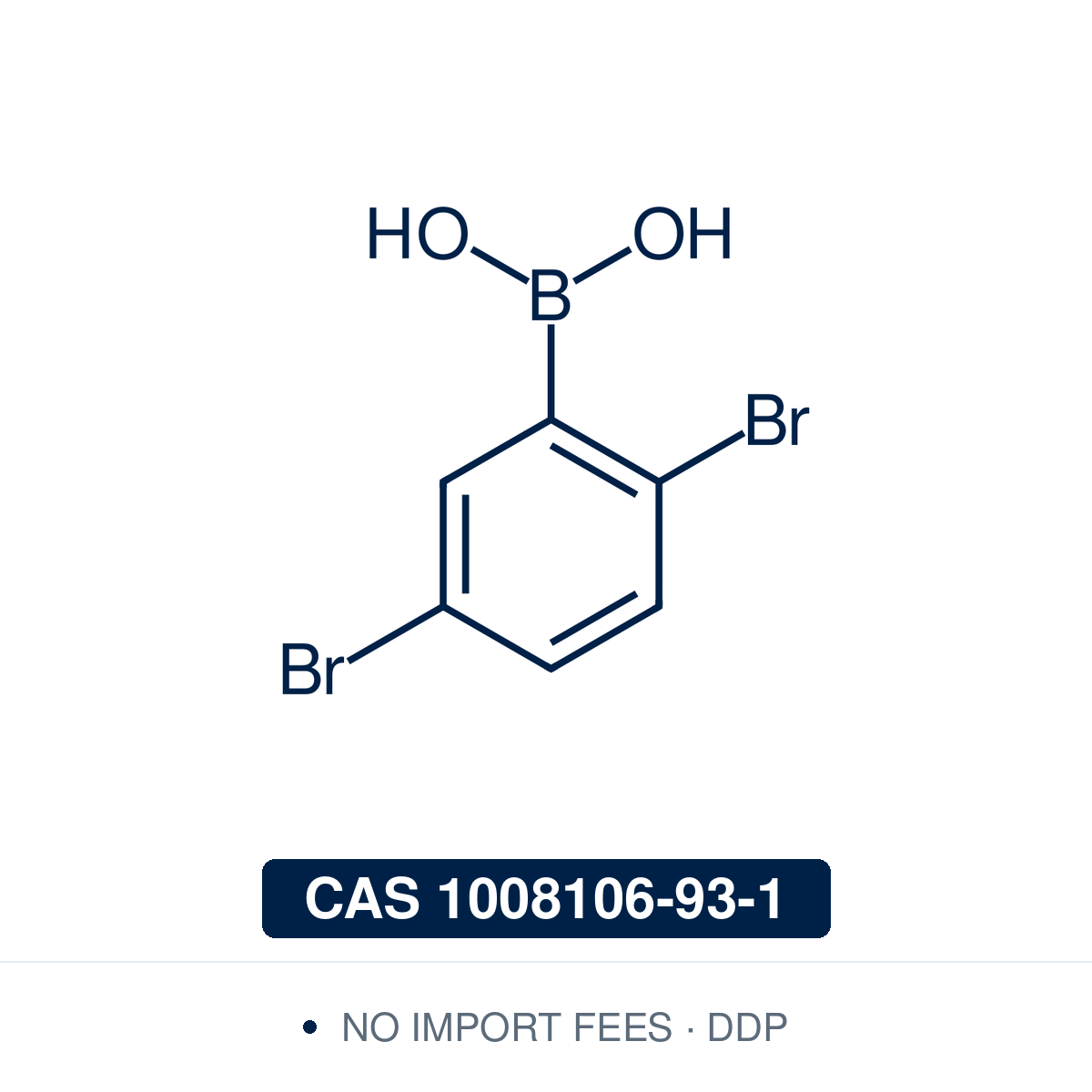
2,5-Dibromophenylboronic Acid
CAS 1008106-93-1
≥98%
2,5-Dibromophenylboronic Acid | CAS 1008106-93-1 | ≥98%
| Pack size | Excl. VAT | Incl. VAT | Add to cart |
|---|---|---|---|
| 1.0 g | €34,90 | ||
| 2.0 g | €59,20 | ||
| 5.0 g | €129,20 | ||
| 10 g | €279,20 | ||
| 25 g | €589,20 |
Taxes and fees, e.g. VAT, included in the price. Shipping calculated at checkout.Free shipping on EU, UK and EFTA orders above €250, and above €400 to the rest of the world.
Technical Specifications
| CAS Number | 1008106-93-1 |
| EC / EINECS Number | 999-188-3 |
| MDL Number | MFCD09743927 |
| SMILES | B(C1=C(C=CC(=C1)Br)Br)(O)O |
| InChI | InChI=1S/C6H5BBr2O2/c8-4-1-2-6(9)5(3-4)7(10)11/h1-3,10-11H |
| InChIKey | CMLBXUUGERIZOO-UHFFFAOYSA-N |
| PubChem CID | 10039281 |
| Molecular Formula | C₆H₅BBr₂O₂ |
| Molecular Weight | 279.72 g/mol |
| Melting Point | 237-241 °C |
| Solubility | Slightly soluble in water; soluble in alcoholic solvents, acetonitrile, DMF, DMSO |
| Purity | ≥98%. May contain small variable amounts of boron anhydrides |
| Physical Form | White to light yellow crystalline powder |
| HS Code | 2931.90 |
| Shelf Life | Retest period: 36 months under recommended storage conditions |
| Storage Conditions | Store at 2–8°C under inert atmosphere. Keep container tightly sealed. Hygroscopic — protect from moisture and air |
Product Description & Scientific Applications
2,5-Dibromophenylboronic Acid ((2,5-Dibromophenyl)boronic Acid, 2,5-Dibromobenzeneboronic Acid) is a trifunctional arylboronic acid building block with two positionally and electronically non-equivalent aryl bromide handles.
Applications and Reactions
- Suzuki–Miyaura coupling: as an arylboronic acid, couples with suitably chosen aryl, heteroaryl, and alkenyl halides or triflates under Pd-catalysed basic conditions to give biaryl, heterobiaryl, and styrene-type products. Because the internal C2 and C5 aryl bromides are themselves potential Pd-oxidative-addition sites, chemoselective coupling at the boronate with retention of both Ar–Br handles is not the automatic outcome of generic Suzuki conditions: it requires deliberately designed conditions (catalyst/ligand choice, base, controlled stoichiometry of the external electrophile, temperature) that favour transmetalation from the boronic acid over oxidative addition into the internal C–Br bonds.
- Sequential cross-coupling on a trifunctional scaffold: after the initial coupling at the boronic acid position under conditions that preserve the Ar–Br bonds, the two remaining C–Br bonds at C2 and C5 are available for sequential Pd-catalysed transformations (Suzuki, Stille, Negishi, Sonogashira, Heck, Buchwald–Hartwig amination, Miyaura borylation), enabling the construction of unsymmetrically trisubstituted phenylene cores from a single building block.
- Protected-boronate lithiation / electrophile-trapping chemistry: the dibromoarylboron framework is related to protected dihalophenylboronate systems (e.g. dihalophenyl dioxazaborocines) used in low-temperature lithiation followed by electrophile trapping, a route to functionalised dihalophenylboronic acid derivatives when the boron centre is suitably protected. This chemistry is best described for suitably protected boronate systems; the unprotected B(OH)₂ form should not be assumed to tolerate organolithium conditions without a substrate-specific procedure.
- Suzuki polycondensation (SPC) monomer: with one boronic acid and two aryl bromides on the same ring, this is an AB₂ monomer. It self-condenses under Suzuki conditions without a comonomer, giving hyperbranched polyarylenes terminated in aryl bromide end groups. The two bromides are inequivalent — ortho (C2) and meta (C5) to boron — so the branching is irregular rather than symmetric. The bromo-terminated periphery is a handle for further functionalisation.
- Chan–Lam-type C–N and C–O coupling: class-level arylboronic-acid chemistry. With Cu(OAc)₂ or related Cu(II) systems and an amine, amide, sulfonamide, carbamate, phenol, or selected alcohol partner under mild aerobic conditions, gives the corresponding N-aryl or O-aryl product at the boronic acid carbon, with the two C–Br bonds normally retained.
- Petasis borono-Mannich reaction: class-level arylboronic-acid chemistry. The boronic acid acts as the aryl donor in a three-component coupling with an amine and an aldehyde, glyoxylic acid, or α-hydroxy aldehyde partner to give arylated amines, including α-aryl glycine and β-amino alcohol scaffolds carrying the 2,5-dibromophenyl group where the substrate is compatible.
Further Reading
For boronic acids, boronic esters, protodeboronation, boroxine content, and Suzuki–Miyaura reagent selection, see NorrChemica's Lab Journal guide: Choosing Your Boron Source for Suzuki–Miyaura Coupling.
Shipping Destinations
- EU & UK: Priority delivery, 2–5 business days.
- United States (DDP): 3–7 business days, duties and taxes prepaid.
- EFTA Countries (DDP): 3–7 business days, duties and taxes prepaid.
- Worldwide: 7–14 business days, selected locations.
Safety Information
| GHS Pictograms |

|
| Signal Word | Warning |
| Hazard Class | None — not subject to transport regulations |
| Transport Category | Not classified as dangerous for transport (ADR/IATA/IMDG) |
| H-Statements | H315 - H319 - H335 |
| P-Statements | P261 - P264 - P271 - P280 - P302+P352 - P305+P351+P338 |
Documentation
| Safety Data Sheet | Download PDF |