NorrChemica™
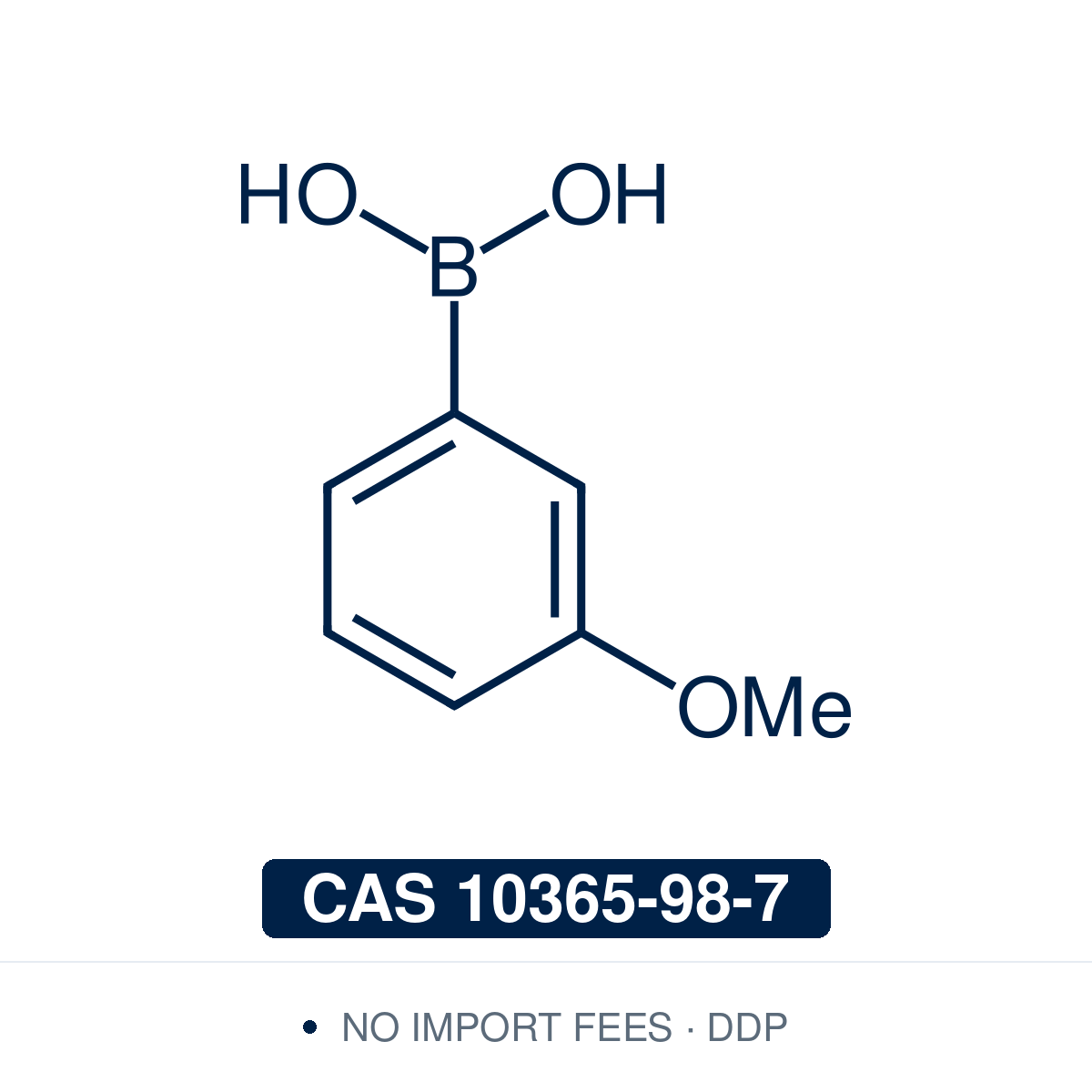
3-Methoxyphenylboronic Acid
3-Methoxyphenylboronic Acid | CAS 10365-98-7 | ≥98%
| Pack size | Excl. VAT | Incl. VAT | Add to cart |
|---|---|---|---|
| 5.0 g−20% | |||
| 10 g−23% | |||
| 25 g−18% | |||
| 50 g−44% | |||
| 100 g−46% | |||
| 250 g−28% | |||
| 500 g−36% | |||
| 1 kg | €995,00 |
Taxes and fees, e.g. VAT, included in the price. Shipping calculated at checkout.Free shipping on EU, UK and EFTA orders above €250, and above €400 to the rest of the world.
Technical Specifications
| CAS Number | 10365-98-7 |
| EC / EINECS Number | 600-467-6 |
| MDL Number | MFCD00039111 |
| SMILES | B(C1=CC(=CC=C1)OC)(O)O |
| InChI | InChI=1S/C7H9BO3/c1-11-7-4-2-3-6(5-7)8(9)10/h2-5,9-10H,1H3 |
| InChIKey | NLLGFYPSWCMUIV-UHFFFAOYSA-N |
| PubChem CID | 2734370 |
| Molecular Formula | C₇H₉BO₃ |
| Molecular Weight | 151.96 g/mol |
| Melting Point | 160–163 °C |
| Solubility | Slightly soluble in water; soluble in alcoholic solvents, acetonitrile, DMF, DMSO. |
| Purity | ≥98%. May contain small variable amounts of boron anhydrides |
| Physical Form | White to light beige crystalline powder |
| HS Code | 2931.90 |
| Shelf Life | Retest period: 36 months from date of manufacture. |
| Storage Conditions | Store at room temperature. Keep container tightly closed in a dry place. Mildly hygroscopic — protect from moisture |
Product Description & Scientific Applications
3-Methoxyphenylboronic Acid (m-anisylboronic acid, m-methoxybenzeneboronic acid) is an arylboronic acid often used in medicinal-chemistry, agrochemical, and fine-chemical synthesis. At the meta position, the methoxy group does not donate electron density to the boronic-acid-bearing carbon by resonance; its net Hammett effect is weakly electron-withdrawing (σm ≈ +0.12), giving a boronic-acid pKa estimated near 8.5 and close to phenylboronic acid. After cross-coupling, the methoxy substituent can serve as a masked phenol, allowing later access to 3-hydroxyaryl products.
The product may contain small amounts of the cyclic anhydride 3-methoxyphenylboroxine; under aqueous or basic coupling conditions the two forms re-equilibrate and the impact on yield is minor.
Applications and Reactions
- Suzuki–Miyaura coupling: couples with aryl, heteroaryl, vinyl, and alkenyl electrophiles to give 3-methoxybiaryls and related aryl-substituted products. The meta-methoxy group is usually carried through the coupling as an intact aryl ether, which makes the reagent useful for installing a masked 3-hydroxyphenyl motif on the coupled scaffold.
- Methoxy-to-phenol unmasking: after coupling, the methoxy ether on the 3-methoxybiaryl can be cleaved by BBr3, AlCl3, or thiolate-based demethylation to give the 3-hydroxybiaryl. The free phenol can be alkylated or acylated, or converted to an aryl sulfonate such as a triflate for subsequent C–C or C–N cross-coupling.
- Rh-catalysed conjugate addition: 3-methoxyphenylboronic acid has been used as the aryl donor in rhodium-catalysed asymmetric 1,4-addition to β-aryl-α,β-unsaturated ketones and tert-butyl cinnamate-type esters. Under [Rh(nbd)2]BF4/(S,S)-chiraphos catalysis, the 3-methoxyphenyl group is transferred to the β-carbon to give enantioenriched β-diaryl carbonyl products.
- Oxidative ipso-hydroxylation: aqueous hydrogen peroxide under basic conditions can replace B(OH)2 with hydroxyl at the same carbon to give 3-methoxyphenol. This route is distinct from methoxy-to-phenol unmasking: ipso-hydroxylation cleaves the C–B bond on the boronic acid itself, while demethylation cleaves the methyl ether on a coupled product.
- Chan–Lam N/O arylation: arylboronic acids can undergo copper-mediated oxidative coupling with N- and O-nucleophiles under air. The 3-methoxyphenyl analogue may be used where the selected Chan–Lam method tolerates anisylboronic acids.
- Petasis borono-Mannich: arylboronic acids can participate in metal-free three-component coupling with amines and carbonyl partners to give α-aryl amines, α-amino acids, or β-amino alcohols. Use of the 3-methoxyphenyl analogue depends on the chosen Petasis method and substrate set.
- Ipso-halodeboronation: organoboron halodeboronation methods can replace B(OH)2 with Br, Cl, or I, providing a route to meta-haloanisole motifs (3-bromoanisole, 3-chloroanisole, 3-iodoanisole) when the substrate and halogenation method are compatible. This complements classical electrophilic aromatic substitution of anisole, where the methoxy group favours ortho/para substitution.
Further Reading
For boronic acids, boronic esters, protodeboronation, boroxine content, and Suzuki–Miyaura reagent selection, see NorrChemica's Lab Journal guide: Choosing Your Boron Source for Suzuki–Miyaura Coupling.
Shipping Destinations
- EU & UK: Priority delivery, 2–5 business days.
- United States (DDP): 3–7 business days, duties and taxes prepaid.
- EFTA Countries (DDP): 3–7 business days, duties and taxes prepaid.
- Worldwide: 7–14 business days, selected locations.
Safety Information
| GHS Pictograms |

|
| Signal Word | Warning |
| Hazard Class | None — not subject to transport regulations |
| Transport Category | Not classified as dangerous goods for transport (ADR/IATA/IMDG) |
| H-Statements | H302 - H315 - H319 - H335 |
| P-Statements | P261 - P264 - P271 - P280 - P301+P312 - P302+P352 - P305+P351+P338 - P332+P317 - P337+P317 - P362 - P403+P233 - P405 - P501 |
Documentation
| Safety Data Sheet | Download PDF |