NorrChemica™
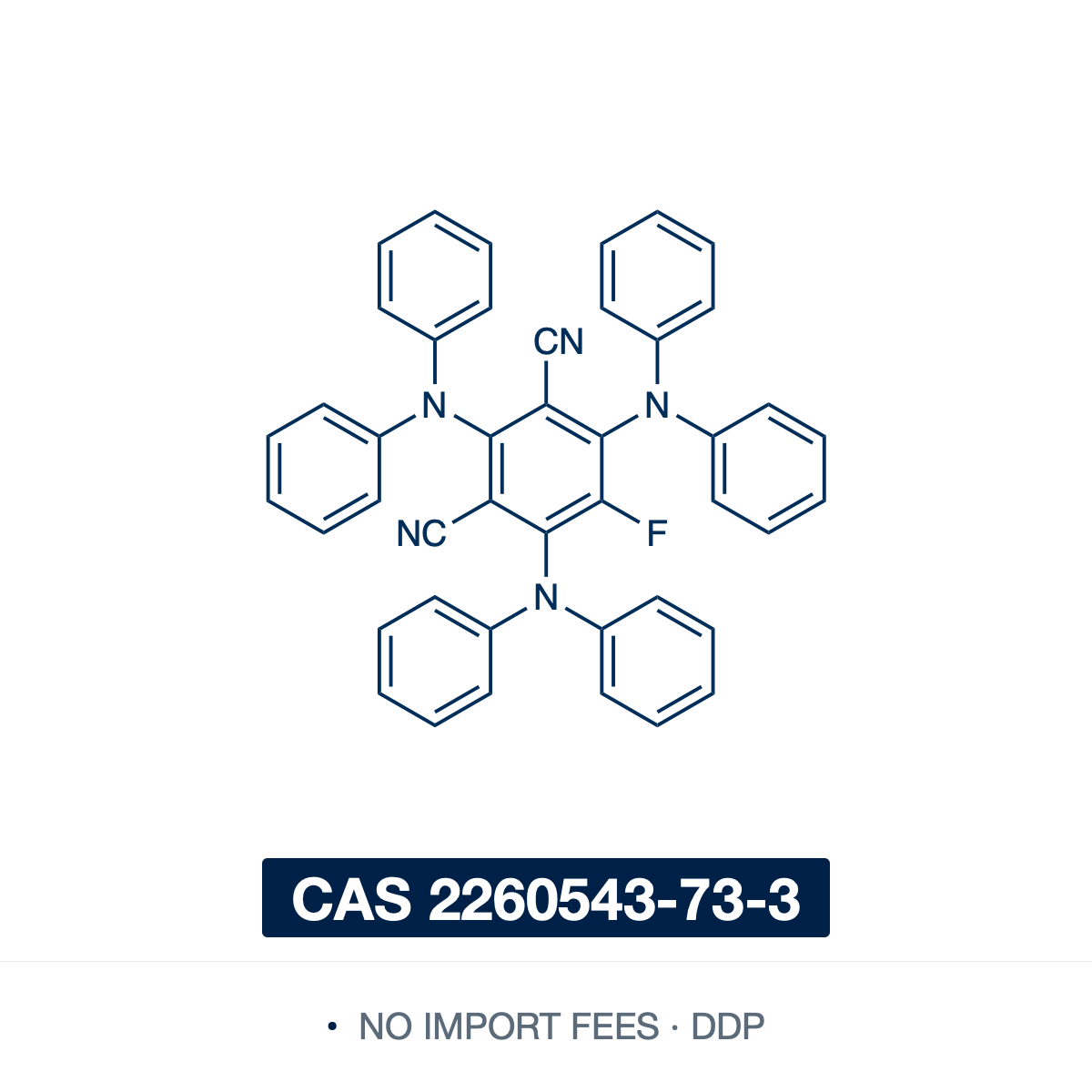
3DPAFIPN
3DPAFIPN | CAS 2260543-73-3 | ≥97%
| Pack size | Excl. VAT | Incl. VAT | Add to cart |
|---|---|---|---|
| 100 mg | €98,20 | ||
| 250 mg | €189,20 | ||
| 1.0 g | €539,20 | ||
| 2.0 g | €995,00 |
Taxes and fees, e.g. VAT, included in the price. Shipping calculated at checkout.Free shipping on EU, UK and EFTA orders above €250, and above €400 to the rest of the world.
Technical Specifications
| CAS Number | 2260543-73-3 |
| MDL Number | MFCD32062492 |
| SMILES | C1=CC=C(C=C1)N(C2=CC=CC=C2)C3=C(C(=C(C(=C3C#N)N(C4=CC=CC=C4)C5=CC=CC=C5)F)N(C6=CC=CC=C6)C7=CC=CC=C7)C#N |
| InChI | InChI=1S/C44H30FN5/c45-41-43(49(35-23-11-3-12-24-35)36-25-13-4-14-26-36)39(31-46)42(48(33-19-7-1-8-20-33)34-21-9-2-10-22-34)40(32-47)44(41)50(37-27-15-5-16-28-37)38-29-17-6-18-30-38/h1-30H |
| InChIKey | GCGRXVMGBHYMDA-UHFFFAOYSA-N |
| PubChem CID | 146014084 |
| Molecular Formula | C₄₄H₃₀FN₅ |
| Molecular Weight | 647.7 g/mol |
| Melting Point | 307–401 °C |
| Solubility | Soluble in acetonitrile. Practically insoluble in water. |
| Purity | ≥97% |
| Physical Form | Yellow crystalline solid |
| HS Code | 2926.90 |
| Shelf Life | Retest period: 36 months from date of manufacture |
| Storage Conditions | Store refrigerated at 3–5 °C in a well-ventilated place. Keep the container tightly closed. |
Product Description & Scientific Applications
3DPAFIPN (2,4,6-tris(diphenylamino)-5-fluoroisophthalonitrile) is a metal-free organic photoredox catalyst. It is a donor–acceptor cyanoarene: three diphenylamino donor groups and a fluorine atom surround a dicyanobenzene (isophthalonitrile) acceptor core.
Thermally activated delayed fluorescence. The lowest singlet and triplet excited states lie close in energy, so the triplet repopulates the emissive singlet by reverse intersystem crossing. This sustains a long-lived singlet excited state, the feature ordinary organic dyes lack because they decay too quickly for efficient bimolecular reactions.
Absorption and emission. In N,N-dimethylacetamide the catalyst shows a charge-transfer absorption maximum at 498 nm and emits at 536 nm, its excited state combining prompt fluorescence (3.6 ns) with delayed fluorescence (43 μs).
Photoredox behaviour. Under blue-light irradiation the excited catalyst drives single-electron transfer to or from a substrate, and returns to its ground state each cycle. Its diphenylamino donors are more electron-rich than the carbazole donors of related cyanoarene catalysts, raising the HOMO and pushing absorption further into the visible. Cyclic voltammetry gives a first reduction potential of −1.94 V vs Fc⁺/Fc, more negative than the carbazole analogues 4CzIPN (−1.72 V) and 3CzClIPN (−1.61 V), so its one-electron-reduced form is a stronger reductant. It is an organic alternative to iridium and ruthenium photocatalysts.
Bond formation. It mediates visible-light C–C, C–N and C–P bond formation and intramolecular cyclisations.
Heterocycle synthesis. At 0.2 mol% under air at room temperature it drives the radical Biginelli synthesis of 3,4-dihydropyrimidin-2-(1H)-ones and thiones in ethanol, and the Knoevenagel–Michael assembly of pyrano[2,3-d]pyrimidines in water, both at gram scale, in several reported protocols via a consecutive visible-light-induced electron-transfer (conPET) pathway.
Shipping Destinations
- EU & UK: Priority delivery, 2–5 business days.
- United States (DDP): 3–7 business days, duties and taxes prepaid.
- EFTA Countries (DDP): 3–7 business days, duties and taxes prepaid.
- Worldwide: 7–14 business days, selected locations.
Safety Information
| GHS Pictograms |

|
| Signal Word | Warning |
| Hazard Class | Not regulated for transport |
| Transport Category | Not classified as dangerous goods for transport (ADR/IATA/IMDG) |
| H-Statements | H315 - H319 - H335 |
| P-Statements | P261 - P264 - P271 - P280 - P302+P352 - P305+P351+P338 - P312 - P337+P313 - P501 |
Documentation
| Safety Data Sheet | Download PDF |