NorrChemica™
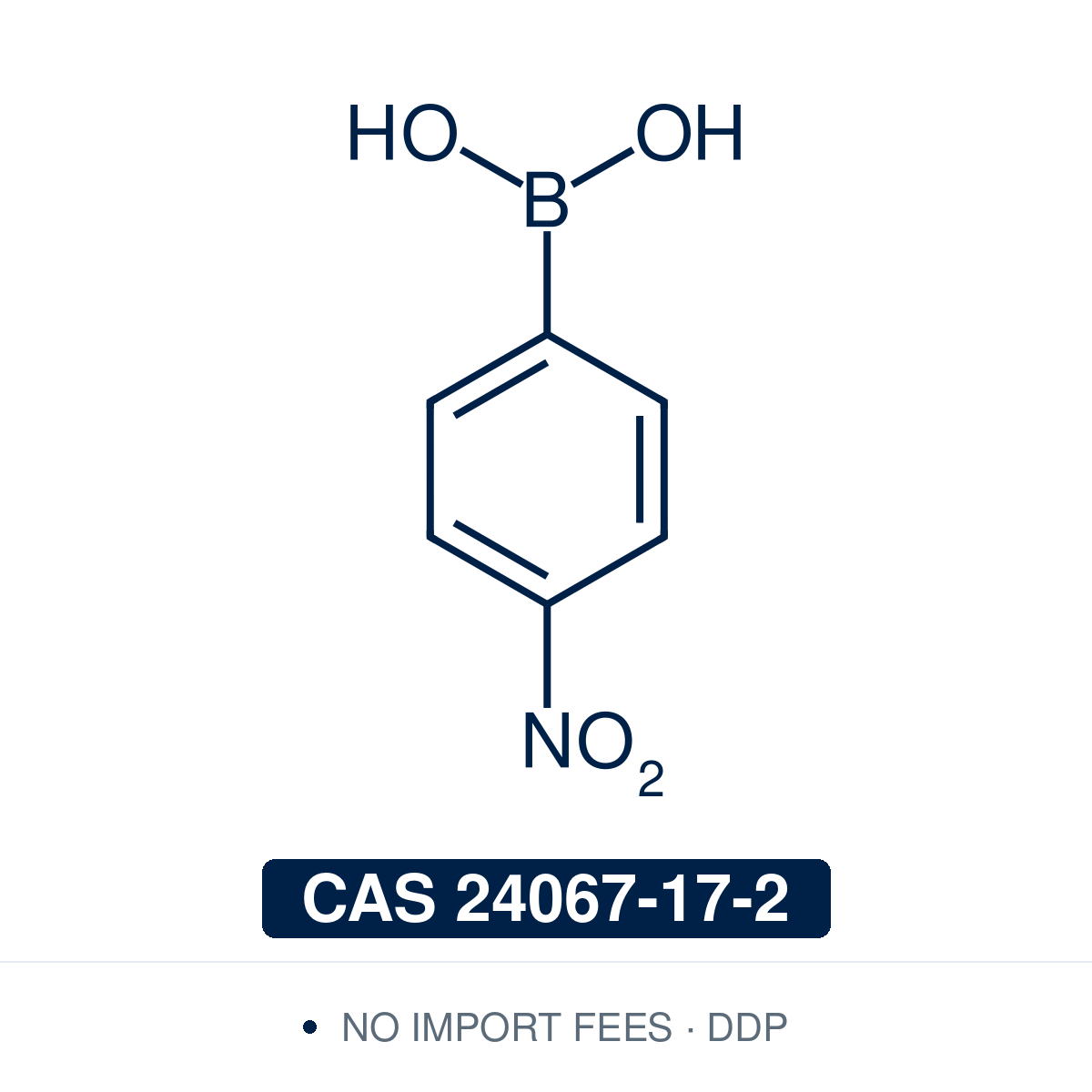
4-Nitrophenylboronic Acid
4-Nitrophenylboronic Acid | CAS 24067-17-2 | ≥98%
Couldn't load pickup availability
Technical Specifications
| CAS Number | 24067-17-2 |
| EC / EINECS Number | 627-647-7 |
| MDL Number | MFCD00161360 |
| SMILES | B(C1=CC=C(C=C1)[N+](=O)[O-])(O)O |
| InChI | InChI=1S/C6H6BNO4/c9-7(10)5-1-3-6(4-2-5)8(11)12/h1-4,9-10H |
| InChIKey | NSFJAFZHYOAMHL-UHFFFAOYSA-N |
| PubChem CID | 2773552 |
| Molecular Formula | C₆H₆BNO₄ |
| Molecular Weight | 166.93 g/mol |
| Melting Point | 285-290 °C (dec.) |
| Solubility | Slightly soluble in water; soluble in alcoholic solvents, acetonitrile, DMF, DMSO. |
| Log Pow | 0.96 |
| Purity | ≥98%. May contain small variable amounts of boron anhydrides |
| Physical Form | Pale yellow to yellow crystalline powder |
| HS Code | 2931.90 |
| Shelf Life | Retest period: 36 months from date of manufacture |
| Storage Conditions | Store at room temperature. Keep container tightly closed in a dry place. Mildly hygroscopic — protect from moisture |
Product Description & Scientific Applications
4-Nitrophenylboronic Acid (4-nitrobenzeneboronic acid, p-nitrophenylboronic acid) is a highly electron-deficient arylboronic acid generally used as a building block in medicinal chemistry, agrochemical development, and the synthesis of electron-poor π-conjugated materials. The presence of the para-nitro group strongly withdraws electron density from both the aromatic ring and the boronic-acid center (σp = +0.78). This extreme electron withdrawal gives the compound an unusually low pKa of approximately 7.1—well below that of standard phenylboronic acid (≈ 8.8)—ensuring that substantial boronate fraction exists even at near-neutral pH. Notably, while it possesses high Lewis acidity, its rate of protodeboronation is dictated by the full substitution pattern rather than pKa alone. Beyond its role as an aryl-transfer reagent, the nitro group provides a valuable orthogonal handle post-coupling; it can be readily reduced to an aniline derivative, unlocking a vast array of downstream transformations via diazonium chemistry.
May contain small amounts of the cyclic anhydride 4-nitrophenylboroxine. Under aqueous or basic coupling conditions, the two forms re-equilibrate and the impact on yield is minor.
Applications and Reactions
- Suzuki–Miyaura coupling: with aryl, heteroaryl, and alkenyl electrophiles to give 4-nitrobiaryls and related products. Ligand-free Pd-catalysed protocols are reported.
- Nitro group transformations: the para-nitro group is an orthogonal handle on the coupled biaryl. Catalytic hydrogenation or chemical reduction (Sn/HCl, Fe/HCl, Zn, SnCl2) gives the 4-aminobiaryl; partial reduction gives nitroso, hydroxylamine, or azo intermediates. The aniline allows accessing Sandmeyer chemistry — halides, phenols, cyanides, fluorides (Balz–Schiemann), azides, and arenes.
- Lewis acidity and Hammett reference: σp(NO2) = +0.78 and pKa ≈ 7.1 place 4-nitrophenylboronic acid at the electron-poor end of common arylboronic acids — useful for comparing substituent effects on ionisation.
- Petasis borono-Mannich: metal-free three-component coupling with amine and carbonyl partners gives α-(4-nitrophenyl) amines, amino acids, or β-amino alcohols.
- Rhodium-catalysed 1,4-addition: a heterogeneous Rh-grafted hydrotalcite catalyst performs achiral 1,4-addition of organoboron reagents to electron-deficient olefins. Homogeneous chiral Rh systems with chiral diene or BINAP ligands extend the same chemistry to enantioselective conjugate addition.
- Palladium-catalysed direct arylation: the 4-nitroaryl source in Pd-catalysed C–H arylation of arenes and heteroarenes.
- Tandem Pd sequence: regioselective Suzuki–Miyaura followed by tandem Pd(II) intramolecular aminocarbonylation/annulation, giving N-heterocycles with a 4-nitroaryl substituent.
- Ruthenium-catalysed direct arylation: reported for benzylic sp3 C–H arylation of acyclic amines using a pyridyl directing group, giving α-(4-nitroaryl) amines.
- Copper-catalysed Chan–Lam N-arylation of ureas: Cu(acac)2-catalysed N-arylation of phenylurea and related ureas, giving 4-nitroaryl ureas.
- Copper-mediated cyanation: Cu-mediated conversion of arylboronic acids to aryl nitriles. For this substrate, gives 4-nitrobenzonitrile — a precursor to tetrazoles, amidines, and primary amides.
- Regioselective glycosylation of unprotected sugars: Tanaka and co-workers report 4-nitrophenylboronic acid as a catalyst for regio- and 1,2-cis-stereoselective SNi-type glycosylation of 1,2-anhydro donors with unprotected sugar acceptors in water. Reversible boronate formation with cis-diols on the acceptor directs the glycosylation site — the compound acts as a diol-recognition catalyst rather than as an aryl-transfer reagent.
- Protected boronate esters: precursor to Bpin, neopentyl glycol, MIDA, and Bdan esters for iterative cross-coupling and easier chromatography.
- Non-classical arylation: coupling with arenediazonium tetrafluoroborates as alternative aryl electrophiles.
- Ipso-halodeboronation: arylboronic-acid halodeboronation methods can replace B(OH)2with Br, Cl, or I, giving access to para-halonitrobenzene motifs such as 4-bromo-, 4-chloro-, or 4-iodonitrobenzene depending on the halogen source and conditions.
- Oxidative ipso-hydroxylation: peroxide or perborate gives 4-nitrophenol under mild conditions; Cu/aerobic and Fe-mediated variants offer alternative oxidants.
Further Reading
For boronic acids, boronic esters, protodeboronation, boroxine content, and Suzuki–Miyaura reagent selection, see NorrChemica's Lab Journal guide: Choosing Your Boron Source for Suzuki–Miyaura Coupling.
Shipping Destinations
- EU & UK: Priority delivery, 2–5 business days.
- United States (DDP): 3–7 business days, duties and taxes prepaid.
- EFTA Countries (DDP): 3–7 business days, duties and taxes prepaid.
- Worldwide: 7–14 business days, selected locations.
Safety Information
| GHS Pictograms |

|
| Signal Word | Warning |
| Hazard Class | None — not subject to transport regulations |
| Transport Category | Not classified as dangerous goods for transport (ADR/IATA/IMDG) |
| H-Statements | H315 - H319 - H335 |
| P-Statements | P261 - P264 - P271 - P280 - P302+P352 - P304+P340 - P305+P351+P338 - P332+P313 - P337+P313 - P362+P364 - P501 |
Documentation
| Safety Data Sheet | Download PDF |