NorrChemica™
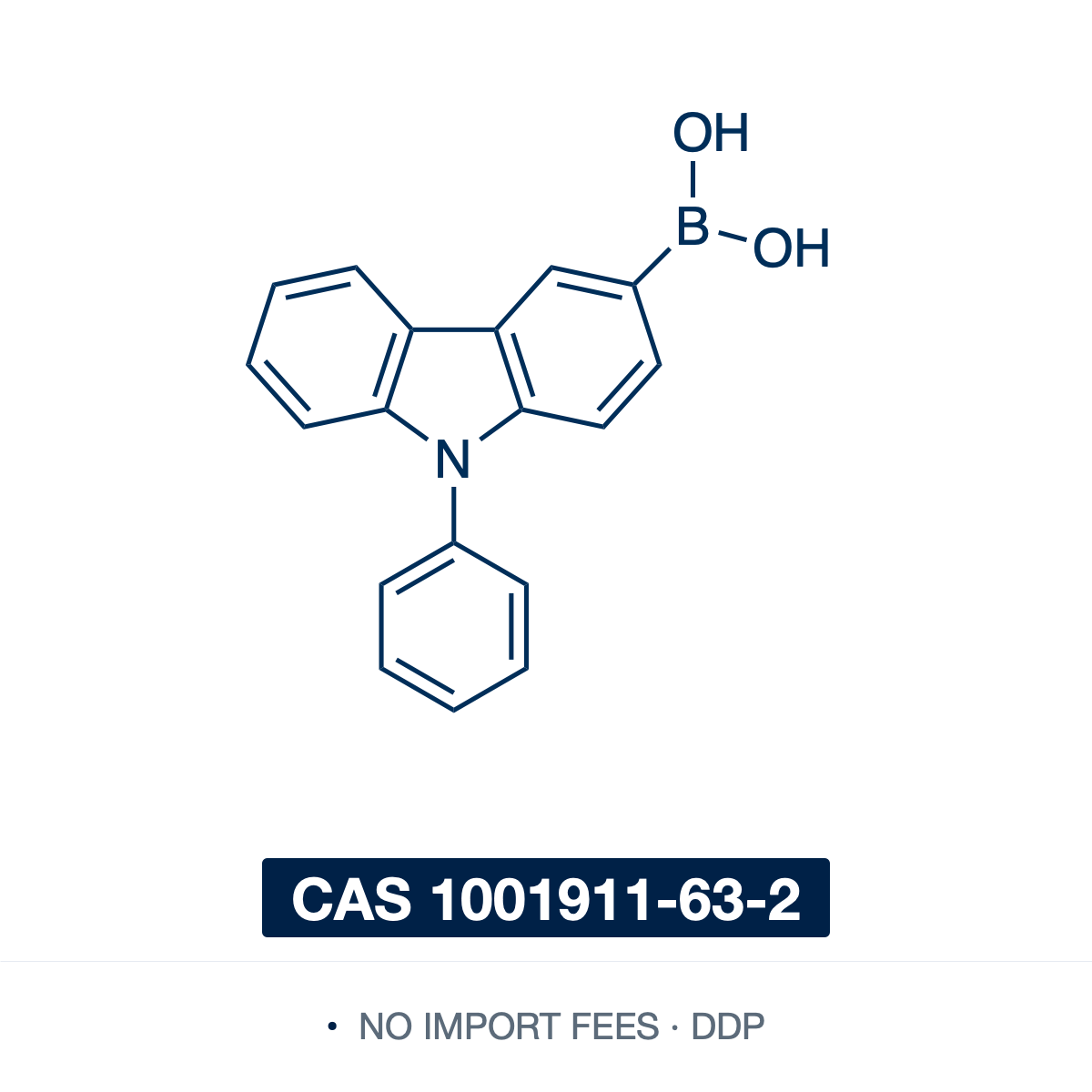
(9-Phenyl-9H-carbazol-2-yl)boronic acid
(9-Phenyl-9H-carbazol-2-yl)boronic acid | CAS 1001911-63-2 | ≥98%
| Pack size | Excl. VAT | Incl. VAT | Add to cart |
|---|---|---|---|
| 100 mg | €29,20 | ||
| 250 mg | €39,20 | ||
| 1 g | €49,20 | ||
| 2 g | €64,20 | ||
| 5 g | €79,20 | ||
| 10 g | €129,20 |
Taxes and fees, e.g. VAT, included in the price. Shipping calculated at checkout.Free shipping on EU, UK and EFTA orders above €250, and above €400 to the rest of the world.
Technical Specifications
| CAS Number | 1001911-63-2 |
| EC / EINECS Number | 808-209-6 |
| MDL Number | MFCD22207050 |
| SMILES | B(C1=CC2=C(C=C1)C3=CC=CC=C3N2C4=CC=CC=C4)(O)O |
| InChI | InChI=1S/C18H14BNO2/c21-19(22)13-10-11-16-15-8-4-5-9-17(15)20(18(16)12-13)14-6-2-1-3-7-14/h1-12,21-22H |
| InChIKey | XSAOVBUSKVZIBE-UHFFFAOYSA-N |
| PubChem CID | 67286243 |
| Molecular Formula | C₁₈H₁₄BNO₂ |
| Molecular Weight | 287.1 g/mol |
| Solubility | Soluble in common organic solvents (THF, dichloromethane, chloroform, ethyl acetate, hot toluene) and compatible with methanol/ethanol as co-solvents; poorly soluble in water. |
| Purity | ≥98% |
| Physical Form | White to yellowish crystalline solid |
| HS Code | 2931.90 |
| Shelf Life | Retest period: 36 months from date of manufacture |
| Storage Conditions | Store in a cool, dry place in a tightly sealed container |
Product Description & Scientific Applications
(9-Phenyl-9H-carbazol-2-yl)boronic acid is an arylboronic acid in which boron is bonded at the 2-position of a carbazole that carries a phenyl group on its nitrogen (the 9-position).
Suzuki–Miyaura coupling. In palladium-catalysed Suzuki–Miyaura cross-coupling the boronic acid is the nucleophilic partner, transferring the 9-phenylcarbazol-2-yl group to an aryl or heteroaryl halide to form a new carbon–carbon bond. Carbazole-2-boronic acids serve in this role: a carbazole-2,7-diboronic acid, for example, couples with an aryl bromide to give the 2,7-diarylcarbazole.
The 2-position. The carbazole's 3,6-positions are the ones that readily react with electrophiles, so the 2-position is not the default site of functionalisation; a pre-formed 2-boronic acid gives direct access to the carbazole long (2,7) axis. Where the ring is joined sets its electronic behaviour: substitution at the 2,7-positions narrows the band gap more than substitution at the 3,6-positions. In otherwise identical carbazole copolymers the 2,7-connected isomer absorbs at lower energy than the 3,6-connected isomer and shows a hole mobility about an order of magnitude higher, together with a more suitable highest-occupied-molecular-orbital level for extracting holes.
Optoelectronic materials. Carbazole-based conjugated polymers are used across organic electronics for their tunable optical and electrical properties. Poly(3,6-carbazole) derivatives have been applied in organic light-emitting diodes and show redox, nonlinear-optical and photorefractive activity, while 2,7-carbazole copolymers generally outperform their 3,6-counterparts in organic field-effect transistors, bulk-heterojunction solar cells, and thermoelectric and electrical-memory devices. As a solution-processable hole-transport layer in perovskite solar cells, a 2,7-carbazole copolymer reached 4.47% power-conversion efficiency, exceeding the 3,6-linked analogue.
Host materials. Carbazole is also a standard host for guest emitters in phosphorescent organic light-emitting devices, a role that requires the wide band gap and high triplet energy needed to prevent energy back-transfer from the dye. That high triplet energy originates in the reduced aromaticity of the central five-membered ring, which weakens conjugation between it and the flanking benzene rings; extending conjugation, as the 2,7-axis does, lowers it. This boronic acid therefore builds the conjugation-extended, charge-transporting members of the carbazole family rather than wide-gap hosts.
Shipping Destinations
- EU & UK: Priority delivery, 2–5 business days.
- United States (DDP): 3–7 business days, duties and taxes prepaid.
- EFTA Countries (DDP): 3–7 business days, duties and taxes prepaid.
- Worldwide: 7–14 business days, selected locations.
Safety Information
| GHS Pictograms |

|
| Signal Word | Warning |
| Hazard Class | Not regulated for transport |
| Transport Category | Not classified as dangerous goods for transport (ADR/IATA/IMDG) |
| H-Statements | H315 - H319 - H335 |
| P-Statements | P261 - P264 - P271 - P280 - P302+P352 - P304+P340 - P305+P351+P338 - P312 - P321 - P332+P313 - P337+P313 - P362+P364 - P403+P233 - P405 - P501 |
Documentation
| Safety Data Sheet | Download PDF |