NorrChemica™
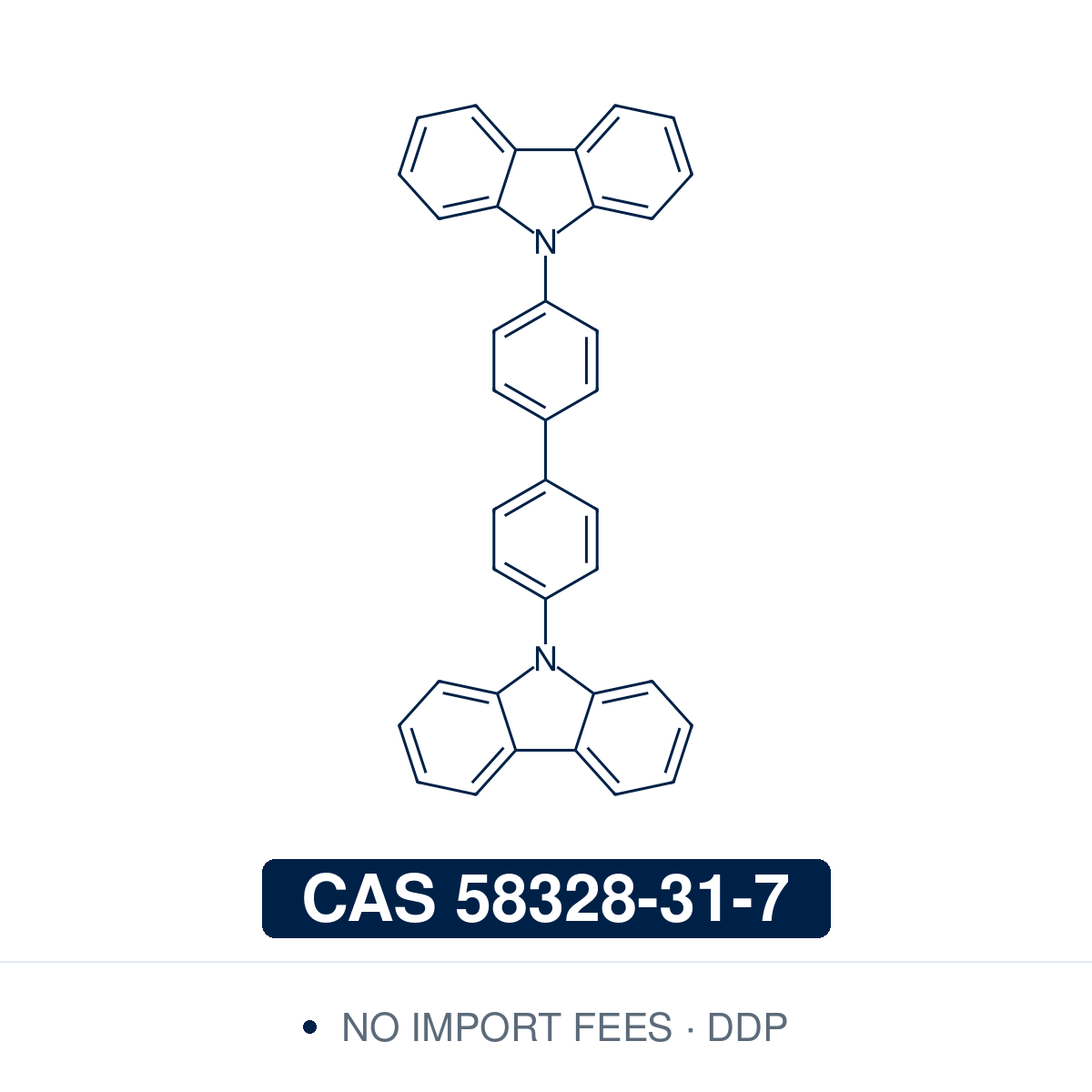
CBP
CBP | CAS 58328-31-7 | ≥97%
| Pack size | Excl. VAT | Incl. VAT | Add to cart |
|---|---|---|---|
| 1 g | €24,90 | ||
| 2 g | €43,20 | ||
| 5 g | €69,20 | ||
| 10 g | €124,20 | ||
| 25 g | €249,20 | ||
| 50 g | €479,20 |
Taxes and fees, e.g. VAT, included in the price. Shipping calculated at checkout.Free shipping on EU, UK and EFTA orders above €250, and above €400 to the rest of the world.
Technical Specifications
| CAS Number | 58328-31-7 |
| EC / EINECS Number | 627-757-5 |
| MDL Number | MFCD00093417 |
| SMILES | C1=CC=C2C(=C1)C3=CC=CC=C3N2C4=CC=C(C=C4)C5=CC=C(C=C5)N6C7=CC=CC=C7C8=CC=CC=C86 |
| InChI | InChI=1S/C36H24N2/c1-5-13-33-29(9-1)30-10-2-6-14-34(30)37(33)27-21-17-25(18-22-27)26-19-23-28(24-20-26)38-35-15-7-3-11-31(35)32-12-4-8-16-36(32)38/h1-24H |
| InChIKey | VFUDMQLBKNMONU-UHFFFAOYSA-N |
| PubChem CID | 11248716 |
| Molecular Formula | C₃₆H₂₄N₂ |
| Molecular Weight | 484.6 g/mol |
| Melting Point | 281–285 °C |
| Solubility | Soluble in THF, chloroform, and dichloromethane. Practically insoluble in water. |
| Purity | ≥97% |
| Physical Form | White to light yellow crystalline powder |
| HS Code | 2933.99 |
| Shelf Life | Retest period: 36 months from date of manufacture |
| Storage Conditions | Store in a cool, dry place in a tightly sealed container, protected from light. |
Product Description & Scientific Applications
CBP (4,4′-bis(N-carbazolyl)-1,1′-biphenyl; also DCBP) is a carbazole-based semiconductor: two N-carbazole units bridged by a central biphenyl core. It is the benchmark host for green and red phosphorescent organic light-emitting diodes (PhOLEDs).
Charge transport. The electron-rich carbazole units make CBP a hole-dominated transporter. Its HOMO is deep — near −6.0 eV by photoemission (shallower, ~−5.6 eV, by cyclic voltammetry) — and delocalised across the molecule, while the LUMO sits mainly on the central biphenyl. Neat films conduct both carriers, with hole mobility near 2×10⁻³ and electron mobility near 3×10⁻⁴ cm²V⁻¹s⁻¹.
Triplet energy and exciton confinement. A phosphorescent host must hold a triplet energy above that of its dopant to keep excitons on the emitter. CBP's triplet, ≈2.56 eV, clears green and red phosphors but falls below blue dopants such as FIrpic (2.62–2.65 eV). The deficit opens an endothermic back-transfer channel from emitter to host, so CBP does not serve blue devices.
Host for TADF emitters. CBP also hosts thermally activated delayed fluorescence (TADF) emitters. As a low-polarity matrix, it stabilises the emitter's charge-transfer state only weakly — in contrast to high-polarity phosphine-oxide hosts such as DPEPO.
Processing. CBP dissolves freely in common organic solvents. Device-grade material is purified by vacuum sublimation, and device layers are grown by thermal vacuum evaporation.
Solid-state behaviour. The molecule crystallises in a herringbone motif and has a glass transition near 62 °C. Devices rely on a metastable glass set by rapid cooling; because room temperature lies above Tg, the film is effectively a supercooled liquid that drifts back toward the crystalline state — a morphological-stability constraint on film and device design.
Optical signature. In dichloromethane, absorption at 293 and 340 nm arises from the carbazole units and a band at 317 nm from the central biphenyl. Emission is governed by the biphenyl, and CBP films do not form excimers.
Shipping Destinations
- EU & UK: Priority delivery, 2–5 business days.
- United States (DDP): 3–7 business days, duties and taxes prepaid.
- EFTA Countries (DDP): 3–7 business days, duties and taxes prepaid.
- Worldwide: 7–14 business days, selected locations.
Safety Information
| GHS Pictograms |


|
| Signal Word | Danger |
| Hazard Class | Not regulated for transport |
| Transport Category | Not classified as dangerous goods for transport (ADR/IATA/IMDG) |
| H-Statements | H315 - H318 - H335 |
| P-Statements | P261 - P264 - P271 - P280 - P302+P352 - P304+P340 - P305+P351+P338 - P310 - P332+P313 - P362+P364 - P403+P233 - P405 - P501 |
Documentation
| Safety Data Sheet | Download PDF |