NorrChemica™
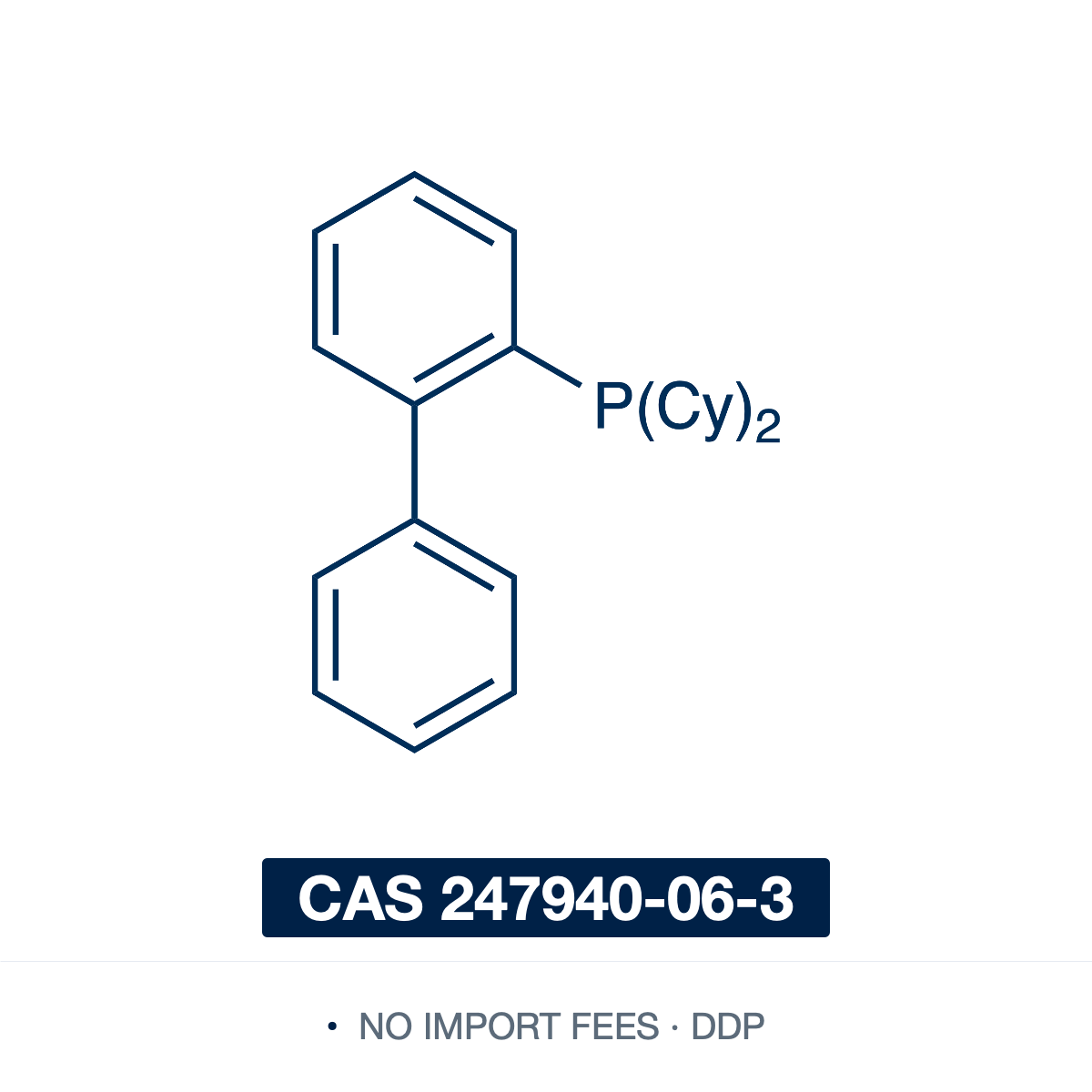
CyJohnPhos
CyJohnPhos | CAS 247940-06-3 | ≥98%
| Pack size | Excl. VAT | Incl. VAT | Add to cart |
|---|---|---|---|
| 1 g | €21,90 | ||
| 2 g | €34,90 | ||
| 5 g | €45,20 | ||
| 10 g | €74,90 | ||
| 25 g | €109,90 | ||
| 50 g | €189,80 | ||
| 100 g | €298,20 |
Taxes and fees, e.g. VAT, included in the price. Shipping calculated at checkout.Free shipping on EU, UK and EFTA orders above €250, and above €400 to the rest of the world.
Technical Specifications
| CAS Number | 247940-06-3 |
| EC / EINECS Number | 607-439-2 |
| MDL Number | MFCD01862441 |
| SMILES | C1CCC(CC1)P(C2CCCCC2)C3=CC=CC=C3C4=CC=CC=C4 |
| InChI | InChI=1S/C24H31P/c1-4-12-20(13-5-1)23-18-10-11-19-24(23)25(21-14-6-2-7-15-21)22-16-8-3-9-17-22/h1,4-5,10-13,18-19,21-22H,2-3,6-9,14-17H2 |
| InChIKey | LCSNDSFWVKMJCT-UHFFFAOYSA-N |
| PubChem CID | 2734216 |
| Molecular Formula | C₂₄H₃₁P |
| Molecular Weight | 350.48 g/mol |
| Melting Point | 102-106 °C |
| Solubility | Soluble in common organic solvents, insoluble in water |
| Log Pow | 9.682 |
| Purity | ≥98% |
| Physical Form | White to off-white crystalline powder |
| HS Code | 2931.49 |
| Country of Origin | Finland |
| Shelf Life | Retest period: 36 months from date of manufacture |
| Storage Conditions | Store in a cool, dry place in a tightly sealed container |
Product Description & Scientific Applications
CyJohnPhos ((2-biphenyl)dicyclohexylphosphine; 2-(dicyclohexylphosphino)biphenyl) is a Buchwald-type biaryl monophosphine ligand for palladium-catalysed cross-coupling, introduced to make unactivated aryl chlorides practical coupling partners.
The ligand and the palladium precursors are weighed and handled in air; the coupling itself is run under an inert atmosphere. It is paired with a palladium source such as Pd(OAc)₂ or Pd₂(dba)₃.
Mechanistic basis. The strong σ-donation of the dialkylphosphine and the steric bulk of the biaryl backbone accelerate oxidative addition into the aryl–chlorine bond and facilitate transmetalation (or Pd–N bond formation) and reductive elimination — the combination that brings unactivated aryl chlorides within reach.
Applications and Reactions
- Suzuki–Miyaura coupling: couples aryl chlorides and bromides with arylboronic acids to form biaryls at room temperature, at palladium loadings as low as ~10⁻⁶ mol%, with broad functional-group tolerance and sterically hindered substrates. It was among the first ligands to make unactivated aryl chlorides practical Suzuki partners.
- Buchwald–Hartwig amination: supports palladium-catalysed C–N coupling of aryl chlorides and bromides with amines to give aromatic amines.
- Direct C–H (het)arylation: with palladium acetate and an inorganic base, arylates indoles, pyrroles and furans directly with aryl chlorides — electron-rich, electron-poor and chloropyridine partners included — building the aryl–heteroaryl bond in one step.
- Nickel-catalysed stereospecific coupling: beyond palladium, CyJohnPhos also serves nickel catalysis — with Ni(cod)₂ or an air-stable Ni(II) salt it drives stereospecific Suzuki–Miyaura arylation of tertiary benzylic esters, through activation of the benzylic C–O bond, with aryl boroxines or boronates. Enantioenriched substrates are carried through with stereoretention to diaryl and triaryl all-carbon quaternary stereocentres in high yield.
Further reading: For phosphine-ligand selection, palladium sources and precatalysts, and Suzuki–Miyaura and Buchwald–Hartwig reagent choice, see NorrChemica's Lab Journal guide: Choosing a Phosphine Ligand for Cross-Coupling: A Practical Guide.
Shipping Destinations
- EU & UK: Priority delivery, 2–5 business days.
- United States (DDP): 3–7 business days, duties and taxes prepaid.
- EFTA Countries (DDP): 3–7 business days, duties and taxes prepaid.
- Worldwide: 7–14 business days, selected locations.
Safety Information
| GHS Pictograms |

|
| Signal Word | Warning |
| Hazard Class | Not regulated for transport |
| Transport Category | Not classified as dangerous goods for transport (ADR/IATA/IMDG) |
| H-Statements | H315 - H319 - H335 |
| P-Statements | P264 - P280 - P302+P352 - P305+P351+P338 - P332+P313 - P337+P313 - P362+P364 - P501 |
Documentation
| Safety Data Sheet | Download PDF |