NorrChemica™
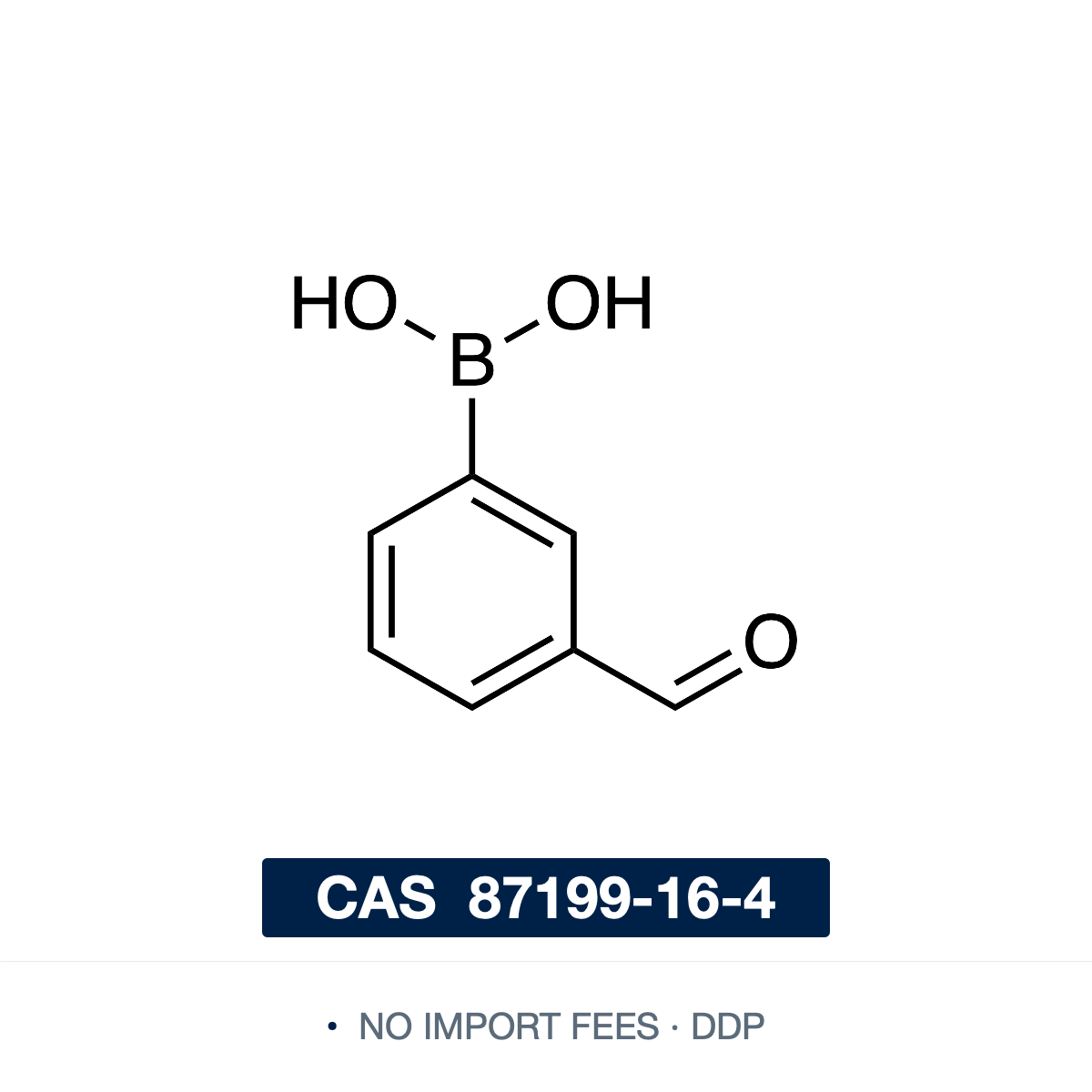
3-Formylphenylboronic Acid
3-Formylphenylboronic Acid | CAS 87199-16-4 | ≥98%
| Pack size | Excl. VAT | Incl. VAT | Add to cart |
|---|---|---|---|
| 2.0 g | €24,90 | ||
| 5.0 g | €37,20 | ||
| 10 g | €54,20 | ||
| 25 g | €74,20 | ||
| 50 g | €109,20 | ||
| 100 g | €149,20 | ||
| 250 g | €289,90 |
Taxes and fees, e.g. VAT, included in the price. Shipping calculated at checkout.Free shipping on EU, UK and EFTA orders above €250, and above €400 to the rest of the world.
Technical Specifications
| CAS Number | 87199-16-4 |
| EC / EINECS Number | 628-589-5 |
| MDL Number | MFCD00161356 |
| SMILES | B(C1=CC(=CC=C1)C=O)(O)O |
| InChI | InChI=1S/C7H7BO3/c9-5-6-2-1-3-7(4-6)8(10)11/h1-5,10-11H |
| InChIKey | HJBGZJMKTOMQRR-UHFFFAOYSA-N |
| PubChem CID | 2734356 |
| Molecular Formula | C₇H₇BO₃ |
| Molecular Weight | 149.94 g/mol |
| Melting Point | 109-113 °C |
| Solubility | Soluble in methanol, ethanol, DMSO, DMF, and dilute aqueous alkali; sparingly soluble in water at neutral pH |
| Purity | ≥98%. May contain varying amounts of the corresponding boronic acid anhydrides |
| Physical Form | White to pale beige crystalline solid |
| HS Code | 2931.90 |
| Country of Origin | Finland |
| Shelf Life | Retest period: 36 months from date of manufacture |
| Storage Conditions | Store in a cool, dry place in a tightly sealed container |
Product Description & Scientific Applications
3-Formylphenylboronic acid ((3-formylphenyl)boronic acid; 3-boronobenzaldehyde) is a bifunctional arylboronic acid combining a phenylboronic-acid coupling handle with a meta aldehyde group.
May contain small amounts of the cyclic anhydride 3-formylphenylboroxine. Under aqueous or basic coupling conditions the two forms re-equilibrate and the impact on yield is minor.
Applications and Reactions
- Suzuki–Miyaura cross-coupling: the boronic acid couples with aryl, heteroaryl, and vinyl electrophiles to install a 3-formylphenyl unit, giving biaryl and heterobiaryl aldehydes for onward elaboration.
- Bifunctional C–B / C–CHO handle: the boronic acid and the aldehyde are chemically orthogonal, so the two sites can be addressed in sequence — cross-coupling at boron, carbonyl chemistry at the aldehyde — to reach unsymmetrical, doubly functionalised products.
- Aldehyde diversification: the formyl group undergoes the usual reactions of an aromatic aldehyde — imine (Schiff-base) and hydrazone formation, reductive amination, and Knoevenagel or Wittig olefination — a direct route to tether the arylboronic-acid unit onto amines, hydrazides, or extended π-systems.
- Free, non-cyclising carbonyl: because the aldehyde sits meta to boron it cannot close to a benzoxaborole — the tautomerisation the ortho (2-formyl) isomer undergoes — so both the aldehyde and the boronic acid stay fully and independently available.
- Boronate-ester formation and diol binding: the boronic acid condenses reversibly with 1,2- and 1,3-diols (sugars, catechols) and other polyols to give cyclic boronate esters, the basis for boronate linkages and diol/saccharide capture.
Further Reading
For boronic acids, boronic esters, protodeboronation, boroxine content, and Suzuki–Miyaura reagent selection, see NorrChemica's Lab Journal guide: Choosing Your Boron Source for Suzuki–Miyaura Coupling.
Shipping Destinations
- EU & UK: Priority delivery, 2–5 business days.
- United States (DDP): 3–7 business days, duties and taxes prepaid.
- EFTA Countries (DDP): 3–7 business days, duties and taxes prepaid.
- Worldwide: 7–14 business days, selected locations.
Safety Information
| GHS Pictograms |

|
| Signal Word | Warning |
| Hazard Class | Not regulated for transport |
| Transport Category | Not classified as dangerous goods for transport (ADR/IATA/IMDG) |
| H-Statements | H315 - H319 - H335 |
| P-Statements | P261 - P264 - P271 - P280 - P302+P352 - P304+P340 - P305+P351+P338 - P332+P313 - P337+P313 - P362+P364 - P501 |
Documentation
| Safety Data Sheet | Download PDF |