NorrChemica™
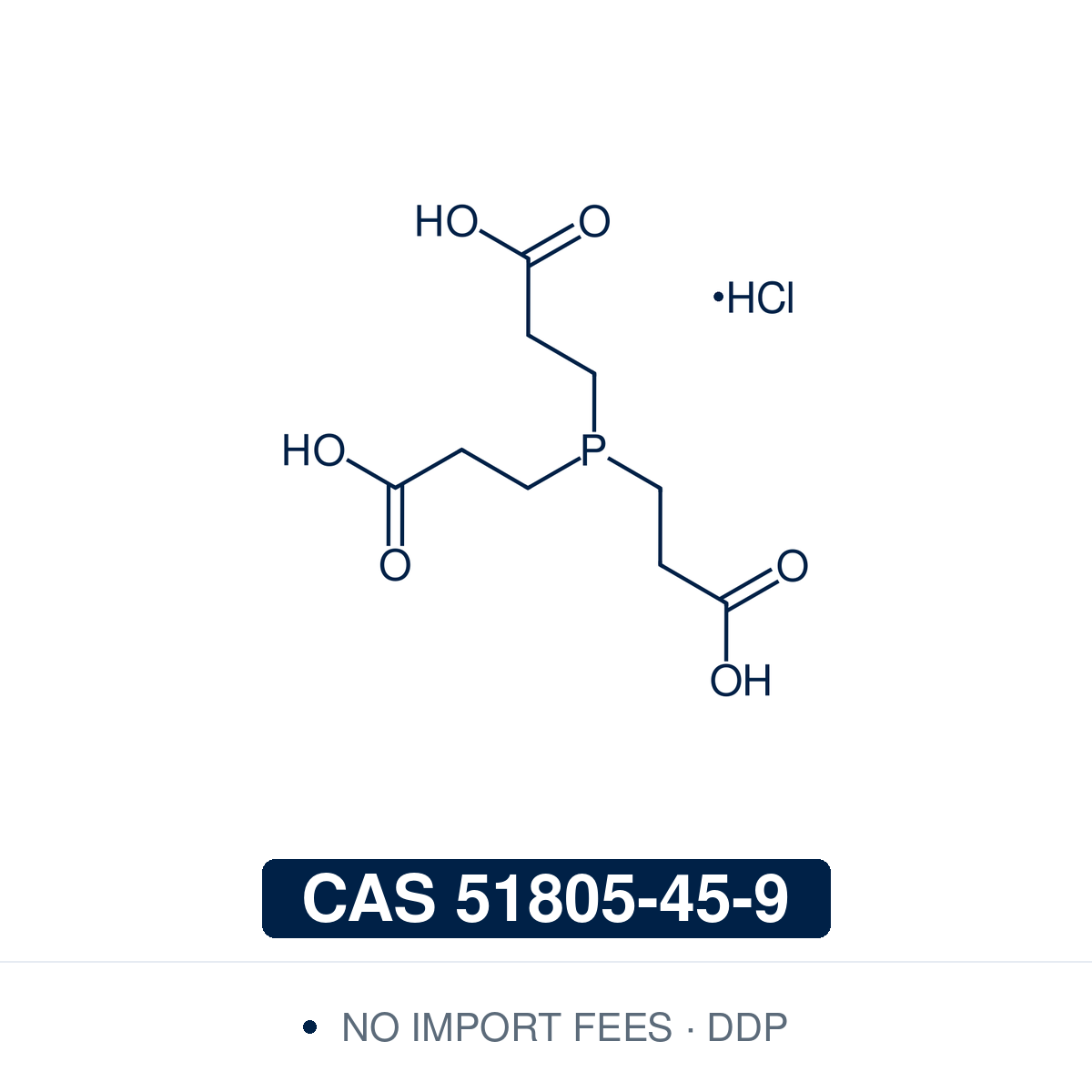
TCEP-HCl
TCEP-HCl | CAS 51805-45-9 | ≥97%
| Pack size | Excl. VAT | Incl. VAT | Add to cart |
|---|---|---|---|
| 1 g | €24,90 | ||
| 2 g | €34,90 | ||
| 5 g | €47,90 | ||
| 10 g | €74,20 | ||
| 25 g | €129,20 | ||
| 50 g | €198,20 | ||
| 100 g | €329,00 |
Taxes and fees, e.g. VAT, included in the price. Shipping calculated at checkout.Free shipping on EU, UK and EFTA orders above €250, and above €400 to the rest of the world.
Technical Specifications
| CAS Number | 51805-45-9 |
| EC / EINECS Number | 629-759-1 |
| MDL Number | MFCD00145469 |
| SMILES | C(CP(CCC(=O)O)CCC(=O)O)C(=O)O.Cl |
| InChI | InChI=1S/C9H15O6P.ClH/c10-7(11)1-4-16(5-2-8(12)13)6-3-9(14)15;/h1-6H2,(H,10,11)(H,12,13)(H,14,15);1H |
| InChIKey | PBVAJRFEEOIAGW-UHFFFAOYSA-N |
| PubChem CID | 2734570 |
| Molecular Formula | C₉H₁₆ClO₆P |
| Molecular Weight | 286.64 g/mol |
| Melting Point | 175-177 °C |
| Solubility | Freely soluble in water (~310 g/L; ~1.08 M); minimally soluble in methanol and ethanol; poorly soluble in non-polar solvents. |
| Purity | ≥97% |
| Physical Form | White to off-white crystalline powder |
| HS Code | 2931.49 |
| Shelf Life | Retest period: 36 months from date of manufacture |
| Storage Conditions | Store at 2–8 °C; –20 °C for long-term storage. Keep tightly closed and protected from moisture. The solid is stable in air for several months. |
Product Description & Scientific Applications
TCEP·HCl (tris(2-carboxyethyl)phosphine hydrochloride) is a water-soluble trialkylphosphine used to reduce disulfide bonds. In water it reduces disulfides rapidly and completely at mildly acidic pH (around 4.5) and preferentially cleaves the more strained disulfides.
Mechanism. Reduction follows the general pathway for disulfide cleavage by phosphines in water: phosphorus attacks the S–S bond and is itself oxidised to the phosphine oxide, converting the disulfide to two free thiols. Because the phosphine is consumed as its oxide, the reduction does not reverse — unlike thiol reductants, which act through a redox equilibrium.
Properties. TCEP is an odourless reducing agent, resistant to air oxidation and stable across a broad pH range. Below pH 8 it is more effective than dithiothreitol (DTT) — which itself oxidises above pH 7.5 — although the better choice between the two reductants is application-specific. Two advantages over DTT are documented in protein biochemistry: nitroxide spin labels are two-to-four times more stable in TCEP than in DTT, and the Ni²⁺ that contaminates proteins eluted from nickel-affinity columns rapidly oxidises DTT but leaves TCEP unaffected.
Handling. As the hydrochloride, TCEP·HCl gives an acidic solution in water and is buffered to the required working pH before use.
Applications and Uses
- Disulfide reduction in proteins and peptides: cleaves inter- and intrachain disulfides and holds cysteines reduced — the standard reduction step ahead of alkylation, labelling and analysis.
- Thiol–maleimide bioconjugation: because it need not be removed before maleimide chemistry, TCEP allows reduction and conjugation to run together, streamlining site-specific labelling of cysteine thiols.
- Mass spectrometry: used for in situ reduction of disulfides in peptides and proteins for MALDI and related mass-spectrometric analysis.
- Thiolated oligonucleotide immobilisation: reduces the protecting disulfide on thiol-modified DNA, freeing the thiol for attachment; it has been optimised for immobilising thiolated oligonucleotides on electrode surfaces in microfluidic biosensors.
- EPR spin labelling: the enhanced stability of nitroxide spin labels in TCEP makes it advantageous for EPR spectroscopy.
Shipping Destinations
- EU & UK and EFTA countries only: Priority delivery, 3–7 business days. Classified as dangerous goods — shipping restrictions apply.
Safety Information
| GHS Pictograms |

|
| Signal Word | Danger |
| Hazard Class | UN 3261 — Corrosive solid, acidic, organic, n.o.s. (tris(2-carboxyethyl)phosphine hydrochloride) (Class 8, PG II) |
| Transport Category | Class 8, PG II (ADR/IATA/IMDG) |
| H-Statements | H314 - H318 |
| P-Statements | P260 - P264 - P280 - P301+P330+P331 - P303+P361+P353 - P304+P340 - P305+P351+P338 - P310 - P363 - P405 - P501 |
Documentation
| Safety Data Sheet | Download PDF |