NorrChemica™
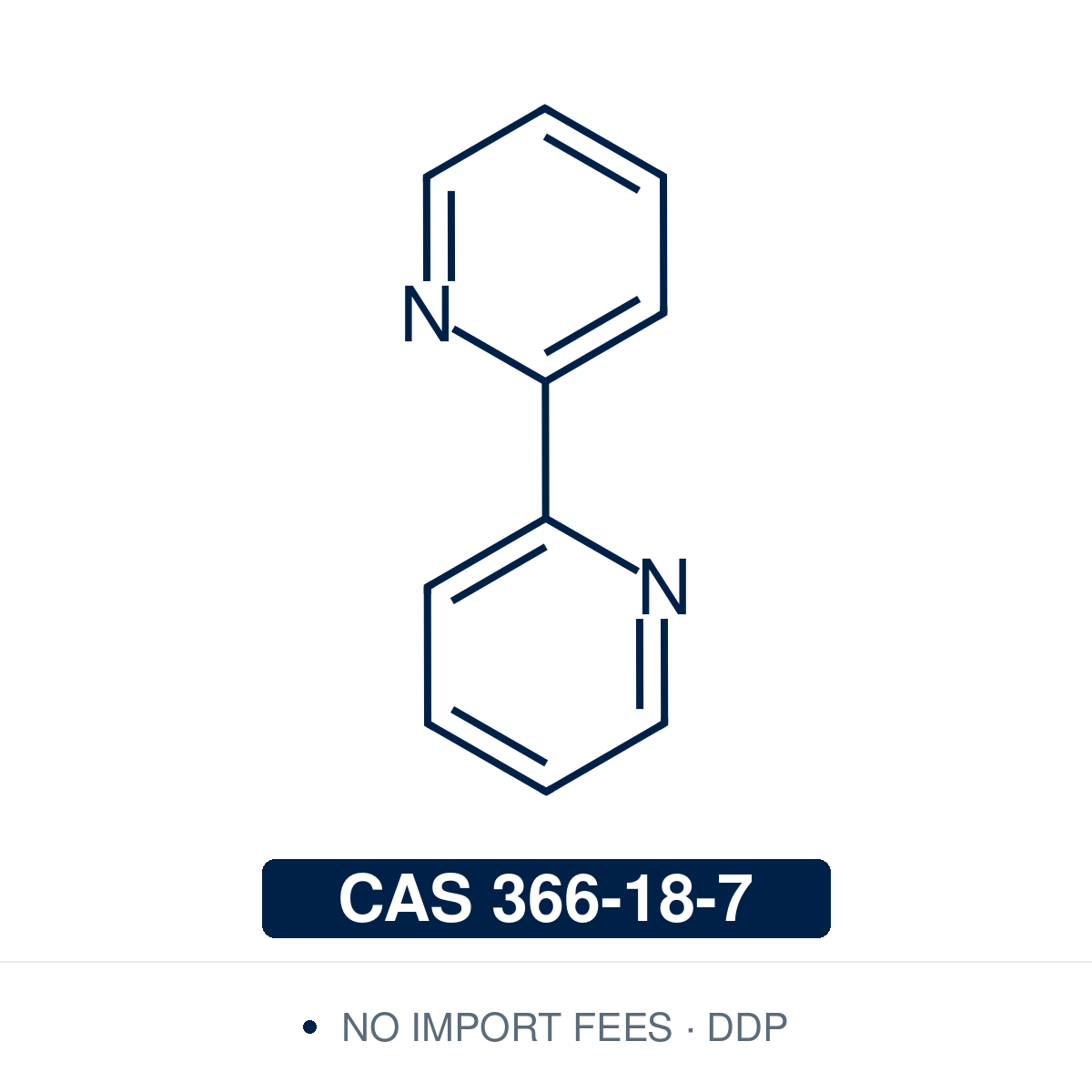
2,2′-Bipyridine
2,2′-Bipyridine | CAS 366-18-7 | ≥97%
Couldn't load pickup availability
Technical Specifications
| CAS Number | 366-18-7 |
| EC / EINECS Number | 206-674-4 |
| MDL Number | MFCD00006212 |
| RTECS Number | DW1750000 |
| SMILES | C1=CC=NC(=C1)C2=CC=CC=N2 |
| InChI | InChI=1S/C10H8N2/c1-3-7-11-9(5-1)10-6-2-4-8-12-10/h1-8H |
| InChIKey | ROFVEXUMMXZLPA-UHFFFAOYSA-N |
| PubChem CID | 1474 |
| Molecular Formula | C₁₀H₈N₂ |
| Molecular Weight | 156.18 g/mol |
| Melting Point | 70–73 °C |
| Solubility | Slightly soluble in water, soluble in common organic solvents |
| Purity | ≥97% |
| Physical Form | White to pale yellow crystalline solid |
| HS Code | 2933.39 |
| Country of Origin | Finland |
| Shelf Life | Retest period: 36 months from date of manufacture |
| Storage Conditions | Store in a cool, dry place in a tightly sealed container |
Product Description & Scientific Applications
2,2'-Bipyridine (2,2'-dipyridyl, α,α'-bipyridyl, bipy, 2-(pyridin-2-yl)pyridine) is the unsubstituted parent of the 2,2'-bipyridine ligand family and a classic bidentate N,N-chelating ligand. Its two pyridyl nitrogens act as σ-donors and π-acceptors, binding a wide range of transition-metal ions through a five-membered chelate ring.
Structure and electronic behaviour
Free 2,2'-bipyridine adopts a transoid conformation about the inter-ring C–C bond and rotates to a cisoid geometry on chelation. The π* system is redox non-innocent: the ligand reduces stepwise to a radical monoanion (bpy•⁻) and a dianion (bpy²⁻), acting as an electron reservoir alongside the coordinated metal in photoredox and reductive catalysis.
Polypyridyl photocatalyst and photochemistry ligand
2,2'-Bipyridine is the ligand backbone of tris(2,2'-bipyridine)ruthenium(II), [Ru(bpy)₃]²⁺, and of ruthenium, iridium, iron, and copper polypyridyl complexes used in visible-light photochemistry. In ruthenium and related complexes, bipyridine supports long-lived metal-to-ligand charge-transfer (MLCT) excited states with defined redox potentials, driving single-electron-transfer and energy-transfer cycles in photoredox catalysis.
Ligand for transition-metal catalysis
Beyond ruthenium and iron, 2,2'-bipyridine is an N,N-chelator for copper, palladium, nickel, and manganese catalysts across cross-coupling, C–H functionalisation, and oxidation chemistry. It is a benchmark ligand for nickel-catalysed reductive cross-electrophile coupling, joining aryl and alkyl halides to form C(sp²)–C(sp³) bonds through open-shell nickel intermediates. Copper/bipyridine systems with nitroxyl co-catalysts oxidise alcohols to aldehydes and ketones under air. Chiral and 4,4'- or 6,6'-substituted bipyridines extend the scaffold to asymmetric catalysis and tune catalyst electronics and sterics.
Controlled radical polymerisation
2,2'-Bipyridine is a foundational ligand in copper-mediated atom-transfer radical polymerisation (ATRP), where the copper–bipyridine complex reversibly activates a carbon–halogen bond for controlled chain growth. 4,4'-Dialkyl-substituted variants improve copper-complex solubility in organic media.
Beyond synthesis
- Electrochemiluminescence: tris(2,2'-bipyridine)ruthenium(II) with a tri-n-propylamine co-reactant emits near 620 nm through electrochemically generated excited states, without external optical excitation. It is a classic luminophore system for electrochemiluminescence assays and biosensor research.
- Spectrophotometric determination of iron(II): with Fe(II), 2,2'-bipyridine forms the intensely red tris-chelate [Fe(bpy)₃]²⁺ with an absorption maximum near 522 nm, used for colorimetric determination of ferrous iron. Analytical grades are sold as reagents for iron(II) and molybdenum.
- Dye-sensitised solar cells and functional materials: functionalised bipyridines are core ligands in ruthenium DSSC sensitisers, where carboxylated or phosphonated derivatives anchor the dye to the semiconductor. The bipyridine scaffold is also used in electrochromic materials, supramolecular assemblies, and metal–organic frameworks.
- Solar-fuel photosensitisers: ruthenium and related bipyridine complexes act as photosensitisers in multicomponent systems for photocatalytic hydrogen evolution and carbon dioxide reduction.
- Metal-ion chelation: 2,2'-bipyridine serves as an N,N-chelator for probing Fe(II) and other transition-metal binding in analytical and coordination-chemistry workflows.
Shipping Destinations
- EU & UK: Priority delivery, 2–5 business days, duties and taxes prepaid.
Safety Information
| GHS Pictograms |

|
| Signal Word | Danger |
| Hazard Class | UN 2811 — Toxic solid, organic, n.o.s. (2,2′-Bipyridine) (Class 6.1, PG III) |
| Transport Category | Class 6.1, PG III (ADR/IATA/IMDG) |
| H-Statements | H301 - H311 |
| P-Statements | P264 - P270 - P280 - P301+P310 - P302+P352 - P312 - P321 - P330 - P361+P364 - P405 - P501 |
Documentation
| Safety Data Sheet | Download PDF |