NorrChemica™
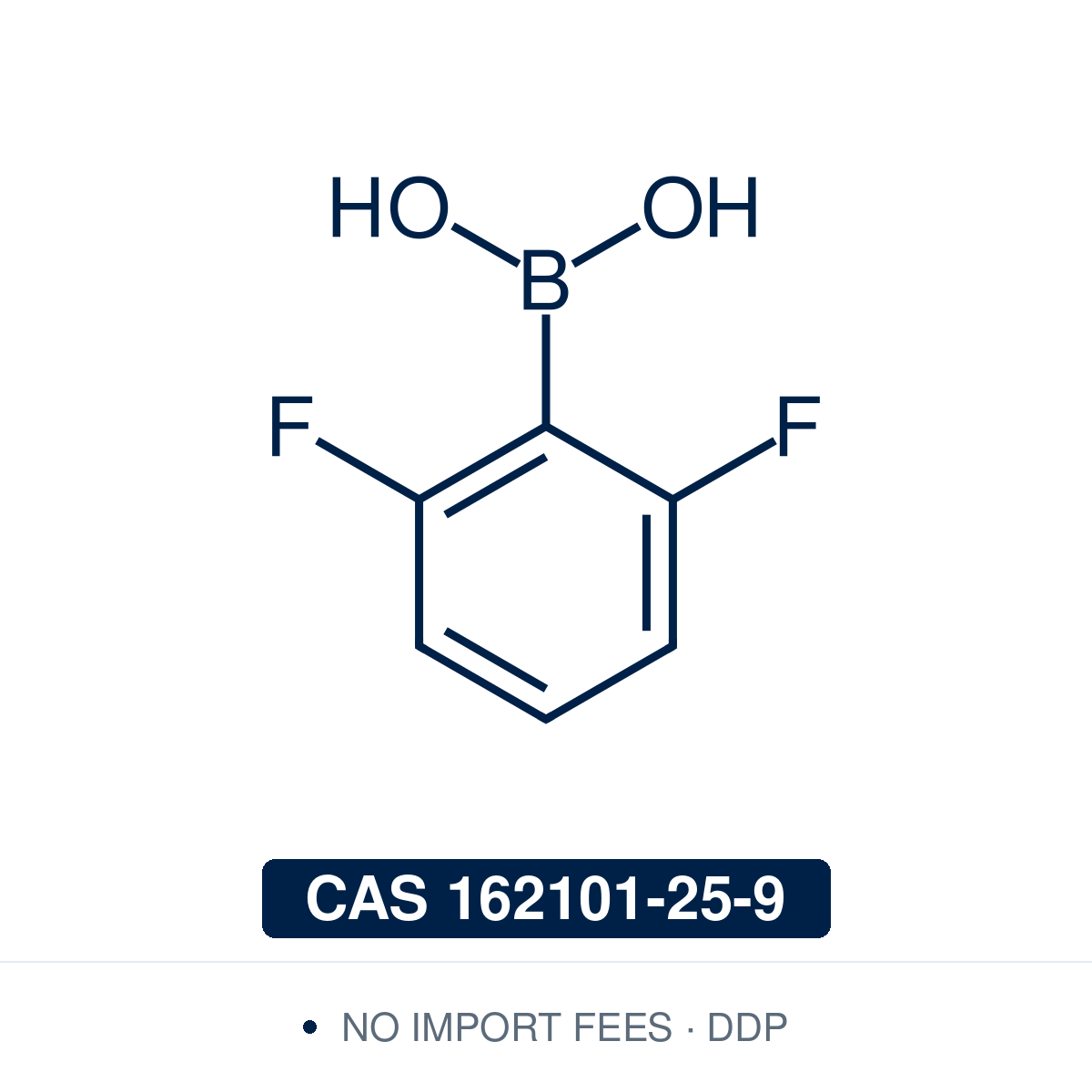
2,6-Difluorophenylboronic Acid
2,6-Difluorophenylboronic Acid | CAS 162101-25-9 | ≥98%
Couldn't load pickup availability
Technical Specifications
| CAS Number | 162101-25-9 |
| EC / EINECS Number | 627-874-1 |
| MDL Number | MFCD00792436 |
| SMILES | B(C1=C(C=CC=C1F)F)(O)O |
| InChI | InChI=1S/C6H5BF2O2/c8-4-2-1-3-5(9)6(4)7(10)11/h1-3,10-11H |
| InChIKey | DBZAICSEFBVFHL-UHFFFAOYSA-N |
| PubChem CID | 2734336 |
| Molecular Formula | C₆H₅BF₂O₂ |
| Molecular Weight | 157.91 g/mol |
| Melting Point | 147-149 °C |
| Solubility | Slightly soluble in water; soluble in alcoholic solvents, acetonitrile, DMF, DMSO |
| Purity | ≥98%. May contain small variable amounts of boron anhydrides |
| Physical Form | White to off-white crystalline powder |
| HS Code | 2931.90 |
| Shelf Life | Retest period: 36 months from date of manufacture |
| Storage Conditions | Store at room temperature. Keep container tightly closed in a dry place. Mildly hygroscopic — protect from moisture |
Product Description & Scientific Applications
2,6-Difluorophenylboronic Acid (2,6-difluorobenzeneboronic acid, B-(2,6-difluorophenyl)boronic acid) carries fluorine substituents at both ortho positions of the phenyl ring, creating severe steric congestion at the boron centre and a distinctive electronic environment. The measured boronic-acid pKa is 7.37 (spectrophotometric) / 7.41 (potentiometric) in water, more acidic than phenylboronic acid (≈ 8.9) but less acidic than the 2,5-difluoro isomer despite carrying two electron-withdrawing fluorines — attributed to formation of only a single intramolecular B–O–H···F hydrogen bond and to steric perturbation of the second ortho-F. Crucially, di-ortho-fluoro substitution accelerates base-promoted protodeboronation: published kinetic studies show that di-ortho-substituted arylboronic acids, including fluorinated examples, can undergo unusually facile base-promoted C–B fission under aqueous-basic conditions, requiring careful selection of catalyst, base, and concentration in cross-coupling. The two ortho-F substituents also bias coupled biaryls toward twisted, non-planar geometries, though the rotational barrier from 2,6-fluoro substitution alone is insufficient for stable atropisomerism at room temperature. Used as a 2,6-difluorophenyl building block in fluorinated π-conjugated materials, organic semiconductors, liquid-crystal intermediates, and pharmaceutical and agrochemical fragment chemistry.
May contain small amounts of the cyclic anhydride 2,6-difluorophenylboroxine. Under aqueous or basic coupling conditions the two forms re-equilibrate and the impact on yield is minor.
Applications and Reactions
- Suzuki–Miyaura coupling: with aryl, heteroaryl, or alkenyl electrophiles to give 2,6-difluorobiaryl, 2,6-difluoroaryl-heteroaryl, terphenyl, and aryl-alkenyl products. 2,6-Difluorophenylboronic acid is a documented model partner in Suzuki coupling with 4-chloro-3-methylanisole under Buchwald-type Pd precatalyst/biaryl-phosphine systems. The di-ortho-fluoro substrate is sterically demanding and base-sensitive, so catalyst, ligand, base, solvent, temperature, and concentration are unusually important for suppressing protodeboronation and obtaining productive transmetalation.
- Protodeboronation susceptibility and mitigation: 2,6-disubstituted arylboronic acids are documented to undergo facile base-promoted C–B fission relative to mono- and meta-substituted analogues. Practical mitigations include milder base selection, reduced exposure to strongly aqueous-basic conditions, lower effective boronate concentration, and use of alternative 2,6-difluoroaryl–boron formats such as pinacol boronate, MIDA/Bdan derivatives, or potassium aryltrifluoroborates; in fluorinated oligophenyl synthesis, potassium 2,6-difluorophenyltrifluoroborate was used to improve coupling performance relative to the free boronic acid.
- Twisted biaryl geometry in coupling products: the two ortho-F substituents bias the resulting biaryl toward non-planar conformations, with one ring rotated significantly out of plane relative to the partner ring. Atropisomerism — stable axial chirality at room temperature — generally requires additional ortho substituents on the partner ring; on its own, 2,6-difluoro substitution gives twisted but rapidly interconverting conformers in most biaryls.
- Fluorinated π-conjugated materials and organic semiconductors: Suzuki–Miyaura building block for selectively fluorinated oligophenyl architectures. In organic-semiconductor research, 2,6-difluorophenylboronic acid was used with 4-bromo-2,6-difluoro-1-iodobenzene to prepare 4-bromo-2,3′,5′,6-tetrafluorobiphenyl by selective coupling at iodine, a key intermediate toward 2,6-difluorinated oligophenyls; related work used potassium 2,6-difluorophenyltrifluoroborate to improve coupling performance in later-stage oligophenyl assembly.
- Liquid-crystal fragment chemistry: fluorinated biphenyl and terphenyl cores are widely used in liquid-crystal materials, where fluorine substitution can tune dipole orientation, dielectric anisotropy, birefringence, viscosity, and mesophase behaviour. 2,6-Difluorophenylboronic acid is supplier-listed as a liquid-crystal intermediate, but this should be treated as class/commercial positioning rather than a specific mesogen-performance claim.
- 2,6-Difluorophenyl as property-tuning fragment: the retained 2,6-difluoro pattern is robust under most synthetic conditions and is used to introduce a defined twisted geometry, dipole, and electron-poor character into derived medicinal-chemistry, agrochemical, and materials scaffolds; effects on permeability, conformation, and metabolic stability remain structure-dependent in the final molecule.
- 19F NMR handle: the two equivalent ortho fluorines give a sharp 19F NMR reporter for the 2,6-difluorophenyl unit, useful for tracking incorporation and following reactions involving this fragment.
- Protected boronate esters: precursor to pinacol (Bpin), neopentyl glycol, MIDA, and 1,8-diaminonaphthalene (Bdan) esters when more chromatographically tractable and base-stable 2,6-difluoroaryl–boron building blocks are required for iterative cross-coupling — particularly relevant for this substrate given its base-sensitivity in the free boronic-acid form.
- Chan–Lam coupling: class-level copper-mediated arylation of N, O, and selected S nucleophiles using arylboronic acids; for the 2,6-difluorophenyl substrate, steric congestion and base sensitivity mean conditions should be screened rather than assumed from less hindered arylboronic acids.
- Petasis borono-Mannich reaction: class-level three-component coupling of arylboronic acids with an amine and a carbonyl partner to give α-aryl amines, α-amino acids, or β-amino alcohols; the 2,6-difluorophenyl analogue should be treated as a hindered, potentially slower arylboronic-acid partner unless a substrate-specific example is used.
- Non-classical arylation: Suzuki–Miyaura-type coupling of arylboronic acids with arenediazonium tetrafluoroborates is a useful class-level alternative to aryl halide electrophiles; for 2,6-difluorophenylboronic acid, this should be treated as broader arylboronic-acid chemistry unless a substrate-specific example is cited.
- Ipso-halodeboronation: deborylative bromination, chlorination, or iodination can replace the boronic-acid group with halogen across the arylboronic-acid class; for the 2,6-difluoro substrate, this is best framed as potential access to 2,6-difluorohalobenzene motifs rather than a verified application unless a direct substrate example is added.
- Oxidative ipso-hydroxylation: peroxide- or perborate-mediated conversion of arylboronic acids to phenols is a broad method class; conversion of 2,6-difluorophenylboronic acid to 2,6-difluorophenol should be treated as class-level ipso-hydroxylation unless a direct example is cited.
Further Reading
For boronic acids, boronic esters, protodeboronation, boroxine content, and Suzuki–Miyaura reagent selection, see NorrChemica's Lab Journal guide: Choosing Your Boron Source for Suzuki–Miyaura Coupling.
Shipping Destinations
- EU & UK: Priority delivery, 2–5 business days.
- United States (DDP): 3–7 business days, duties and taxes prepaid.
- EFTA Countries (DDP): 3–7 business days, duties and taxes prepaid.
- Worldwide: 7–14 business days, selected locations.
Safety Information
| GHS Pictograms |

|
| Signal Word | Warning |
| Hazard Class | None — not subject to transport regulations |
| Transport Category | Not classified as dangerous goods for transport (ADR/IATA/IMDG) |
| H-Statements | H315 - H319 - H335 |
| P-Statements | P261 - P264 - P271 - P280 - P302+P352 - P305+P351+P338 |
Documentation
| Safety Data Sheet | Download PDF |