NorrChemica™
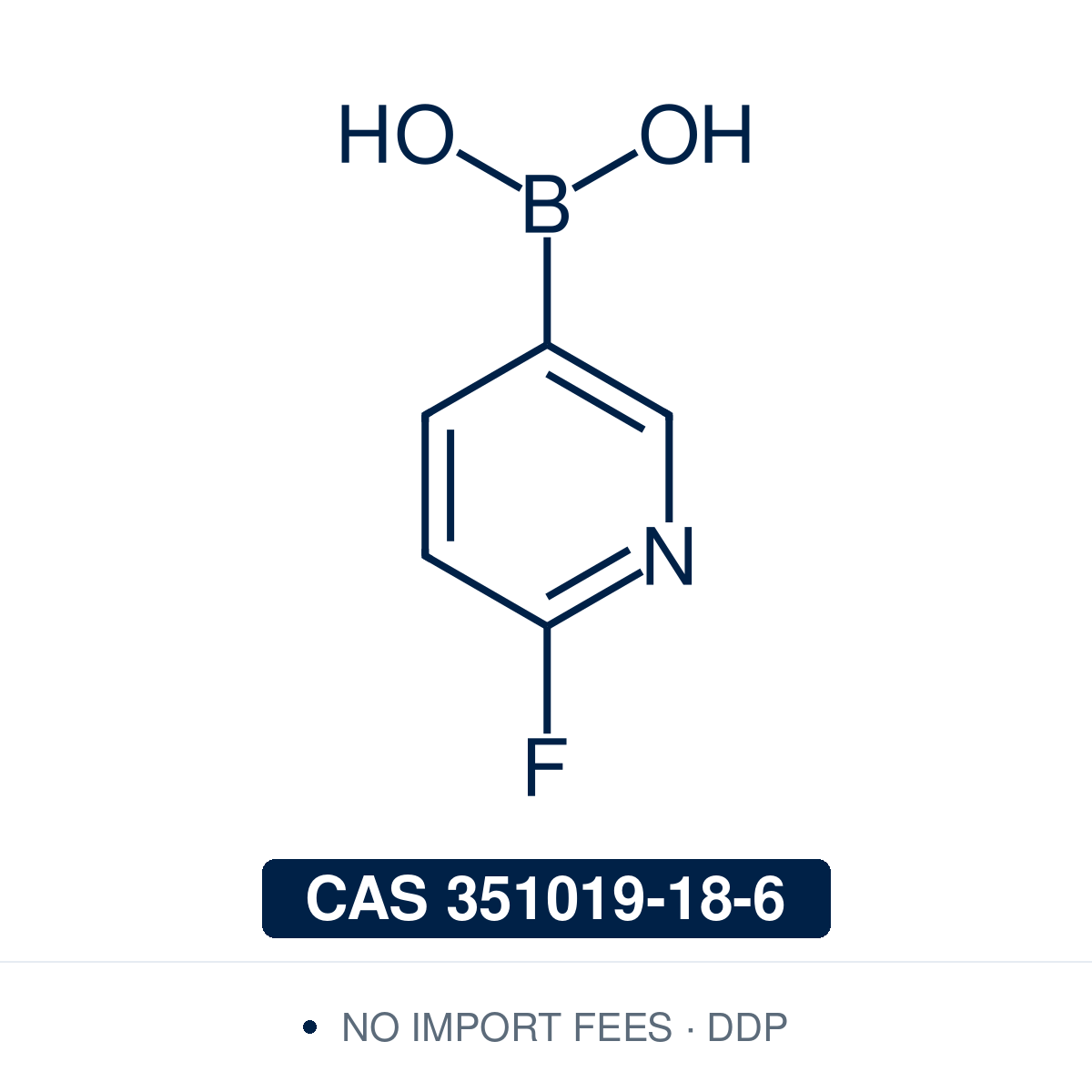
2-Fluoropyridine-5-boronic Acid
2-Fluoropyridine-5-boronic Acid | CAS 351019-18-6 | ≥98%
Couldn't load pickup availability
Technical Specifications
| CAS Number | 351019-18-6 |
| EC / EINECS Number | 627-412-9 |
| MDL Number | MFCD03411559 |
| SMILES | B(C1=CN=C(C=C1)F)(O)O |
| InChI | InChI=1S/C5H5BFNO2/c7-5-2-1-4(3-8-5)6(9)10/h1-3,9-10H |
| InChIKey | OJBYZWHAPXIJID-UHFFFAOYSA-N |
| PubChem CID | 2783397 |
| Molecular Formula | C₅H₅BFNO₂ |
| Molecular Weight | 140.91 g/mol |
| Melting Point | 172 °C |
| Solubility | Slightly soluble in water; soluble in alcoholic solvents, acetonitrile, DMF, DMSO |
| Log Pow | 0.994 |
| Purity | ≥98%. May contain small variable amounts of boron anhydrides |
| Physical Form | White to off-white crystalline powder |
| HS Code | 2931.90 |
| Shelf Life | Retest period: 36 months from date of manufacture |
| Storage Conditions | Store at room temperature. Keep container tightly closed in a dry place. Mildly hygroscopic — protect from moisture |
Product Description & Scientific Applications
2-Fluoropyridine-5-boronic Acid (6-fluoropyridine-3-boronic acid, 6-fluoro-3-pyridinylboronic acid, 2-fluoro-5-pyridylboronic acid) is an electron-deficient heteroaryl boronic acid generally used as a fluorinated pyridyl building block in medicinal-chemistry, agrochemical, and fine-chemical synthesis. The boronic-acid group is away from the nitrogen, so the compound is relatively less prone to undergo rapid protodeboronation than other compounds featuring the 2-pyridylboronic-acid motif.
This compound may contain small amounts of the cyclic anhydride (boroxine); which have a minor impact on the yield of its subsequent reactions.
Applications and Reactions
- Hydroxydeboronation to fluorohydroxypyridines: aqueous hydrogen peroxide or mCPBA replaces the B(OH)2 group with hydroxyl and retains the C–F bond, giving 2-fluoro-5-hydroxypyridine (6-fluoropyridin-3-ol). Rault and co-workers reported this transformation for halopyridinylboronic acids and esters under mild conditions, regioselectively and without N-oxide formation.
- Suzuki–Miyaura coupling: couples with aryl, heteroaryl, vinyl, and alkenyl electrophiles to give 2-fluoro-5-aryl-, 2-fluoro-5-heteroaryl-, and alkenyl-substituted pyridines. As with other pyridylboronic acids, the pyridine nitrogen can interact with transition-metal catalysts, so palladium source, ligand, base, solvent, and coupling partner strongly affect performance.
- Aromatic SNAr at the 2-position: the ring nitrogen activates the C–F bond at C2 toward aromatic nucleophilic substitution. Amines, alkoxides, phenoxides, thiolates, amides, hydrazines, and stabilised carbanions can displace fluoride under suitable conditions, giving 2-amino-, 2-alkoxy-, 2-thio-, and 2-carbon-substituted pyridines from the coupled product.
- Protected and masked boron variants: the pinacol ester is commercially available (CAS 444120-95-0). Molander and co-workers reported potassium 6-fluoropyridin-3-yltrifluoroborate as a bench-stable Suzuki partner; in their substrate scope, it coupled more efficiently with 4-chlorobenzonitrile than with 4-bromobenzonitrile.
Further Reading
For boronic acids, boronic esters, protodeboronation, boroxine content, and Suzuki–Miyaura reagent selection, see NorrChemica's Lab Journal guide: Choosing Your Boron Source for Suzuki–Miyaura Coupling.
Shipping Destinations
- EU & UK: Priority delivery, 2–5 business days.
- United States (DDP): 3–7 business days, duties and taxes prepaid.
- EFTA Countries (DDP): 3–7 business days, duties and taxes prepaid.
- Worldwide: 7–14 business days, selected locations.
Safety Information
| GHS Pictograms |

|
| Signal Word | Warning |
| Hazard Class | None — not subject to transport regulations |
| Transport Category | Not classified as dangerous goods for transport (ADR/IATA/IMDG) |
| H-Statements | H315 - H319 - H335 |
| P-Statements | P261 - P264 - P271 - P280 - P302+P352 - P304+P340 - P305+P351+P338 - P332+P313 - P337+P313 - P362+P364 - P501 |
Documentation
| Safety Data Sheet | Download PDF |