NorrChemica™
2,4,6-Triphenylpyrylium tetrafluoroborate
2,4,6-Triphenylpyrylium tetrafluoroborate | CAS 448-61-3 | ≥95%
Couldn't load pickup availability
Technical Specifications
| CAS Number | 448-61-3 |
| EC / EINECS Number | 207-186-4 |
| MDL Number | MFCD00012001 |
| RTECS Number | UZ1370000 |
| SMILES | [B-](F)(F)(F)F.C1=CC=C(C=C1)C2=CC(=[O+]C(=C2)C3=CC=CC=C3)C4=CC=CC=C4 |
| InChI | InChI=1S/C23H17O.BF4/c1-4-10-18(11-5-1)21-16-22(19-12-6-2-7-13-19)24-23(17-21)20-14-8-3-9-15-20;2-1(3,4)5/h1-17H;/q+1;-1 |
| InChIKey | VQYPWMWEJGDSTF-UHFFFAOYSA-N |
| PubChem CID | 9930615 |
| Molecular Formula | C₂₃H₁₇BF₄O |
| Molecular Weight | 396.2 g/mol |
| Melting Point | 250-251 °C |
| Solubility | Insoluble in water, ethyl alcohol, diethyl ether. Soluble in trifluoroacetic acid. |
| Purity | ≥95% |
| Physical Form | Dark yellow solid |
| HS Code | 2932.99 |
| Shelf Life | Retest period: 36 months from date of manufacture |
| Storage Conditions | Moisture Sensitive. Store away from oxidizing agents, water/moisture. Store under inert gas. Keep the container tightly closed and place it in a cool, dry and well ventilated condition. |
Product Description & Scientific Applications
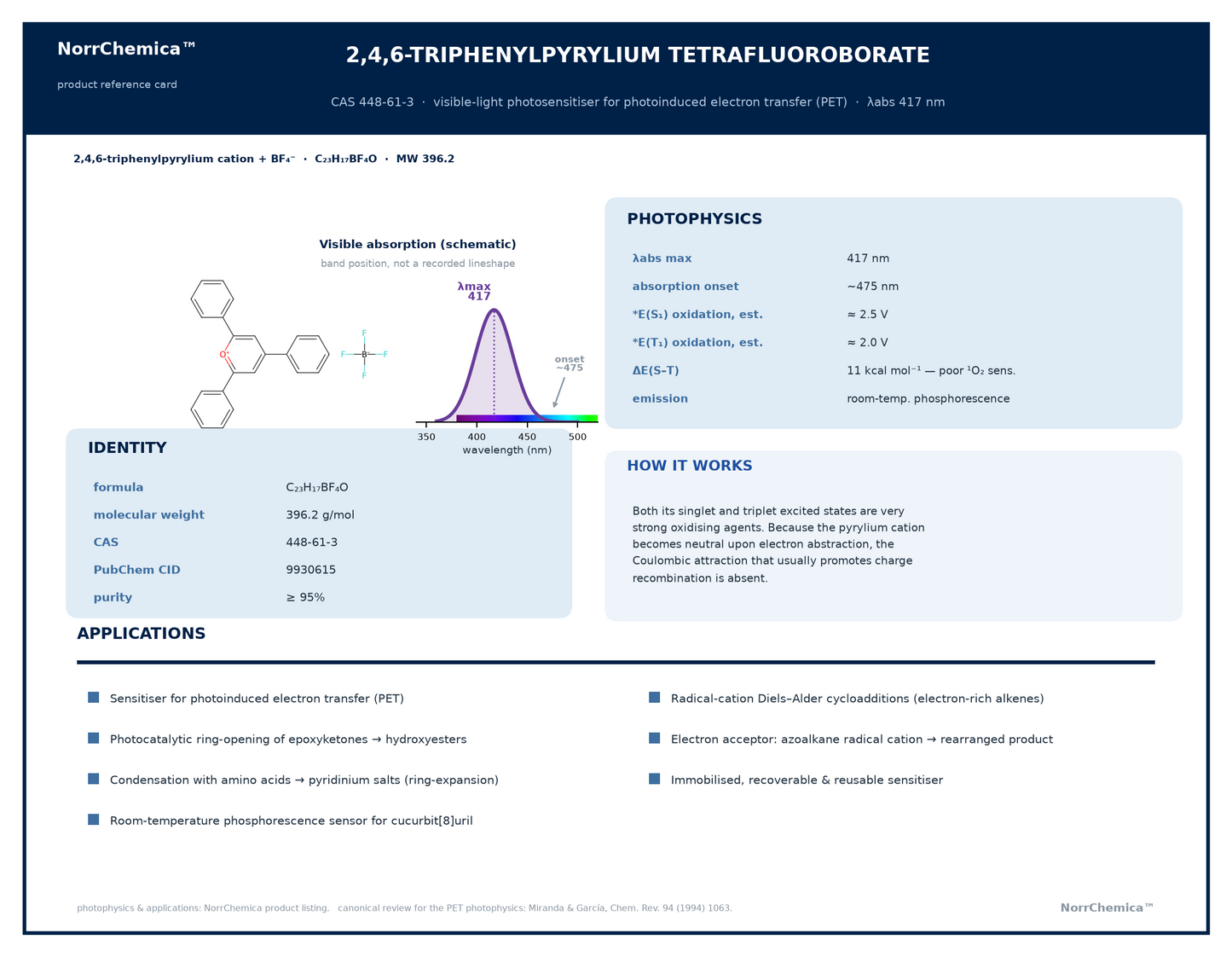
2,4,6-Triphenylpyrylium tetrafluoroborate, the tetrafluoroborate salt of the 2,4,6-triphenylpyrylium ion (TP+), is a pyrylium salt used as a sensitiser for photoinduced electron-transfer (PET) reactions. It absorbs visible light, with a maximum at 417 nm and an absorption onset near 475 nm. Both its singlet and triplet excited states are very strong oxidising agents, with excited-state oxidation potentials estimated at 2.5 V and 2.0 V respectively. A small singlet–triplet energy gap of 11 kcal mol−1 makes it a poor singlet-oxygen sensitiser. Because the pyrylium cation becomes neutral upon electron abstraction, the Coulombic attraction that usually promotes charge recombination is absent.
On photochemical excitation it converts electron-rich alkenes into radical cations that act as electron-poor dienophiles, enabling Diels–Alder cycloadditions through an electron-transfer chain mechanism. It photocatalyses the ring-opening of epoxyketones to give diastereomeric hydroxyester products. As an electron acceptor it forms a radical cation from an azoalkane, redirecting the photoreaction toward a rearranged product.
It condenses with amino acids to give pyridinium salts that serve as substrates for a downstream ring-expansion protocol. Immobilised versions of the sensitiser have been developed, allowing its recovery and reuse. The triphenylpyrylium core shows room-temperature phosphorescence, allowing its use as a sensor for cucurbit[8]uril.
Shipping Destinations
- EU & UK: Priority delivery, 2–5 business days.
- United States (DDP): 3–7 business days, duties and taxes prepaid.
- EFTA Countries (DDP): 3–7 business days, duties and taxes prepaid.
- Worldwide: 7–14 business days, selected locations.
Safety Information
| GHS Pictograms |


|
| Signal Word | Warning |
| Hazard Class | Not regulated for transport |
| Transport Category | Not classified as dangerous goods for transport (ADR/IATA/IMDG) |
| H-Statements | H302 - H315 - H319 - H335 |
| P-Statements | P261 - P264 - P270 - P271 - P280 - P301+P310 - P302+P352 - P304+P340 - P305+P351+P338 - P330 - P332+P313 - P337+P313 - P362+P364 - P501 |