NorrChemica™
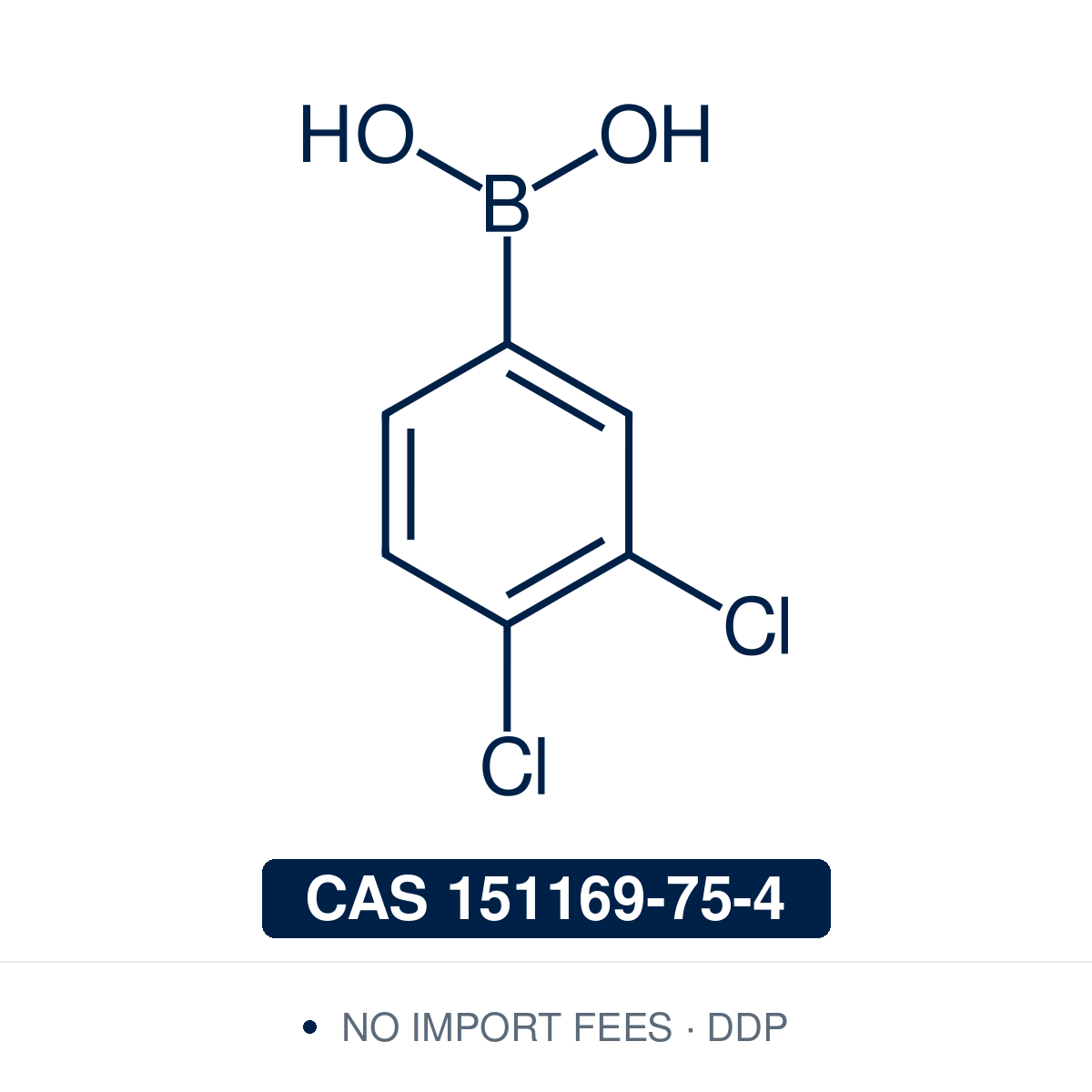
3,4-Dichlorophenylboronic Acid
3,4-Dichlorophenylboronic Acid | CAS 151169-75-4 | ≥98%
Couldn't load pickup availability
Technical Specifications
| CAS Number | 151169-75-4 |
| EC / EINECS Number | 629-198-2 |
| MDL Number | MFCD01074646 |
| SMILES | B(C1=CC(=C(C=C1)Cl)Cl)(O)O |
| InChI | InChI=1S/C6H5BCl2O2/c8-5-2-1-4(7(10)11)3-6(5)9/h1-3,10-11H |
| InChIKey | JKIGHOARKAIPJI-UHFFFAOYSA-N |
| PubChem CID | 2734330 |
| Molecular Formula | C₆H₅BCl₂O₂ |
| Molecular Weight | 190.82 g/mol |
| Melting Point | 280-285 °C |
| Solubility | Slightly soluble in water; soluble in alcoholic solvents, acetonitrile, DMF, DMSO |
| Purity | ≥98% |
| Physical Form | White to light yellow crystalline powder |
| HS Code | 2931.90 |
| Shelf Life | Retest period: 36 months from date of manufacture. |
| Storage Conditions | Store at room temperature in a tightly sealed container. Protect from moisture and light. May contain varying amounts of boroxine anhydride |
Product Description & Scientific Applications
3,4-Dichlorophenylboronic acid ((3,4-dichlorophenyl)boronic acid) is a moderately-to-strongly electron-withdrawing, trifunctional arylboronic acid building block.
May contain small amounts of the cyclic anhydride 3,4-dichlorophenylboroxine. Under aqueous or basic coupling conditions the two forms re-equilibrate and the impact on yield is minor.
Applications and Reactions
Suzuki–Miyaura coupling and sequential C–Cl functionalisation: couples with aryl, heteroaryl, and alkenyl halides or pseudohalides under Pd catalysis to install the 3,4-dichlorophenyl fragment onto biaryl, heterobiaryl, and styrenyl scaffolds. The C–B bond couples selectively while the two ring C–Cl bonds are retained, giving 3,4-dichlorobiaryl and -biheteroaryl scaffolds. The retained C–Cl handles are addressed later under aryl-chloride activation conditions — Buchwald–Hartwig amination, further Suzuki coupling, or Pd/phosphine catalysis (Pd/SPhos, XPhos, BrettPhos, cataCXium A, Pd(t-Bu)₃P); nucleophilic aromatic substitution applies only where the aryl chloride is sufficiently activated (electron-withdrawing groups, electron-deficient heteroaryl context).
Polychlorinated biphenyl (PCB) congener synthesis: Suzuki-based routes give defined PCB congeners and metabolites used as authentic reference materials in environmental chemistry, toxicology, and metabolism research. Modified Suzuki coupling of chlorinated arylboronic acids with bromochlorobenzenes gives selected PCB substitution patterns in moderate to good yields, avoiding separation from technical PCB mixtures.
Medicinal-chemistry and agrochemical scaffold synthesis: the 3,4-dichlorophenyl fragment is a lipophilic aryl substituent in medicinal-chemistry and agrochemical building-block research. It is used in heteroaryl and biaryl scaffold construction, including Mycobacterium tuberculosis H37Rv chorismate mutase inhibitor scaffolds. In agrochemical building blocks, dichloroaryl substitution tunes lipophilicity, electronic character, and metabolic stability. The role of the 3,4-dichlorophenyl group depends on the complete molecular scaffold, substitution pattern, and coupling partner.
Substituent positioning and electronic profile: the 3-Cl substituent acts through the meta-inductive pathway with no resonance compensation (σm ≈ +0.37); the 4-Cl substituent is net electron-withdrawing, partially moderated by weak π-donation from chlorine (σp ≈ +0.23 net). The combined pattern gives an electron-deficient arylboronic acid with a predicted lower pKa than phenylboronic acid, shifting boronic-acid/boronate speciation toward the boronate under aqueous-basic conditions. The natural-abundance ³⁵Cl/³⁷Cl isotope pattern provides a distinctive mass-spectrometry handle for tracking the fragment through coupling, work-up, and purification.
Protodeboronation and condition sensitivity: stability under aqueous-basic conditions depends on substituent, pH, base, concentration, and temperature; conditions are selected for the specific electrophile, base, solvent, and exposure time. This compound also appears in lithiation/borylation–protodeboronation methodology involving homoallyl carbamates.
Chan–Lam coupling: the boronic acid acts as the aryl donor in copper-mediated C–N, C–O, and C–S bond formation under aerobic conditions, transferring the 3,4-dichlorophenyl group to amines, anilines, amides, phenols, alcohols, or thiols.
Petasis borono-Mannich reaction: arylboronic acids act as aryl donors in three-component reactions with an amine and an aldehyde, glyoxylic acid, or α-hydroxy aldehyde to give arylated amines, α-aryl glycine derivatives, or β-amino alcohol scaffolds.
Protected boronate ester forms: the pinacol ester (2-(3,4-dichlorophenyl)-4,4,5,5-tetramethyl-1,3,2-dioxaborolane, CAS 401797-02-2, MW 272.97) is commercially available as a protected form for handling and Suzuki–Miyaura coupling where the free boronic acid is inconvenient (chromatography, prolonged storage). MIDA boronates and potassium organotrifluoroborates enable controlled-release coupling.
Further Reading
For boronic acids, boronic esters, protodeboronation, boroxine content, and Suzuki–Miyaura reagent selection, see NorrChemica's Lab Journal guide: Choosing Your Boron Source for Suzuki–Miyaura Coupling.
Shipping Destinations
- EU & UK: Priority delivery, 2–5 business days.
- United States (DDP): 3–7 business days, duties and taxes prepaid.
- EFTA Countries (DDP): 3–7 business days, duties and taxes prepaid.
- Worldwide: 7–14 business days, selected locations.
Safety Information
| GHS Pictograms |

|
| Signal Word | Warning |
| Hazard Class | Not classified as dangerous for transport (ADR/IATA/IMDG) |
| Transport Category | Not classified as dangerous goods for transport (ADR/IATA/IMDG) |
| H-Statements | H315 - H319 - H335 |
| P-Statements | P261 - P264 - P271 - P280 - P302+P352 - P304+P340 - P305+P351+P338 - P332+P313 - P337+P313 - P362+P364 - P501 |
Documentation
| Safety Data Sheet | Download PDF |