NorrChemica™
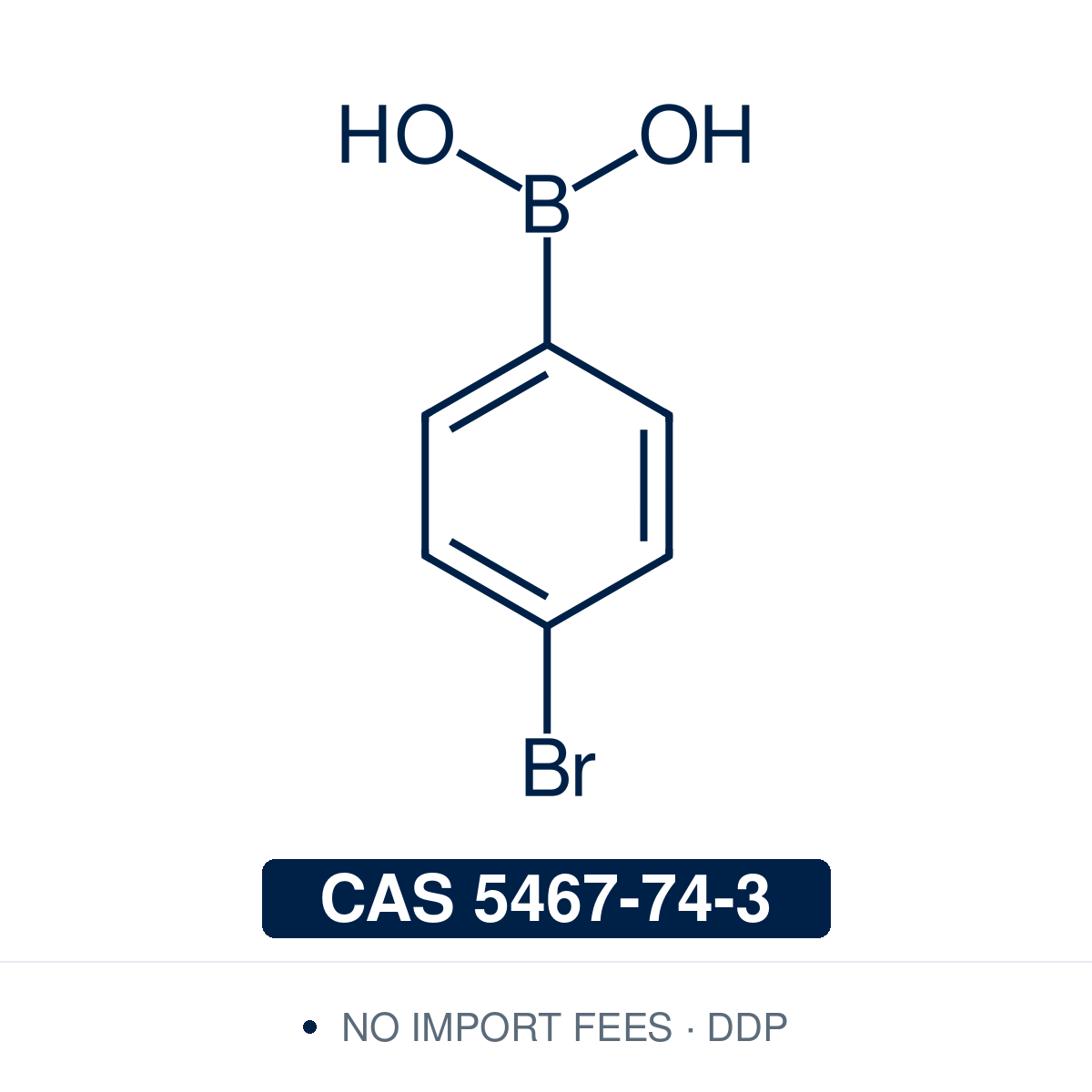
4-Bromophenylboronic Acid
4-Bromophenylboronic Acid | CAS 5467-74-3 | ≥98%
Couldn't load pickup availability
Technical Specifications
| CAS Number | 5467-74-3 |
| EC / EINECS Number | 226-779-9 |
| MDL Number | MFCD00002104 |
| RTECS Number | CY8650000 |
| SMILES | B(C1=CC=C(C=C1)Br)(O)O |
| InChI | InChI=1S/C6H6BBrO2/c8-6-3-1-5(2-4-6)7(9)10/h1-4,9-10H |
| InChIKey | QBLFZIBJXUQVRF-UHFFFAOYSA-N |
| PubChem CID | 79599 |
| Molecular Formula | C₆H₆BBrO₂ |
| Molecular Weight | 200.83 g/mol |
| Melting Point | 284-288 °C |
| Solubility | Slightly soluble in water; soluble in alcoholic solvents, acetonitrile, DMF, DMSO |
| Purity | ≥98%. May contain small variable amounts of boron anhydrides |
| Physical Form | White to off-white crystalline powder |
| HS Code | 2931.90 |
| Shelf Life | Retest period: 36 months from date of manufacture |
| Storage Conditions | Store at room temperature. Keep container tightly closed in a dry place. Mildly hygroscopic — protect from moisture |
Product Description & Scientific Applications
4-Bromophenylboronic Acid (4-bromobenzeneboronic acid, p-bromophenylboronic acid) carries a para-bromine with σp +0.23, essentially matching para-chloro in Hammett electronic terms, and has a measured boronic-acid pKa around 8.2 in water at 25 °C, below phenylboronic acid (≈ 8.9). The aryl C–Br bond is a versatile downstream handle: more reactive than the corresponding aryl chloride in Pd-catalysed cross-coupling, accessible to halogen–metal exchange and magnesium insertion when the boron centre is suitably protected, and an AB-type aryl bromide / boronic-acid motif for Suzuki polycondensation or para-phenylene incorporation. Used as a 4-bromophenyl building block in medicinal chemistry, agrochemicals, conjugated materials, organic semiconductors, and polymer synthesis.
May contain small amounts of the cyclic anhydride 4-bromophenylboroxine. Under aqueous or basic coupling conditions the two forms re-equilibrate and the impact on yield is minor.
Applications and Reactions
- Suzuki–Miyaura coupling: with aryl, heteroaryl, or alkenyl electrophiles to give 4-bromophenyl biaryls, heterobiaryls, terphenyls, and styrenyl products. Selectivity for the boronic acid over the aryl bromide depends on electrophile class and catalyst system; aryl iodide or aryl triflate partners typically allow the C–Br to be retained for later use.
- Iterative cross-coupling at the bromide handle: the C–Br bond can be engaged in subsequent Pd- or Ni-catalysed Suzuki–Miyaura, Buchwald–Hartwig, Negishi, Stille, Sonogashira, or Heck chemistry; relative to aryl chlorides, aryl bromides generally require less forcing oxidative-addition conditions, although catalyst and ligand choice remain coupling-class-dependent.
- Photoredox / nickel dual-catalysis cross-coupling: reported as the aryl bromide partner in Csp³–Csp² coupling with alkyltrifluoroborates; unprotected 4-bromophenylboronic acid is a specific example where the free boronic acid is tolerated as a latent functional group and remains available for subsequent Suzuki–Miyaura chemistry.
- Iron-catalysed radical arylation of arenes: reported in Fe(OTf)3 / 1,10-phenanthroline-mediated oxidative coupling with benzene derivatives using di-tert-butyl peroxide as oxidant; aryl radicals generated from the boronic acid undergo homolytic aromatic substitution to give 4-bromobiaryl products while retaining the para-bromide.
- Halogen–metal exchange and organomagnesium chemistry: the para-bromide can be converted to aryl-lithium or aryl-magnesium intermediates in protected boronate formats, with pinacol, MIDA, Bdan, or related protected boron derivatives preferred where the boron function must survive; the free boronic acid is not directly compatible with strong organolithium or Grignard conditions.
- Chan–Lam coupling: copper-mediated C–N and C–O arylation onto amines, amides, sulfonamides, carbamates, N–H heterocycles, phenols, and selected alcohols.
- Petasis borono-Mannich reaction: three-component coupling with an amine and a carbonyl partner to give α-aryl amines, α-amino acids, or β-amino alcohols bearing the 4-bromophenyl group, metal-free.
- Pd-catalysed Heck-type and conjugate addition chemistry: reported in stereoselective Heck-type arylation of allylic esters and Pd(II)-catalysed diastereoselective conjugate addition to activated alkenes.
- Tandem Pd(II) oxidative Heck / C–H amidation: reported in tandem-type oxidative Heck arylation followed by intramolecular C–H amidation sequences for heterocycle construction.
- Copper-mediated fluoroalkylation: reported in ligandless aerobic Cu-catalysed reactions with fluoroalkyl iodides to give 4-bromo-fluoroalkylarene products.
- AB-type Suzuki polycondensation: the bifunctional aryl bromide / boronic-acid pair makes the molecule an AB-type monomer or capping unit for poly(para-phenylene)-type and related Suzuki-polycondensation architectures.
- Protected boronate esters: precursor to pinacol (Bpin), neopentyl glycol, MIDA, and 1,8-diaminonaphthalene (Bdan) esters. Bdan masking is particularly useful in iterative synthesis, allowing Pd-catalysed reactions at the C–Br bond while the boron centre remains inert until later deprotection.
- Non-classical arylation: Suzuki–Miyaura-type coupling with arenediazonium tetrafluoroborates as alternative aryl electrophiles.
- Ipso-halodeboronation: deborylative bromination or iodination of arylboronic acids can replace the boronic-acid group with halogen; for the 4-bromo substrate this provides access to para-dihalogenated benzene motifs such as 1,4-dibromobenzene or 1-bromo-4-iodobenzene, depending on halogen source and conditions.
- Oxidative ipso-hydroxylation: peroxide- or perborate-mediated conversion to 4-bromophenol under mild arylboronic-acid hydroxylation conditions; aerobic photoredox and copper-catalysed variants are broader arylboronic-acid method classes.
Further Reading
Shipping Destinations
- EU & UK: Priority delivery, 2–5 business days.
- United States (DDP): 3–7 business days, duties and taxes prepaid.
- EFTA Countries (DDP): 3–7 business days, duties and taxes prepaid.
- Worldwide: 7–14 business days, selected locations.
Safety Information
| GHS Pictograms |

|
| Signal Word | Warning |
| Hazard Class | None — not subject to transport regulations |
| Transport Category | Not classified as dangerous goods for transport (ADR/IATA/IMDG) |
| H-Statements | H315 - H319 - H335 |
| P-Statements | P261 - P264 - P271 - P280 - P302+P352 - P304+P340 - P305+P351+P338 - P319 - P332+P317 - P337+P317 - P362+P364 - P403+P233 - P405 - P501 |
Documentation
| Safety Data Sheet | Download PDF |