NorrChemica™
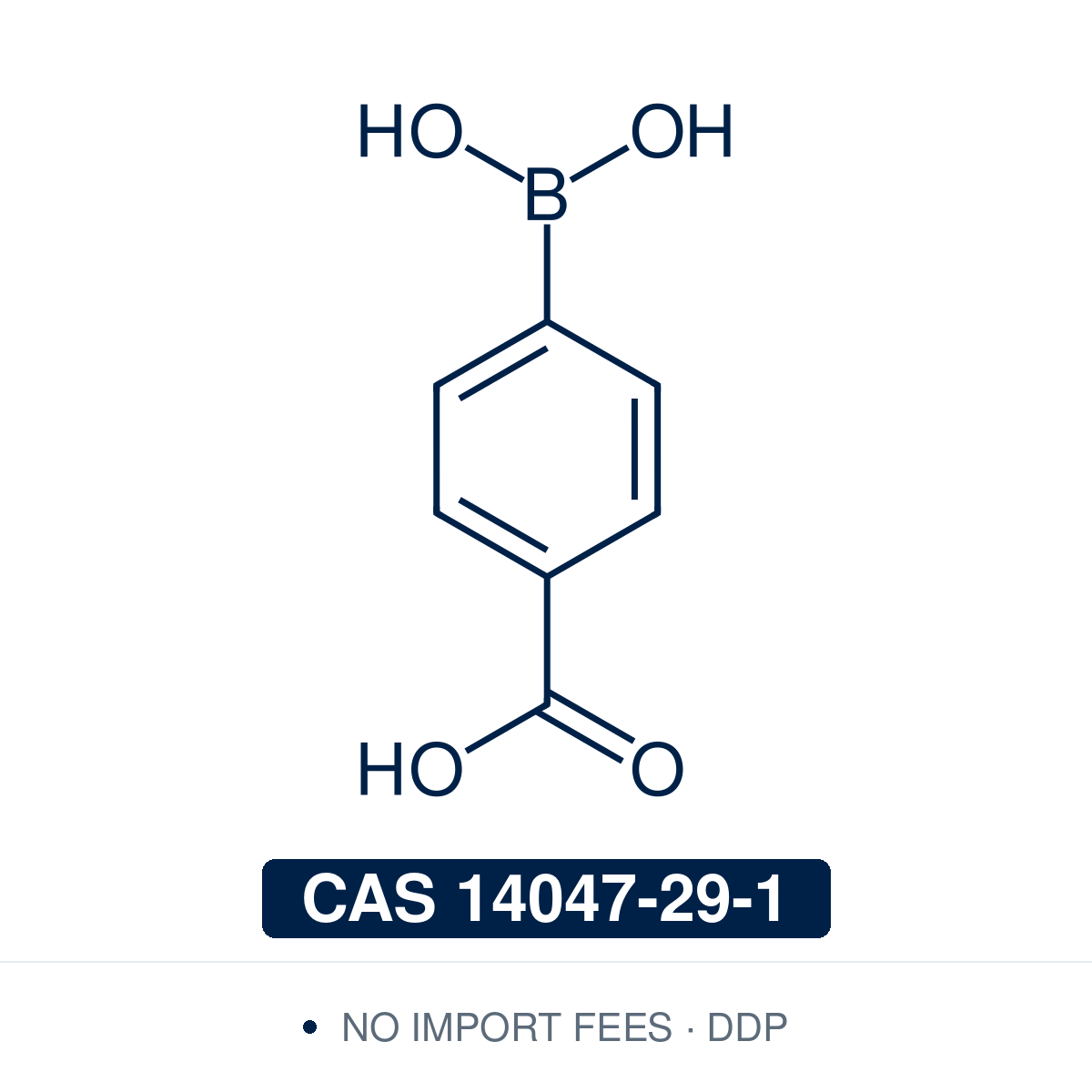
4-Carboxyphenylboronic acid
4-Carboxyphenylboronic acid | CAS 14047-29-1 | ≥97%
Couldn't load pickup availability
Technical Specifications
| CAS Number | 14047-29-1 |
| EC / EINECS Number | 604-189-6 |
| MDL Number | MFCD00151801 |
| SMILES | B(C1=CC=C(C=C1)C(=O)O)(O)O |
| InChI | InChI=1S/C7H7BO4/c9-7(10)5-1-3-6(4-2-5)8(11)12/h1-4,11-12H,(H,9,10) |
| InChIKey | SIAVMDKGVRXFAX-UHFFFAOYSA-N |
| PubChem CID | 312183 |
| Molecular Formula | C₇H₇BO₄ |
| Molecular Weight | 165.94 g/mol |
| Melting Point | 220 °C (dec.) |
| Solubility | Soluble in alcoholic solvents, acetonitrile, DMF, DMSO |
| Purity | ≥97%. May contain varying amounts of the corresponding boronic acid anhydrides. |
| Physical Form | White to off-white crystalline powder |
| HS Code | 2931.90 |
| Shelf Life | Retest period: 36 months from date of manufacture |
| Storage Conditions | Store in a cool, dry place in a tightly sealed container |
Product Description & Scientific Applications
4-Carboxyphenylboronic acid (4-boronobenzoic acid) is a bifunctional arylboronic acid. Its boronic acid recognises diols and acts as a cross-coupling nucleophile. Its carboxyl is derivatised to amides or coordinated to metal nodes, leaving boron free to react. This orthogonality makes it a para-carboxyphenyl building block for biaryls, surfaces and functional materials.
Solution behaviour. Under anhydrous conditions arylboronic acids equilibrate with their cyclic trimeric anhydrides, the boroxines. In water the Lewis-acidic boron ionises to an anionic trihydroxyboronate.
Reversible diol recognition. The boronic acid binds cis-1,2- and 1,3-diols, forming five- and six-membered cyclic boronate esters. The boron centre converts from a neutral trigonal-planar form to an anionic tetrahedral ester. Binding is reversible and pH-dependent, strengthening as the medium turns basic. Acid or a competing diol releases the bound diol. Unsubstituted phenylboronic acid has a pKa near nine. Ring substituents shift this pKa, correlating with Hammett constants. Affinity tracks diol structure: catechols and the polyol sorbitol bind strongly. Fructose binds far more strongly than glucose, given its greater furanose abundance.
Saccharide and glycan recognition. As synthetic diol receptors, arylboronic acids serve as lectin mimics for sugars and glycans. They bind monosaccharides, glycoproteins and glycated proteins. Unlike protein lectins, they are stable, inexpensive and oxygen-independent. These properties underpin boronic-acid glucose sensing.
Boronate-affinity capture. Immobilised through its carboxyl, the boronic acid becomes a boronate-affinity ligand. Coupled to lysine residues, it forms a di-boronate resin for affinity chromatography. The resin binds cis-diol species under base and releases them under acid. It has captured deoxyfructosylated peptides, early markers of glycation, from serum-albumin digests. Further affinity targets include nucleosides, nucleotides, nucleic acids and carbohydrates.
Responsive and self-healing materials. The reversible boronate ester also crosslinks stimuli-responsive polymers. Grafted onto poly(2-hydroxyethyl methacrylate) through its carboxyl, the compound gives a dual pH- and glucose-responsive material. It binds glucose at physiological pH, its aggregates dissociating into unimers around the boron ionisation. Diol exchange renders such boronate networks self-healing.
Framework-tethered sensing. As a bifunctional linker it builds luminescent metal–organic frameworks. Tethered through its carboxyl to an amino-functionalised zirconium framework, the pendant boron binds sialic acid. Recognition of its triol switches the framework fluorescence, giving a sialic-acid sensor.
Further applications.
- Suzuki–Miyaura coupling. Arylboronic acids are the standard nucleophilic partners for biaryl synthesis. Here the boronic acid couples to an aryl bromide over recyclable graphene-supported palladium. The carboxyl is carried through to a carboxy-biaryl. Such couplings reach industrial scale, as in the fungicide boscalid.
- Chan–Lam coupling. Arylboronic acids arylate amines and phenols under copper catalysis, forming C–N and C–O bonds.
- Oxidation to phenols. Peroxide-type oxidants convert arylboronic acids to the corresponding phenols by 1,2-aryl migration to oxygen.
Further Reading
For boronic acids, boronic esters, protodeboronation, boroxine content, and Suzuki–Miyaura reagent selection, see NorrChemica's Lab Journal guide: Choosing Your Boron Source for Suzuki–Miyaura Coupling
Shipping Destinations
- EU & UK: Priority delivery, 2–5 business days.
- United States (DDP): 3–7 business days, duties and taxes prepaid.
- EFTA Countries (DDP): 3–7 business days, duties and taxes prepaid.
- Worldwide: 7–14 business days, selected locations.
Safety Information
| GHS Pictograms |

|
| Signal Word | Warning |
| Hazard Class | None — not subject to transport regulations |
| Transport Category | Not classified as dangerous goods for transport (ADR/IATA/IMDG) |
| H-Statements | H315 - H319 - H335 |
| P-Statements | P261 - P264 - P271 - P280 - P302+P352 - P304+P340 - P305+P351+P338 - P332+P313 - P337+P313 - P362+P364 - P501 |
Documentation
| Safety Data Sheet | Download PDF |