NorrChemica™
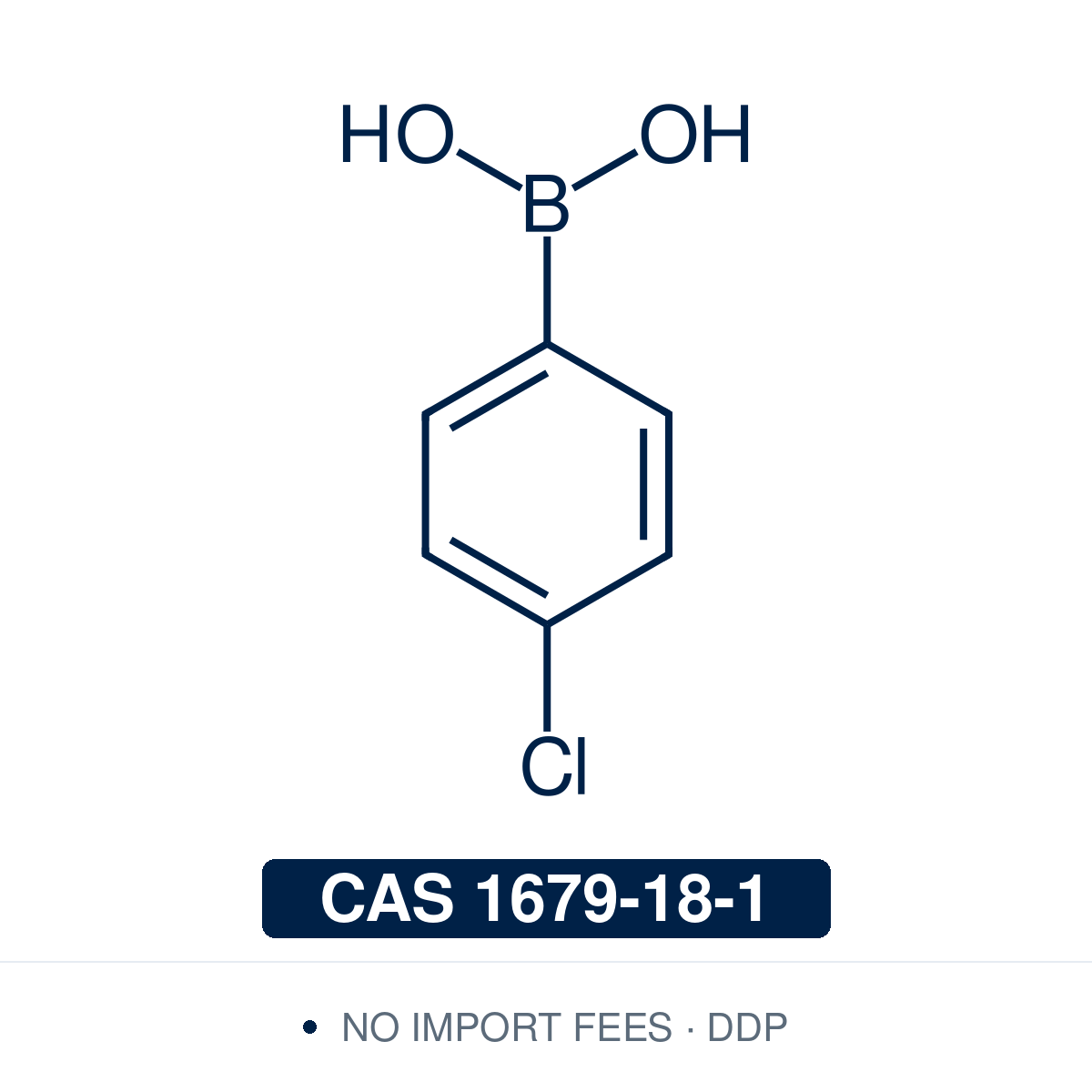
4-Chlorophenylboronic Acid
4-Chlorophenylboronic Acid | CAS 1679-18-1 | ≥98%
Couldn't load pickup availability
Technical Specifications
| CAS Number | 1679-18-1 |
| EC / EINECS Number | 216-845-5 |
| MDL Number | MFCD00039137 |
| RTECS Number | CY8950000 |
| SMILES | B(C1=CC=C(C=C1)Cl)(O)O |
| InChI | InChI=1S/C6H6BClO2/c8-6-3-1-5(2-4-6)7(9)10/h1-4,9-10H |
| InChIKey | CAYQIZIAYYNFCS-UHFFFAOYSA-N |
| PubChem CID | 74299 |
| Molecular Formula | C₆H₆BClO₂ |
| Molecular Weight | 156.38 g/mol |
| Melting Point | 284-289 °C |
| Solubility | Slightly soluble in water; soluble in alcoholic solvents, acetonitrile, DMF, DMSO. |
| Purity | ≥98%. May contain small variable amounts of boron anhydrides |
| Physical Form | White to off-white crystalline powder |
| HS Code | 2931.90 |
| Shelf Life | Retest period: 36 months from date of manufacture |
| Storage Conditions | Store at room temperature. Keep container tightly closed in a dry place. Mildly hygroscopic — protect from moisture |
Product Description & Scientific Applications
4-Chlorophenylboronic Acid (4-chlorobenzeneboronic acid, p-chlorophenylboronic acid) bears a para-chlorine that is moderately electron-withdrawing (σp +0.23), with inductive withdrawal outweighing weak resonance donation, lowering the boronic-acid pKa below that of phenylboronic acid (≈ 8.9). The aryl C–Cl bond is also a useful synthetic handle: after installation of the 4-chlorophenyl unit, it can be retained for later Pd- or Ni-catalysed cross-coupling, Buchwald–Hartwig amination, or related aryl chloride chemistry under suitable conditions. Used as a 4-chlorophenyl building block in medicinal chemistry, agrochemicals, functional molecules, and materials intermediates.
May contain small amounts of the cyclic anhydride 4-chlorophenylboroxine. Under aqueous or basic coupling conditions the two forms re-equilibrate and the impact on yield is minor.
Applications and Reactions
- Suzuki–Miyaura coupling: with aryl, heteroaryl, or alkenyl electrophiles to give 4-chlorophenyl biaryls, heterobiaryls, terphenyls, and styrenyl products. The residual aryl chloride can be retained for later diversification.
- Iterative cross-coupling at the chloride handle: the C–Cl bond in 4-chlorophenyl products can be engaged in later Suzuki–Miyaura, Buchwald–Hartwig, or related Pd/Ni-catalysed reactions when the ligand system and substrate class support aryl chloride activation.
- Chan–Lam coupling: copper-mediated C–N and C–O arylation onto amines, amides, sulfonamides, carbamates, N–H heterocycles, phenols, and selected alcohols.
- Petasis borono-Mannich reaction: three-component coupling with an amine and a carbonyl partner to give α-aryl amines, α-amino acids, or β-amino alcohols bearing the 4-chlorophenyl group, metal-free.
- Pd- and Ru-catalysed direct arylation: aryl source in palladium- and ruthenium-catalysed direct arylation and related C–H functionalisation chemistry.
- Cyclopalladation and tandem Pd chemistry: reported in cyclopalladation, Pd-catalysed arylative cyclisation, and tandem Pd(II)-catalysed oxidative Heck / intramolecular C–H amidation sequences.
- Regioselective arylation and alkynylation: reported in Suzuki–Miyaura and Sonogashira-type cross-coupling sequences where the 4-chlorophenyl unit is part of the arylation/alkynylation design.
- Protected boronate esters: precursor to pinacol (Bpin), neopentyl glycol, and MIDA esters when a more robust 4-chloroaryl-boron building block is required for staged or iterative synthesis.
- Ipso-halodeboronation: to 1-bromo-4-chlorobenzene, 1,4-dichlorobenzene, or 1-chloro-4-iodobenzene under electrophilic halogenation.
- Oxidative hydroxylation: to 4-chlorophenol under aerobic photoredox, peroxide, or copper-catalysed conditions.
Further Reading
Shipping Destinations
- EU & UK: Priority delivery, 2–5 business days.
- United States (DDP): 3–7 business days, duties and taxes prepaid.
- EFTA Countries (DDP): 3–7 business days, duties and taxes prepaid.
- Worldwide: 7–14 business days, selected locations.
Safety Information
| GHS Pictograms |

|
| Signal Word | Warning |
| Hazard Class | None — not subject to transport regulations |
| Transport Category | Not classified as dangerous goods for transport (ADR/IATA/IMDG) |
| H-Statements | H302 |
| P-Statements | P261 - P264 - P270 - P271 - P280 - P301+P317 - P302+P352 - P304+P340 - P317 - P330 - P362+P364 - P403+P233 - P405 - P501 |
Documentation
| Safety Data Sheet | Download PDF |