NorrChemica™
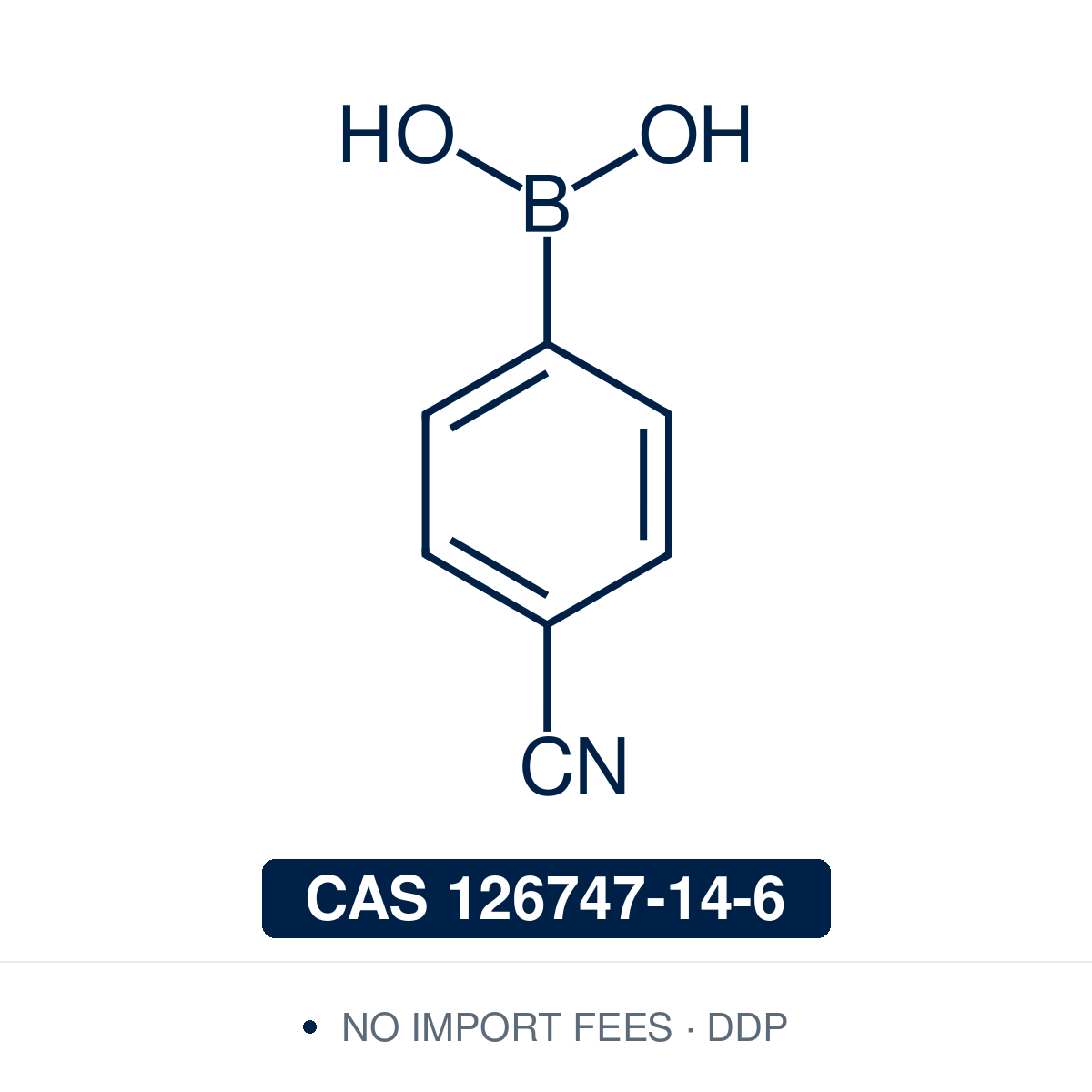
4-Cyanophenylboronic Acid
4-Cyanophenylboronic Acid | CAS 126747-14-6 | ≥98%
Couldn't load pickup availability
Technical Specifications
| CAS Number | 126747-14-6 |
| EC / EINECS Number | 671-676-8 |
| MDL Number | MFCD01318968 |
| SMILES | B(C1=CC=C(C=C1)C#N)(O)O |
| InChI | InChI=1S/C7H6BNO2/c9-5-6-1-3-7(4-2-6)8(10)11/h1-4,10-11H |
| InChIKey | CEBAHYWORUOILU-UHFFFAOYSA-N |
| PubChem CID | 2734326 |
| Molecular Formula | C₇H₆BNO₂ |
| Molecular Weight | 146.94 g/mol |
| Melting Point | >350 °C (lit.) |
| Solubility | Slightly soluble in water; soluble in alcoholic solvents, acetonitrile, DMF, DMSO |
| Log Pow | 1.09 |
| Purity | ≥98%. May contain small variable amounts of boron anhydrides |
| Physical Form | White to off-white crystalline powder |
| HS Code | 2931.90 |
| Shelf Life | Retest period: 36 months from date of manufacture |
| Storage Conditions | Store at room temperature. Keep container tightly closed in a dry place. Mildly hygroscopic — protect from moisture |
Product Description & Scientific Applications
4-Cyanophenylboronic Acid (4-cyanobenzeneboronic acid, p-cyanophenylboronic acid, 4-boronobenzonitrile) carries a para-cyano group that is strongly electron-withdrawing (σp +0.66), with inductive (−I) and resonance (−M) effects acting in the same direction to give one of the strongest electron-withdrawing substituents in routine arylboronic-acid chemistry. The strong electron-deficiency gives a reported boronic-acid pKa around 7.7 in water, well below phenylboronic acid (≈ 8.9), changes boronate speciation under Suzuki–Miyaura conditions, and can make base-promoted protodeboronation a more important competing pathway under strongly aqueous-basic conditions. The retained para-cyano group is itself a versatile downstream handle: hydrolysis to 4-substituted benzoic acids, reduction to 4-aminomethyl arenes or 4-substituted benzaldehydes, [3+2] cycloaddition to tetrazoles as carboxylic-acid bioisosteres, and Pinner-type conversion to amidines or imidates. Used as a 4-cyanophenyl building block in medicinal chemistry, agrochemicals, cyanobiphenyl liquid crystals, and electron-poor π-conjugated materials.
May contain small amounts of the cyclic anhydride 4-cyanophenylboroxine. Under aqueous or basic coupling conditions the two forms re-equilibrate and the impact on yield is minor.
Applications and Reactions
- Suzuki–Miyaura coupling: with aryl, heteroaryl, or alkenyl electrophiles to give 4-cyanobiaryl, 4-cyano-arylheteroaryl, terphenyl, and aryl-alkenyl products. The strong electron-deficiency changes boronate speciation and can make competing protodeboronation more prominent under aqueous-basic conditions; milder bases, partially anhydrous solvent systems, lower temperatures, or boronate-ester forms may be useful where protodeboronation is observed.
- Cyano group transformation in coupled products: the retained para-cyano group is a versatile orthogonal handle for downstream chemistry, including hydrolysis to 4-substituted benzoic acids, catalytic or LiAlH4 reduction to 4-aminomethyl arenes, controlled DIBAL-H reduction to 4-substituted benzaldehydes, [3+2] cycloaddition with sodium azide or TMSN3 to tetrazoles as carboxylic-acid bioisosteres, and Pinner-type conversion to amidines, imidates, and orthoesters.
- Cyanobiphenyl liquid crystal synthesis: key arylboronic-acid building block for cyanobiphenyl (CB) and cyanobiphenyl-based dimer liquid crystals through Suzuki–Miyaura cross-coupling with alkylphenyl halides or related partners; the strongly polar para-cyano group provides the dielectric anisotropy that underlies nematic liquid-crystalline behaviour in the cyanobiphenyl family.
- Cyanoaryl acceptor fragments and electron-poor π-systems: useful for installing a strongly electron-withdrawing 4-cyanophenyl unit into donor–acceptor chromophores, polar biaryls, and electron-poor conjugated materials; optical and frontier-orbital effects remain scaffold-dependent and should be evaluated in the final π-system.
- Fullerene functionalisation: reported in ferric perchlorate-promoted reaction of [60]fullerene with arylboronic acids to give fullerenyl boronic esters, with further diol functionalisation to C60-fused dioxane or dioxepane derivatives.
- Chan–Lam coupling: copper-mediated arylation onto N, O, and S nucleophiles, including amines, amides, sulfonamides, carbamates, N–H heterocycles, phenols, selected alcohols, and thiols; S-arylation gives diaryl sulfides from aryl thiols and aryl alkyl sulfides from aliphatic thiols.
- Petasis borono-Mannich reaction: three-component coupling with an amine and a carbonyl partner to give α-aryl amines, α-amino acids, or β-amino alcohols bearing the 4-cyanophenyl group, metal-free.
- Ligand-free copper-catalysed coupling with nitroarenes: reported in Cu-catalysed coupling of nitroarenes with arylboronic acids to form diaryl ethers, providing a C–O bond-forming route to cyanoaryl ether scaffolds without phosphine-ligand activation.
- Ruthenium-catalysed direct arylation: reported for 4-cyanophenyl arylboronate derivatives in Ru-catalysed arylation of benzylic sp³ C–H positions of directed acyclic amines (typically using a 3-substituted pyridyl directing group), giving α-aryl-amine scaffolds.
- Protected boronate esters: precursor to pinacol (Bpin), neopentyl glycol, MIDA, and 1,8-diaminonaphthalene (Bdan) esters when more stable or chromatographically tractable 4-cyanoaryl–boron building blocks are required for iterative cross-coupling, particularly given the protodeboronation susceptibility of the free boronic acid.
- Non-classical arylation: Suzuki–Miyaura-type coupling with arenediazonium tetrafluoroborates as alternative aryl electrophiles, and reported in base-free Suzuki-type coupling with pentavalent triarylantimony diacetates.
- Ipso-halodeboronation: deborylative bromination, chlorination, or iodination of arylboronic acids can replace the boronic-acid group with halogen; for the 4-cyano substrate this gives access to 4-halobenzonitriles such as 4-bromobenzonitrile, 4-chlorobenzonitrile, or 4-iodobenzonitrile, depending on halogen source and conditions.
- Oxidative ipso-hydroxylation: peroxide- or perborate-mediated conversion to 4-cyanophenol under mild arylboronic-acid hydroxylation conditions; aerobic photoredox and copper-catalysed variants are broader arylboronic-acid method classes.
Further Reading
Shipping Destinations
- EU & UK: Priority delivery, 2–5 business days.
- United States (DDP): 3–7 business days, duties and taxes prepaid.
- EFTA Countries (DDP): 3–7 business days, duties and taxes prepaid.
- Worldwide: 7–14 business days, selected locations.
Safety Information
| GHS Pictograms |

|
| Signal Word | Warning |
| Hazard Class | None — not subject to transport regulations |
| Transport Category | Not classified as dangerous goods for transport (ADR/IATA/IMDG) |
| H-Statements | H315 - H319 - H335 |
| P-Statements | P261 - P264 - P271 - P280 - P302+P352 - P305+P351+P338 - P321 - P332+P317 - P337+P317 - P403+P233 - P405 - P501 |
Documentation
| Safety Data Sheet | Download PDF |