NorrChemica™
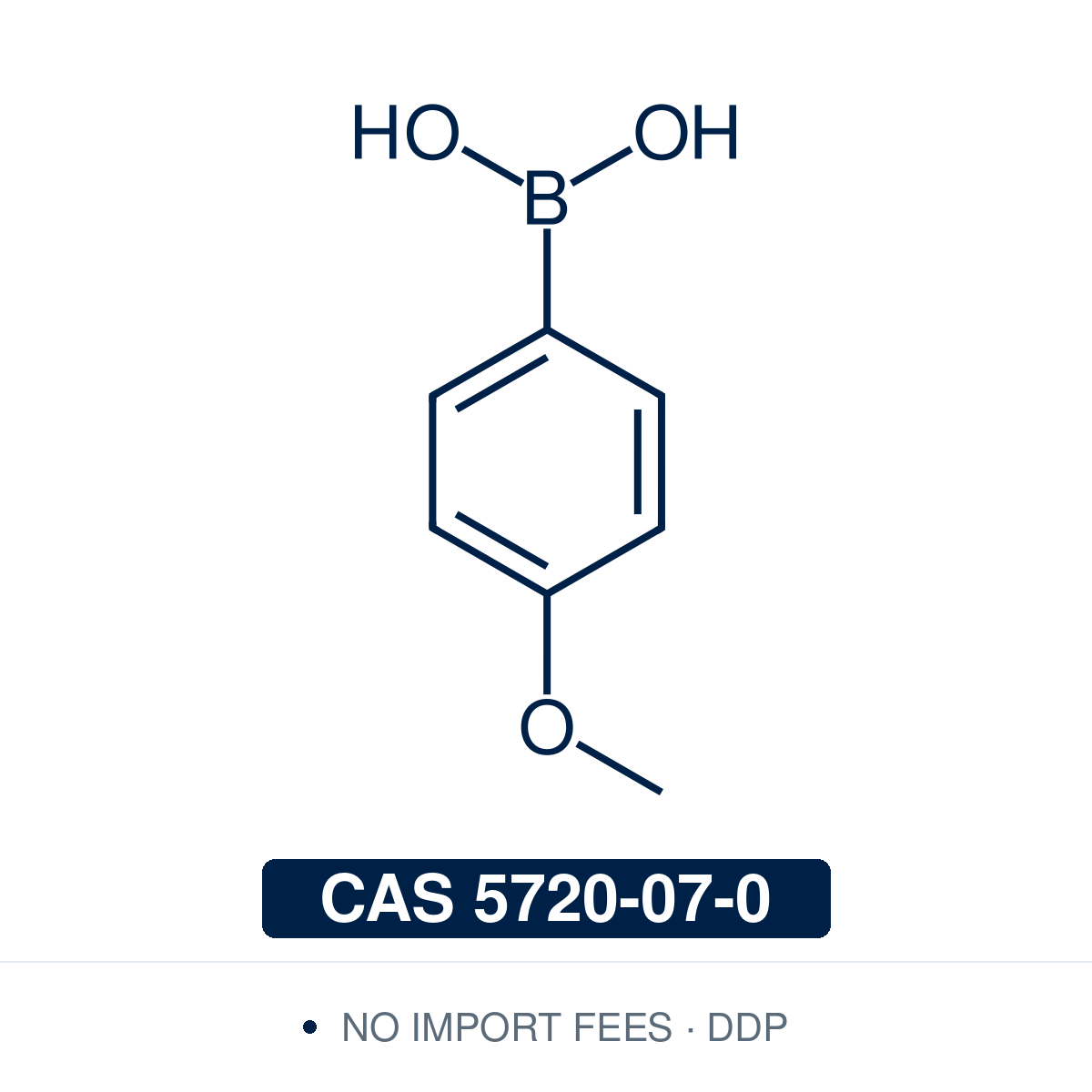
4-Methoxyphenylboronic Acid
CAS 5720-07-0
≥98%
4-Methoxyphenylboronic Acid | CAS 5720-07-0 | ≥98%
Regular price
€19,95 EUR (incl. VAT)
Regular price
Sale price
€19,95 EUR
Taxes included.
Shipping calculated at checkout.
Quantity
Couldn't load pickup availability
Technical Specifications
| CAS Number | 5720-07-0 |
| EC / EINECS Number | 611-482-2 |
| MDL Number | MFCD00039139 |
| RTECS Number | CY8975000 |
| SMILES | B(C1=CC=C(C=C1)OC)(O)O |
| InChI | InChI=1S/C7H9BO3/c1-11-7-4-2-6(3-5-7)8(9)10/h2-5,9-10H,1H3 |
| InChIKey | VOAAEKKFGLPLLU-UHFFFAOYSA-N |
| PubChem CID | 201262 |
| Molecular Formula | C₇H₉BO₃ |
| Molecular Weight | 151.96 g/mol |
| Melting Point | 204-206 °C |
| Solubility | Slightly soluble in water; soluble in alcoholic solvents, acetonitrile, DMF, DMSO. |
| Purity | ≥98%. May contain small variable amounts of boron anhydrides |
| Physical Form | White to off-white crystalline powder |
| HS Code | 2931.90 |
| Shelf Life | Retest period: 36 months from date of manufacture |
| Storage Conditions | Store at room temperature. Keep container tightly closed in a dry place. Mildly hygroscopic — protect from moisture |
Product Description & Scientific Applications
4-Methoxyphenylboronic Acid (4-anisylboronic acid, p-anisylboronic acid, 4-methoxybenzeneboronic acid) bears a para-methoxy group, a strong resonance donor (+M effect; σp ≈ −0.27). It is used in medicinal-chemistry, agrochemical, natural-product-analogue, and π-conjugated materials synthesis.
Like many arylboronic acids, 4-methoxyphenylboronic acid may contain small amounts of the corresponding cyclic anhydride, 4-methoxyphenylboroxine, in the solid state. Under aqueous/basic coupling conditions, boronic acid and boroxine forms usually re-equilibrate.
Applications and Reactions
- Suzuki–Miyaura coupling: Used with aryl, heteroaryl, or alkenyl electrophiles to prepare p-anisyl-substituted biaryls, heterobiaryls, and aryl–alkene products. The methoxy group gives an electron-rich aryl unit useful in SAR, materials, and synthetic-methodology work.
- Chan–Lam coupling: Common partner in copper-mediated C–N and C–O arylation. It transfers the p-anisyl group to amines, amides, sulfonamides, carbamates, N–H heterocycles, compatible phenols, and selected alcohols.
- Rhodium-catalysed conjugate addition: Participates in 1,4-addition to α,β-unsaturated carbonyl substrates, transferring the p-anisyl group to the β-position of enones, enoates, enamides, nitroalkenes, and related Michael acceptors. Suitable chiral ligand systems can give enantioenriched β-(p-anisyl) carbonyl and β-(p-anisyl)nitro products.
- Petasis borono-Mannich reaction: Combines with an amine and a carbonyl component in a multicomponent reaction to give substituted amines bearing the p-anisyl group at the α-position to nitrogen. Glyoxylic acid/glyoxylates and suitable α-hydroxy aldehydes give access to α-(p-anisyl)-α-amino acid derivatives and β-amino-alcohol scaffolds.
- Electron-rich materials and functional-molecule synthesis: Practical p-anisyl source for biaryl, aryl-heteroaryl, and arylated small-molecule intermediates used in materials, ligand, dye, natural-product-analogue, and functional-molecule R&D. The p-anisyl unit is a recurring donor fragment in push-pull chromophores, electron-rich π-conjugated systems, and arylated heterocycles.
- Latent phenol handle: The methoxy group can undergo demethylation (e.g. BBr3, etc) to generate the corresponding phenol
- Protected boronate ester preparation: Precursor for protected 4-methoxyphenylboronate esters such as pinacol, neopentyl glycol, and MIDA derivatives when a more stable p-anisyl-boron building block s required.
- Ipso-halodeboronation: Can be converted to 4-bromoanisole, 4-chloroanisole, or 4-iodoanisole under suitable electrophilic halogenation conditions where the boronic acid has served as a directing or coupling handle in earlier steps.
- Oxidative hydroxylation: Substrate for conversion to 4-methoxyphenol (mequinol) under aerobic photoredox, peroxide-mediated, or copper-catalysed boronic acid → phenol conditions.
- Diol recognition studies: Secondary cis-diol recognition motif in boronate-ester binding studies. The electron-donating methoxy group tends to raise boronic-acid pKa, so practical glucose/saccharide sensing is usually weaker than with more acidic or amine-appended boronic acid receptors.
Further Reading
Shipping Destinations
- EU & UK: Priority delivery, 2–5 business days.
- United States (DDP): 3–7 business days, duties and taxes prepaid.
- EFTA Countries (DDP): 3–7 business days, duties and taxes prepaid.
- Worldwide: 7–14 business days, selected locations.
Safety Information
| GHS Pictograms |

|
| Signal Word | Warning |
| Hazard Class | None — not subject to transport regulations |
| Transport Category | Not classified as dangerous goods for transport (ADR/IATA/IMDG) |
| H-Statements | H315 - H319 - H335 |
| P-Statements | P261 - P264 - P271 - P280 - P302+P352 - P304+P340 - P305+P351+P338 - P332+P317 - P337+P317 - P403+P233 - P405 - P501 |
Documentation
| Safety Data Sheet | Download PDF |