NorrChemica™
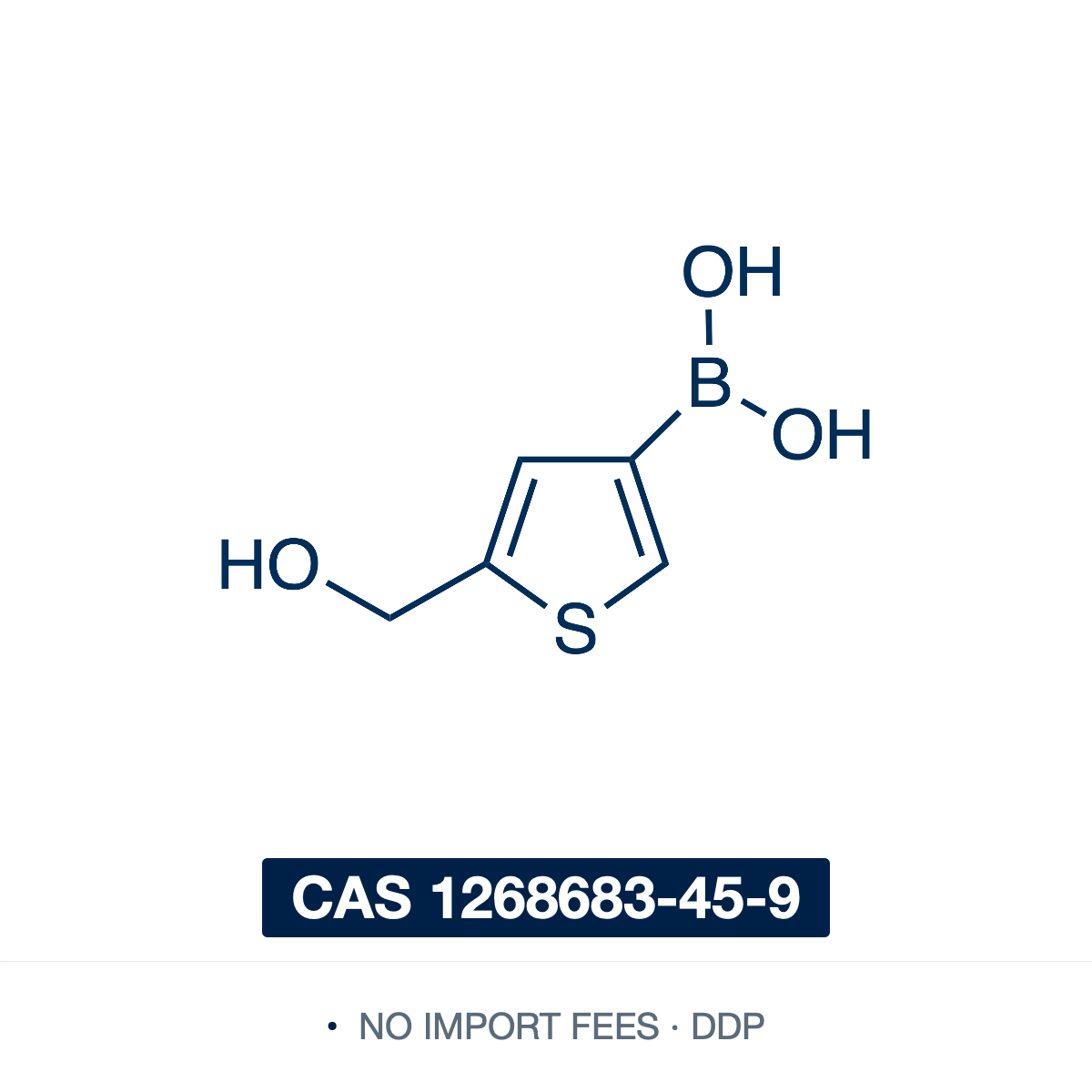
5-(Hydroxymethyl)thiophene-3-boronic Acid
5-(Hydroxymethyl)thiophene-3-boronic Acid | CAS 1268683-45-9 | ≥98%
Couldn't load pickup availability
Technical Specifications
| CAS Number | 1268683-45-9 |
| MDL Number | MFCD27665427 |
| SMILES | B(C1=CSC(=C1)CO)(O)O |
| InChI | InChI=1S/C5H7BO3S/c7-2-5-1-4(3-10-5)6(8)9/h1,3,7-9H,2H2 |
| InChIKey | KSCBULRYCWLXQG-UHFFFAOYSA-N |
| PubChem CID | 58314156 |
| Molecular Formula | C₅H₇BO₃S |
| Molecular Weight | 157.99 g/mol |
| Solubility | Soluble in methanol, ethanol, DMSO, DMF, and dilute aqueous alkali; sparingly soluble in water at neutral pH. |
| Purity | ≥98%. May contain varying amounts of the corresponding boronic acid anhydrides |
| Physical Form | Light yellow to yellow solid |
| HS Code | 2931.90 |
| Country of Origin | Finland |
| Shelf Life | Retest period: 36 months from date of manufacture |
| Storage Conditions | Store refrigerated (2–8 °C) in a tightly sealed container, protected from light and moisture; inert atmosphere recommended |
Product Description & Scientific Applications
5-(Hydroxymethyl)thiophene-3-boronic Acid ([5-(hydroxymethyl)thiophen-3-yl]boronic acid) is a bifunctional thiophene building block: a Suzuki-active boronic acid at the 3-position and a primary hydroxymethyl group at the 5-position of an electron-rich thiophene, the boron coupling while the alcohol stays free for further functionalisation.
May contain small amounts of the corresponding boroxine (cyclic boronic acid anhydride). Under aqueous or basic coupling conditions the acid and boroxine forms re-equilibrate, so anhydride content is not normally material for Suzuki–Miyaura use.
Applications and Reactions
- Suzuki–Miyaura coupling: couples as a heteroarylboronic acid with aryl and heteroaryl halides to give hydroxymethyl-thienyl-substituted (hetero)aromatics — reported, for instance, in coupling onto a chloro-azaheterocycle to build a kinase-inhibitor scaffold.
- 3-(β-)thienyl boronic acid: the boron occupies the thiophene 3-(β-)position; as with heteroarylboronic acids generally, its protodeboronation behaviour is condition-dependent.
- Orthogonal hydroxymethyl handle: the primary alcohol is a second point of diversification — oxidised toward formyl or carboxyl analogues, or converted to ethers and esters, before or after coupling.
Further Reading
For boronic acids, boronic esters, organotrifluoroborates, protodeboronation, boroxine content, and Suzuki–Miyaura reagent selection, see NorrChemica's Lab Journal guide: Choosing Your Boron Source for Suzuki–Miyaura Coupling.
Shipping Destinations
- EU & UK: Priority delivery, 2–5 business days.
- United States (DDP): 3–7 business days, duties and taxes prepaid.
- EFTA Countries (DDP): 3–7 business days, duties and taxes prepaid.
- Worldwide: 7–14 business days, selected locations.
Safety Information
| GHS Pictograms |

|
| Signal Word | Warning |
| Hazard Class | Not regulated for transport |
| Transport Category | Not classified as dangerous goods for transport (ADR/IATA/IMDG) |
| H-Statements | H315 - H319 - H335 |
| P-Statements | P261 - P264 - P271 - P280 - P302+P352 - P304+P340 - P305+P351+P338 - P332+P313 - P337+P313 - P362+P364 - P501 |
Documentation
| Safety Data Sheet | Download PDF |