NorrChemica™
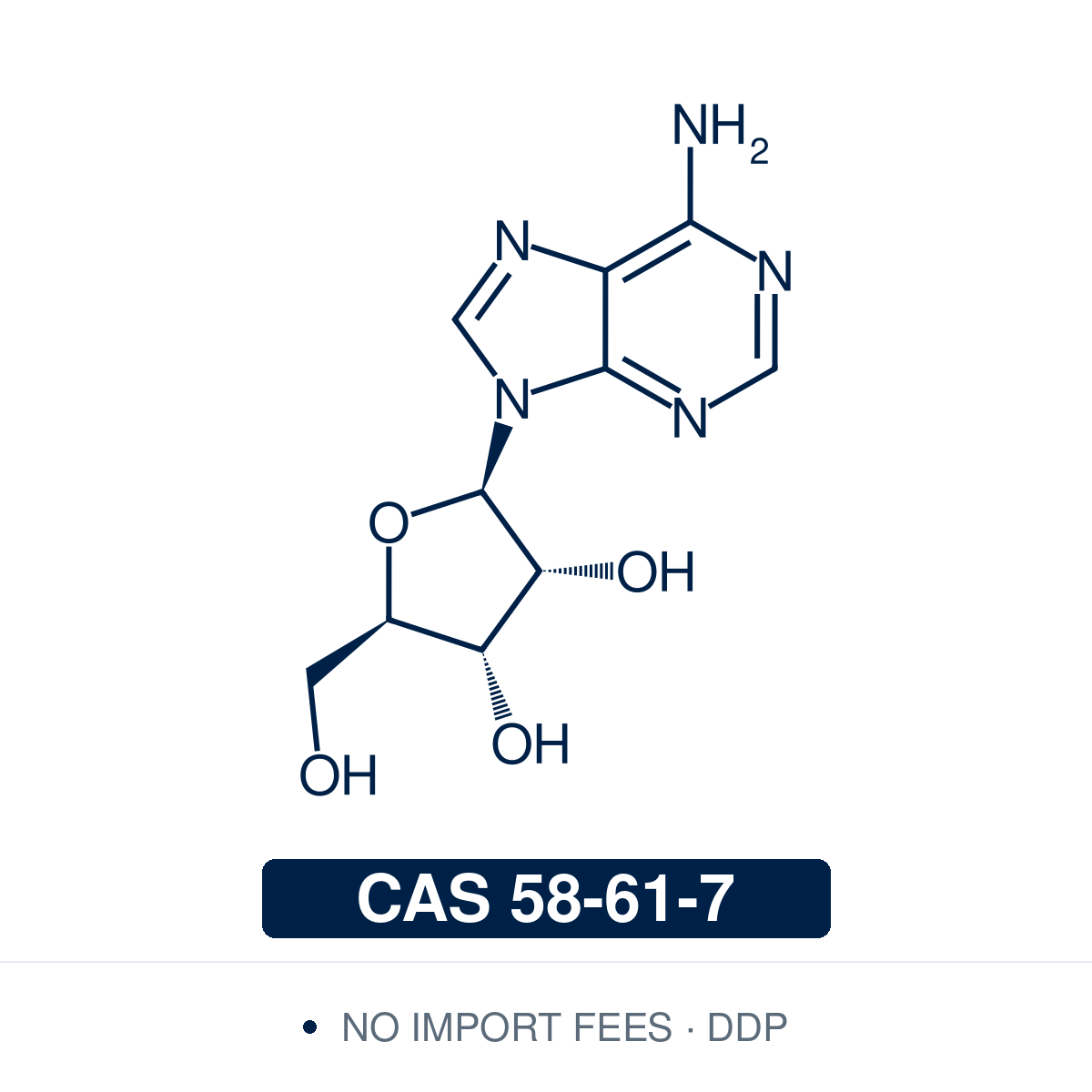
Adenosine
Adenosine | CAS 58-61-7 | ≥98%
Couldn't load pickup availability
Technical Specifications
| CAS Number | 58-61-7 |
| EC / EINECS Number | 200-389-9 |
| MDL Number | MFCD00005752 |
| SMILES | C1=NC(=C2C(=N1)N(C=N2)[C@H]3[C@@H]([C@@H]([C@H](O3)CO)O)O)N |
| InChI | InChI=1S/C10H13N5O4/c11-8-5-9(13-2-12-8)15(3-14-5)10-7(18)6(17)4(1-16)19-10/h2-4,6-7,10,16-18H,1H2,(H2,11,12,13)/t4-,6-,7-,10-/m1/s1 |
| InChIKey | OIRDTQYFTABQOQ-KQYNXXCUSA-N |
| PubChem CID | 60961 |
| Molecular Formula | C₁₀H₁₃N₅O₄ |
| Molecular Weight | 267.24 g/mol |
| Melting Point | 234–236 °C |
| Solubility | Soluble in water; slightly soluble in ethanol; soluble in DMSO |
| Purity | ≥98% |
| Physical Form | White crystalline powder |
| HS Code | 2934.99 |
| Country of Origin | Finland |
| Shelf Life | Retest period: 36 months from date of manufacture |
| Storage Conditions | Store refrigerated (2–8 °C) in a tightly sealed container under inert atmosphere, protected from light |
Product Description & Scientific Applications
Adenosine (β-D-adenosine, Ado) is the purine ribonucleoside formed by adenine linked to D-ribofuranose through a β-N9-glycosidic bond. In RNA it pairs with uridine through Watson–Crick hydrogen bonding and adopts the anti glycosidic orientation and C3'-endo sugar pucker of A-form helices. Its adenylate unit is a structural component of cAMP, S-adenosylmethionine, NAD⁺, FAD, and coenzyme A, placing it across nucleic-acid, energy, signalling, and cofactor chemistry.
Adenine Nucleotide Pool and Energy Charge. Adenosine kinase (ADK; EC 2.7.1.20) is a high-affinity, low-capacity ATP:adenosine 5'-phosphotransferase, with reported Kₘ values in the submicromolar-to-low-micromolar range, that drives the committed step of purine ribonucleoside salvage: ATP + adenosine → ADP + AMP. The reverse step is run by cytosolic 5'-nucleotidase (cN-I; EC 3.1.3.5); the two enzymes form a substrate cycle in which small changes in ADK activity produce large changes in ambient adenosine. Intracellular AMP/ADP/ATP sit in the millimolar range and free adenosine in the nanomolar range, so ADK holds the cytosol as a sink for extracellular adenosine. Adenosine is therefore a defining substrate in ADK kinetic assays, in adenine-nucleotide-pool profiling, and in studies of energy-charge homeostasis under hypoxia or metabolic stress.
cAMP Generation and P1 (Adenosine) Receptor Signalling. ATP is the direct substrate of adenylyl cyclase, which generates 3',5'-cyclic AMP and pyrophosphate; cAMP is then hydrolysed by phosphodiesterases to 5'-AMP. Adenosine is the endogenous agonist of the four P1 receptor GPCRs (A1, A2A, A2B, A3). Extracellular ecto-5'-nucleotidase (CD73) generates the local adenosine that feeds these receptors. Adenosine serves as the reference agonist in P1-receptor pharmacology, used alongside subtype-selective ligands, phosphodiesterase inhibitors, and adenylyl-cyclase activators to separate cyclic-nucleotide synthesis from degradation.
SAM/SAH Methylation Cycle. S-adenosylmethionine (SAM) is the principal biological methyl donor; more than fifty SAM-dependent methyltransferases transfer its activated methyl group to DNA, RNA, histone, protein, lipid, and small-molecule substrates, releasing S-adenosylhomocysteine (SAH) as the obligate by-product. SAH is hydrolysed to adenosine and L-homocysteine by S-adenosylhomocysteine hydrolase (SAHH/AHCY; EC 3.13.2.1), an NAD⁺-dependent tetrameric enzyme whose intrinsic equilibrium favours SAH synthesis; the reaction runs hydrolytically in vivo only because adenosine is removed by ADK and adenosine deaminase (ADA; EC 3.5.4.4) and homocysteine by transsulfuration and remethylation. Adenosine accumulation therefore drives SAH up, depresses the SAM/SAH ratio, and product-inhibits cellular methyltransferases. Adenosine is the product standard in SAHH activity assays and in LC-MS profiling of one-carbon and methionine-cycle metabolites.
Adenylyl Transfer in NAD⁺, FAD, and Coenzyme A Biosynthesis. The adenylyl group donated by ATP is transferred onto three cofactor systems. Nicotinamide mononucleotide adenylyltransferase (NMNAT; EC 2.7.7.1) condenses NMN with ATP to give NAD⁺ and pyrophosphate; FAD synthetase (FADS/FLAD1; EC 2.7.7.2) performs the equivalent reaction on FMN to give FAD; phosphopantetheine adenylyltransferase (PPAT; EC 2.7.7.3) adenylylates 4'-phosphopantetheine en route to coenzyme A. Adenylyl transfer with pyrophosphate displacement is the shared chemistry across this family. Adenosine and its nucleotides are therefore reference materials in studies of NAD⁺ biosynthesis and salvage, FAD-dependent oxidoreductases, and CoA-mediated acyl transfer.
Spectroscopic and Chemoenzymatic Reference. Adenosine has a UV absorption maximum near 260 nm with ε ≈ 15,400 M⁻¹cm⁻¹ at neutral pH, giving direct concentration determination by UV spectrophotometry and serving as the per-base extinction reference for A-rich oligonucleotide quantification. Its ¹H NMR signatures are diagnostic: the H1' anomeric proton at δ ≈ 5.9–6.0 ppm in D₂O, and the adenine H8 and H2 singlets at δ 8.1–8.4 ppm. Reverse-phase C18 HPLC at 254/260 nm and ion-pair LC-MS use adenosine as a retention and quantitation standard for purine ribonucleosides. ADK accepts a broad range of base- and sugar-modified analogues, and SAHH accommodates 3'-modified analogues such as cordycepin (3'-deoxyadenosine), making adenosine a benchmark substrate for chemoenzymatic preparation of AMP, ADP, ATP, cAMP, NAD⁺, and modified adenine derivatives for synthetic RNA chemistry.
Other Applications
- Substrate for adenosine-deaminase (ADA) activity assays
- Purine ribonucleoside supplement in defined-media and salvage-dependent culture systems
- Reference compound for ¹H, ¹³C, and ³¹P NMR studies of nucleoside conformation and glycosidic-bond geometry
- Building block for solid-phase oligonucleotide synthesis via N6-protected, 5'-O-DMTr, 2'-O-protected, 3'-O-phosphoramidite derivatives
Shipping Destinations
- EU & UK: Priority delivery, 2–5 business days.
- United States (DDP): 3–7 business days, duties and taxes prepaid.
- EFTA Countries (DDP): 3–7 business days, duties and taxes prepaid.
- Worldwide: 7–14 business days, selected locations.
Safety Information
| Hazard Class | None — not subject to transport regulations |
| Transport Category | Not classified as dangerous goods for transport (ADR/IATA/IMDG) |
Documentation
| Safety Data Sheet | Download PDF |
Share