NorrChemica™
CDT
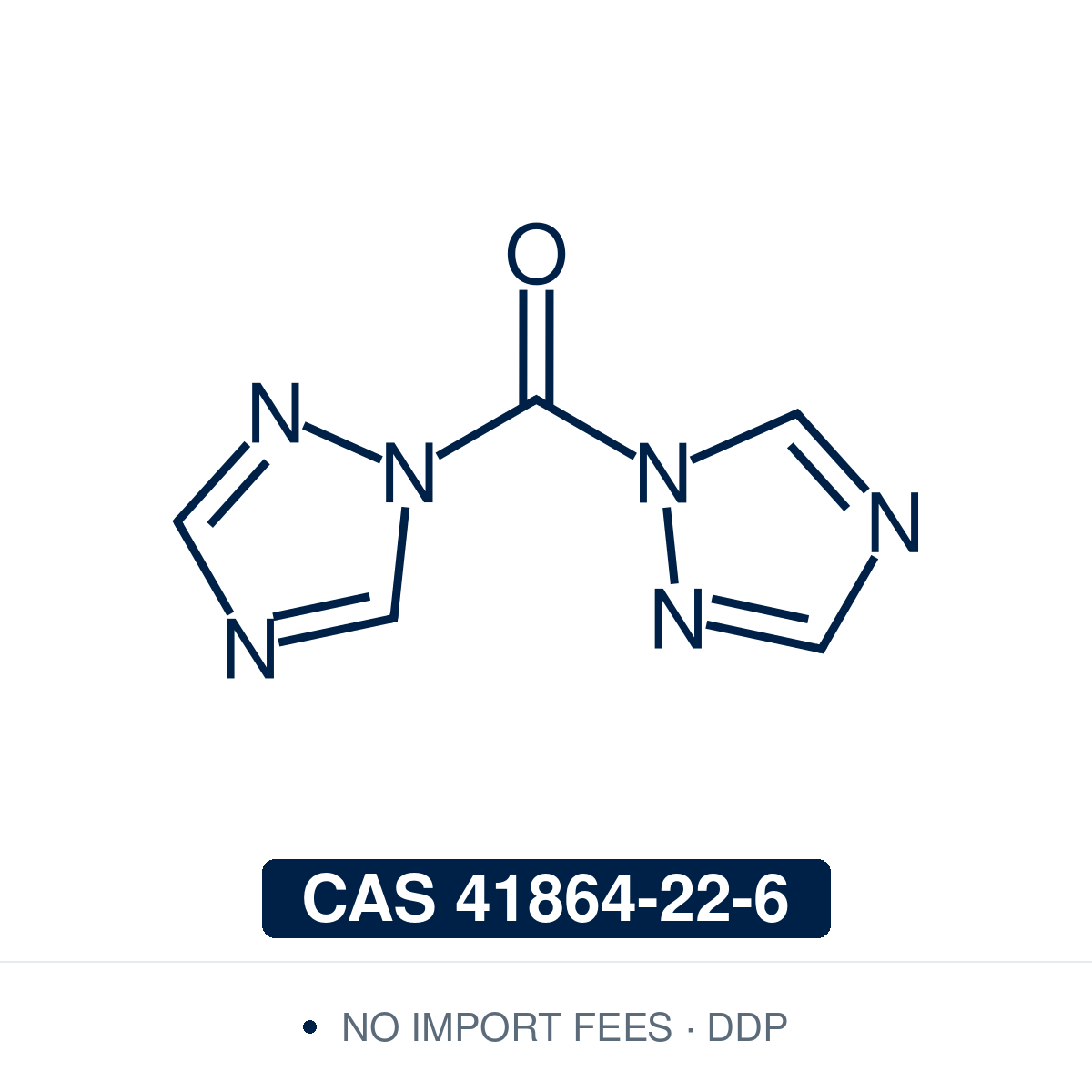
CDT | 1,1'-Carbonyldi(1,2,4-triazole) | CAS 41864-22-6 | ≥95%
Couldn't load pickup availability
Technical Specifications
| CAS Number | 41864-22-6 |
| EC / EINECS Number | 634-845-7 |
| MDL Number | MFCD00043399 |
| SMILES | C1=NN(C=N1)C(=O)N2C=NC=N2 |
| InChI | InChI=1S/C5H4N6O/c12-5(10-3-6-1-8-10)11-4-7-2-9-11/h1-4H |
| InChIKey | YHNUDLCUIKMNSN-UHFFFAOYSA-N |
| PubChem CID | 4393961 |
| Molecular Formula | C₅H₄N₆O |
| Molecular Weight | 164.12 g/mol |
| Melting Point | 145–150 °C |
| Solubility | Soluble in methanol, THF, acetone, DCM; reacts with water (hydrolysis) |
| Purity | ≥95% |
| Physical Form | White to pale yellow crystalline powder |
| HS Code | 2933.99 |
| Shelf Life | Retest period: 36 months from date of manufacture |
| Storage Conditions | Store refrigerated (2–8 °C) in a tightly sealed container under inert atmosphere, protected from moisture |
Product Description & Scientific Applications
CDT (1,1'-carbonyl-di-(1,2,4-triazole); di(1H-1,2,4-triazol-1-yl)methanone) is a crystalline carbonyl-transfer and condensing reagent in the same azole-carbonyl family as CDI. It reacts with carboxylic acids to give acyl triazolide intermediates in which the 1,2,4-triazole ring acts as the leaving group. Because 1,2,4-triazole is substantially more acidic as an N–H azole than imidazole, the corresponding triazolate is a weaker base and better leaving group than imidazolate. Acyl triazolides are therefore more electrophilic acyl donors than the corresponding acyl imidazolides, which can improve acyl-transfer efficiency with hindered alcohols, weakly nucleophilic amines, or substrates that respond poorly to imidazolide activation. CDT provides non-phosgene carbonyl-transfer chemistry for selected acylation and carbonylation workflows.
Activation of carboxylic acids as acyl triazolides
CDT converts carboxylic acids into reactive acyl triazolides, activated acyl-transfer species in which 1,2,4-triazole serves as the leaving group. This higher reactivity makes CDT useful where carbodiimide or imidazolide activation gives incomplete conversion or demands forcing conditions, including acylation of sterically hindered alcohols and weakly nucleophilic aromatic amines. The activated intermediate reacts with amine nucleophiles to give amides, with the higher electrophilicity of the acyl triazolide useful when imidazolide activation is insufficient.
Thioester and selenoester formation
Acyl triazolides generated from CDT undergo thiolysis or selenolysis to give thioesters and selenoesters. These products are useful acyl-transfer intermediates and softer electrophiles than ordinary oxoesters, and CDT provides access to them from the parent carboxylic acid without isolating an acid chloride.
Phosgene substitute for ureas and carbamates
CDT is used as a non-phosgene carbonyl-transfer reagent for urea and carbamate synthesis. Sequential displacement of the two triazole leaving groups allows stepwise carbonyl transfer to nitrogen and oxygen nucleophiles, making CDT useful where a solid azole-carbonyl reagent is preferred over phosgene-type reagents.
Esterification of unprotected glucose
CDT-derived acyl triazolides have been used for direct esterification of unprotected glucose to give β-D-glucosyl esters. This is a useful carbohydrate-acylation example because it avoids a protecting-group sequence and exploits the reactivity balance of the acyl triazolide toward the unprotected sugar substrate.
Singlet-oxygen generation for oxidation chemistry
CDT reacts with hydrogen peroxide as a dehydrating/activating reagent to generate singlet molecular oxygen. This CDT/H₂O₂ system has been used in oxidation chemistry, including epoxidation, where singlet oxygen is generated in situ under mild conditions.
Further Reading
For guidance on selecting between carbodiimides, aminium/uronium salts, phosphonium salts, and other reagent classes for amide and peptide bond formation, see NorrChemica's Lab Journal guide: Choosing a Coupling Reagent for Amide and Peptide Bond Formation.
Shipping Destinations
- EU & UK only: 3–7 business days.
- UK delivered DDP — duties and taxes prepaid; CoA & SDS included.
Safety Information
| GHS Pictograms |


|
| Signal Word | Danger |
| Hazard Class | None — not subject to transport regulations |
| Transport Category | Not classified as dangerous goods for transport (ADR/IATA/IMDG) |
| H-Statements | H302 - H318 - H361 |
| P-Statements | P201 - P202 - P264 - P270 - P280 - P301+P312 - P305+P351+P338 - P308+P313 - P330 - P405 - P501 |
Documentation
| Safety Data Sheet | Download PDF |