NorrChemica™
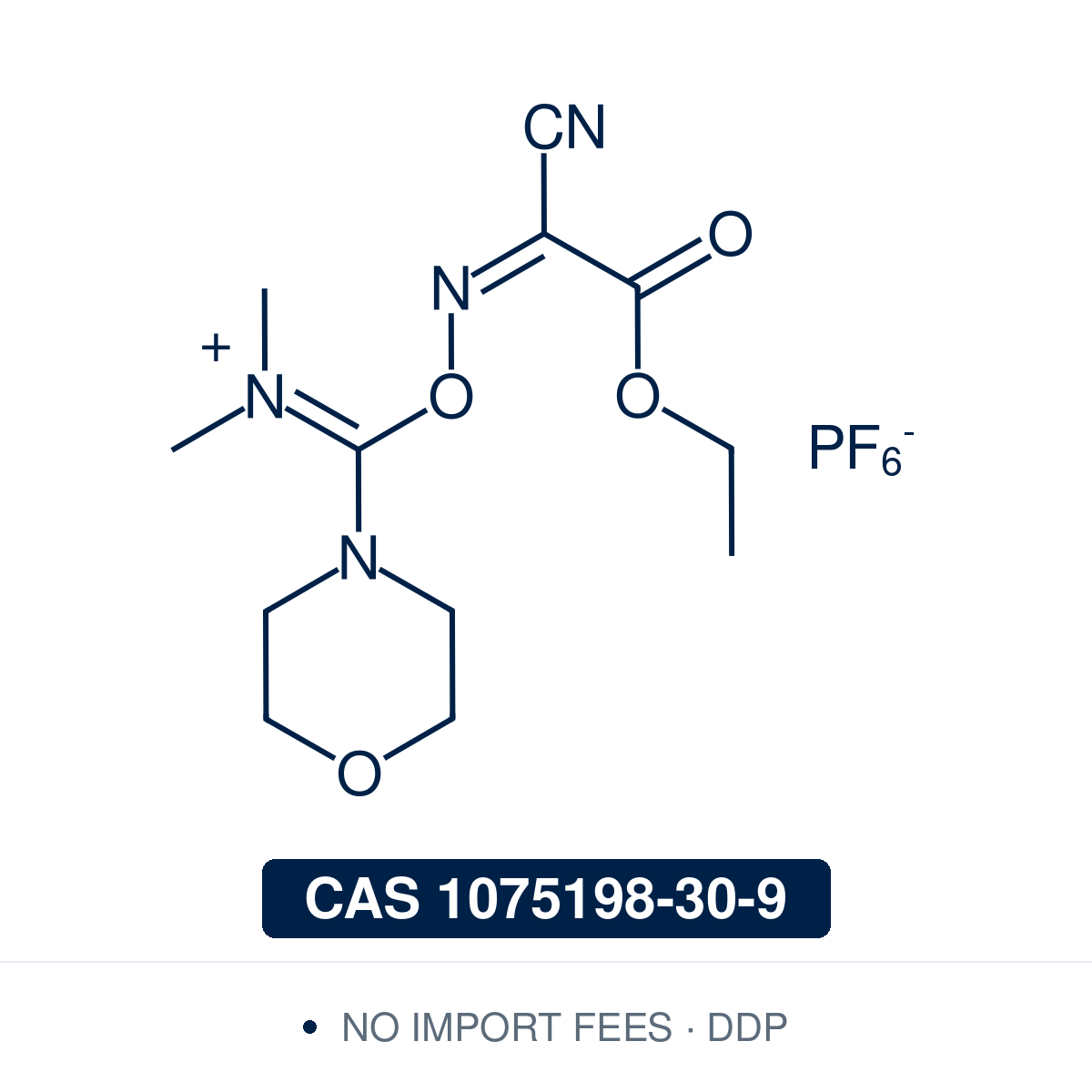
COMU
COMU | CAS 1075198-30-9 | ≥98%
Couldn't load pickup availability
Technical Specifications
| CAS Number | 1075198-30-9 |
| EC / EINECS Number | 682-899-5 |
| MDL Number | MFCD11975052 |
| SMILES | CCOC(=O)/C(=N\OC(=[N+](C)C)N1CCOCC1)/C#N.F[P-](F)(F)(F)(F)F |
| InChI | InChI=1S/C12H19N4O4.F6P/c1-4-19-11(17)10(9-13)14-20-12(15(2)3)16-5-7-18-8-6-16;1-7(2,3,4,5)6/h4-8H2,1-3H3;/q+1;-1/b14-10-; |
| InChIKey | GPDHNZNLPKYHCN-DZOOLQPHSA-N |
| PubChem CID | 44471148 |
| Molecular Formula | C₁₂H₁₉F₆N₄O₄P |
| Molecular Weight | 428.27 g/mol |
| Melting Point | 159 °C |
| Solubility | Soluble in DMF, NMP, acetonitrile; soluble in DCM; reacts in water, insoluble in diethyl ether |
| Purity | ≥98% |
| Physical Form | White to beige powder |
| HS Code | 2934.99 |
| Shelf Life | Retest period: 36 months from date of manufacture |
| Storage Conditions | Store refrigerated (2–8 °C) in a tightly sealed container, protected from moisture |
Product Description & Scientific Applications
COMU ((1-cyano-2-ethoxy-2-oxoethylidenaminooxy)dimethylamino-morpholino-carbenium hexafluorophosphate) is a third-generation uronium-type peptide coupling reagent that pairs the Oxyma (ethyl 2-cyano-2-(hydroxyimino)acetate) leaving group with a dimethylamino–morpholino carbenium cation and a hexafluorophosphate counter-ion. On activation with a tertiary-amine base it converts a carboxylic acid into the corresponding Oxyma active ester, driving fast, efficient amide-bond formation with very low racemisation, comparable to HATU. The morpholino skeleton gives COMU markedly higher solubility than HBTU or HATU — permitting roughly four-fold more concentrated DMF stocks — and acts as an internal hydrogen-bond acceptor, so that coupling proceeds with only one equivalent of base. Its by-products are water-soluble for simple aqueous workup, and the reaction solution changes colour as coupling proceeds, allowing visual or colorimetric monitoring.
Common Scientific Applications
Solid-phase peptide synthesis (Fmoc-SPPS): Widely used for assembling peptides, with coupling rates comparable to HATU and requiring only one equivalent of a tertiary-amine base. It is particularly effective for sterically hindered amino acids and for double couplings of difficult sequences where less reactive reagents can give incomplete conversion, and it performs well under microwave-accelerated protocols.
Solution-phase amide-bond formation: An efficient reagent for solution-phase amide synthesis, including peptidomimetics and the condensation of protected peptide fragments. Its high solubility in DMF and NMP and rapid activation kinetics suit solution-phase coupling, while its water-soluble by-products make aqueous workup straightforward.
Low racemisation and fragment condensation: COMU delivers among the lowest epimerisation levels reported for uronium reagents; in standard racemisation test models such as the Young test and the Z-Phg-Pro-NH2 model it suppresses epimerisation as effectively as HATU and more effectively than HBTU at the activated stereocentre. Its low epimerisation and rapid activation make it well suited to segment condensation, where prolonged activation of a C-terminal residue would otherwise promote loss of configuration.
Reaction monitoring and practical handling: The colour change of the coupling solution lets the reaction be followed visually or colorimetrically without sampling, a convenient feature on both manual and automated peptide synthesisers. Because COMU solutions have a more limited shelf-life than carbodiimide/Oxyma systems, working solutions are best prepared fresh.
Amide and ester bond formation beyond peptides: Beyond peptide chemistry, COMU activates carboxylic acids for amide and ester bond formation in general organic synthesis.
Further Reading
For guidance on selecting between carbodiimides, aminium/uronium salts, phosphonium salts, and other reagent classes for amide and peptide bond formation, see NorrChemica's Lab Journal guide: Choosing a Coupling Reagent for Amide and Peptide Bond Formation.
Shipping Destinations
- EU & UK: Priority delivery, 2–5 business days.
- United States (DDP): 3–7 business days, duties and taxes prepaid.
- EFTA Countries (DDP): 3–7 business days, duties and taxes prepaid.
- Worldwide: 7–14 business days, selected locations.
Safety Information
| GHS Pictograms |

|
| Signal Word | Warning |
| Hazard Class | None — not subject to transport regulations |
| Transport Category | Not classified as dangerous goods for transport (ADR/IATA/IMDG) |
| H-Statements | H315 - H319 - H335 |
| P-Statements | P261 - P264 - P271 - P280 - P302+P352 - P304+P340 - P305+P351+P338 - P332+P313 - P337+P313 - P501 |
Documentation
| Safety Data Sheet | Download PDF |